Recommended Reading: The Nearest Thing to Life, by James Wood

IMG_5613As I wrote about a few weeks ago, I very much enjoyed hearing James Wood’s lecture during the Boston Book Festival, after which he signed copies of his newest book, The Nearest Thing to Life (the title is drawn from George Eliot’s description of art). Three of its four chapters (which read like extended essays) were originally delivered as lectures, and indeed I found the book’s style similar to Mr. Wood’s speaking style; erudite and fluid, geared toward the intelligent and interested layperson reader. Though Mr. Wood is a professor at Harvard, his writing is very different from the jargon-laden, theory-heavy academic writing on literature that yours truly grew accustomed to reading in graduate school; this is an almost old-fashioned style of personally-inflected criticism.

In the first chapter, “Why?,” Mr. Wood considers the question of death (and the subsequent need for theodicy) as it relates to fiction and its worlds of infinite possibility, writing, for example, that “I was struck by the thought that death gives us the awful privilege of seeing a life whole; that a funeral or even an obituary is a liturgical home for that uneasy privilege; and that fiction is the literary genre that most powerfully offers a secular version of that liturgical hospitality” (19).

Next, Mr. Wood reflects on the role of detail in fiction in the chapter “Serious Noticing,” which was also the subject of his talk at the Boston Book Festival. Fiction asks us to look more closely at people and objects, and for Mr. Wood detail is the “lifeness” that fiction alone can present: “[details] represent that magical fusion, wherein the maximum amount of literary artifice (the writer’s genius for selection and imaginative creation) produces a simulacrum of the maximum amount of nonliterary or actual life, a process whereby artifice is then indeed converted into (fictional, which is to say, new) life” (39).

In “Using Everything,” Mr. Wood makes a case for evaluative literary criticism. Since literary criticism is the only kind of arts criticism that falls into the same medium as its subject, Mr. Wood sees an opportunity for “critical retelling” or “revoicing” in literary criticism, which uses the same tools (like metaphor) as literature itself.

Finally, “Secular Homelessness,” the most personal, I think, of the work here, finds the author reflecting on exile, emigration, and home. Thought-provoking; it made me wonder if Mr. Wood has read George Prochnik’s excellent book on Stefan Zweig, The Impossible Exile.

To illustrate his points, Mr. Wood examines scenes from Chekov, Woolf, Penelope Fitzgerald, and many other writers (though I do wish more were women); his writing is wonderfully descriptive, enhancing the texts he considers, as the best criticism does.

I highly recommend The Nearest Thing to Life to readers of fiction who are interested in thinking deeply about how fiction works, and why; to writers of fiction, for the same reason; and to my fellow bloggers—here you’ll find a model of criticism to strive for.

“the little Mars rover”: Matthew Rohrer’s “There Is Absolutely Nothing Lonelier”

photo (74)A couple weeks ago, Mr. O and I were able to go see The Martian in the theatre (a rare treat); I absolutely loved the book and heartily endorse the movie. There was a catch, however: now I want to re-read the book, and since this is the season when my desire to read all the books smashes up my need to knit all the things—Houston, we have a problem.

To satisfy my sci-fi craving, first I tried to convince our four-year-old to watch WALL-E, but no dice; he’s preemptively scared of most movies. You’re thinking that maybe I should just look forward to the next Star Wars, but I say unto you: thrice bitten, still shy (and still going, but that’s beside the point).

So then I started thinking about poetry, and while I continue to commend Tracy K. Smith’s Life on Mars to you, I have a new poem for your perusal. I owe a tip of the hat to poet Simeon Berry on this one, who posted a link to Matthew Rohr’s poem “There Is Absolutely Nothing Lonelier” a few days ago.

You will never read a JPL press release quite the same way again.

Recommended Reading: The Gap of Time by Jeanette Winterson**

IMG_5576Over the Thanksgiving holiday, I finished reading Jeanette Winterson’s The Gap of Time,* a reimagining of Shakespeare’s late play The Winter’s Tale. (If you don’t know The Winter’s Tale, think Othello plus pregnancy, a lost and then found child, funny time business, more clowns, and a happy ending.)

Adaptations of Shakespeare, as of anything sui generis, are tricky. Shakespeare’s plots are derivative, pulled from history or earlier plays and tales; what makes Shakespeare Shakespeare is the poetry, the depth of characterization, the verbal pyrotechnics of the plays, and these, of course, cannot be adapted in the way that a story can be.

But it’s fun to watch talented people try, isn’t it?

In this case, Ms. Winterson pulls the plot of The Winter’s Tale four hundred years into the future and hundreds of miles west; Sicilia is now a large company in London headed by Leo, and Bohemia is now New Bohemia, a New Orleans-type city in North America, the occasionally home to Leo’s best friend, Xeno. Hermione is now the Parisian singer MiMi, married to Leo and expecting his second child. In a fit of cruel and unfounded jealously, Leo accuses Xeno of sleeping with MiMi (and fathering her child), attempts to kill him, and provokes MiMi’s early labor. When Perdita is born, Leo has her spirited away, which leads indirectly to his young son’s death and MiMi’s disappearance.

Fast forward sixteen years. Perdita has been raised by the kindly Shep and his son Clo, and through a series of improbabilities, comes to fall in love with Xeno’s son, Zel, and learn of her unusual parentage. Next stop: a very awkward family reunion.

Though she generally adheres to the five-act structure of the original play (including two “intervals”), and weights the first half with more psychosexual tension than a bevy of Freudians would know what to do with, Ms. Winterson makes one break that I found dramatically useful: she begins the tale with the scene of Perdita’s accidental abandonment and subsequent rescue by Shep, a grieving widower and musician. This change heightens the tension and gives readers something to look forward to as they read the sordid story of Leo and Xeno; here, as in the play, it’s not at all clear what MiMi saw in Leo in the first place.

The book participates in the oddness of its source material’s plot and characters while retaining its themes: loss, forgiveness, remorse, grief, the startling power of music and imagination. Ms. Winterson’s writing is studded with lovely metaphors (“Milo stood between them like a lighthouse between the rocks and the shipwreck”), images (“he could only look at her through the kaleidoscope cut-outs of the crowd”), and wry observations (“one thing you’ll notice about progress, kid, is that it doesn’t happen to everyone”), self-referential asides, and overt references to the play. Autolycus’s (here, perfectly, a used car dealer) jokes fall flat, but then, I never enjoyed them in the original, so maybe that’s intentional. Nevertheless, The Gap of Time is engaging, a fast read that Shakespeare stalwarts will find thought-provoking and fans of quirky, genre-bending fiction will appreciate.

This is the first in Hogarth’s planned series of Shakespeare adaptations that will roll out more frequently next year (to mark the 400th anniversary of the Bard’s death); authors tapped include Margaret Atwood (!), Gillian Flynn, and Jo Nesbo.

What’s your favorite Shakespeare adaptation, Dear Readers? And has anyone read Ms. Winterson’s other work? What should I be on the lookout for?

*I received a review copy of this book from the publisher for review consideration, which did not affect the content of my review.

** I want you all to know that I refrained from calling this post “The Bard Awakens.”

“to paper my wall with rejection slips”: W.S. Merwin’s “Berryman”

Photo by Viktor Jakovlev via Unsplash

Photo by Viktor Jakovlev via Unsplash

I don’t write much about my non-blog, non-job-related writing for a variety of reasons. One is that there’s precious little time for that writing, so writing about it seems like a waste of that time. Another is that I get a great many rejections. Six in a week? Been there.Three in one day? Yep. Two rejections (from different magazines) in two minutes? Yes, it’s possible.

This is, as you might suspect, discouraging.

Plenty of articles, lists, and even whole magazines are dedicated to encouraging and advising writers, both new and seasoned, in the face of almost certain rejection. I sample these prescriptions for perseverance occasionally, but the best I have ever found is a poem (surprise? probably not).

In “Berryman,” poet W. S. Merwin (he’s prolific, but most likely you’ve encountered his translations of Neruda) describes the advice John Berryman (most famous for The Dream Songs) gave him as a young writer. I love the whole poem, but especially these lines:

as for publishing he advised me
to paper my wall with rejection slips
and the closing two stanzas:
I had hardly begun to read
I asked how can you ever be sure
that what you write is really
any good at all and he said you can’t
you can’t you can never be sure
you die without knowing
whether anything you wrote was any good
if you have to be sure don’t write


And there you have it.

Recommended Reading: The Art of Asking, by Amanda Palmer

IMG_5370As I mentioned a few weeks ago, I do not have strong Feelings, as many do, about Amanda Palmer, singer and performance artist perhaps best known for her punk-cabaret duo the Dresden Dolls. She gave a very well-received TED talk in 2013 and is now the best-selling author of The Art of Asking*.

[You may have heard of her with respect to her Kickstarter campaign that garnered more than a million dollars to produce an album, as well as the ensuing controversy regarding volunteer musicians (overblown, from where I sit). Or you might know of her tangentially since she’s married to Neil Gaiman, author extraordinaire of various works of speculative fiction (here’s a review). A friend in high school (brilliant, creative, and rather sad) was a big fan of Dresden Dolls, so I’ve kept an ear out for Ms. Palmer over the years, and she pops up pretty frequently in my various newsfeeds since she was based in Boston for many years.]

I read this book out of sheer curiosity; I find Ms. Palmer fascinating. Though her lyrics, several of which are included in The Art of Asking, reveal an introvert’s self-examination and anxieties, she’s outspokenly open about much of her personal life (from sharing finances with her spouse to not shaving her legs) and her artistic process. You might get a sense of this openness from the book’s cover. She’s worked as a street performer and recently appeared in only body paint to benefit the New York Public Library. She and Mr.Gaiman have an open marriage. In essence, she does things I would be utterly terrified to do or utterly uninterested in doing.

And she makes her living by making art, which most writers will tell you is extremely difficult in this day and age. The Art of Asking is a memoir that also explains how and why she is able to do this.

The book shifts back and forth in time, but the touchstone is Ms. Palmer’s street performance as “The Eight-foot Bride” in Harvard Square. Wearing a wedding dress and painting her face white, she stood silently on milk crates in the bustling square; when someone dropped money in the jar she set out, she theatrically handed the person a flower from her bouquet. The performance went on until she ran out of flowers (or until it rained). This is her theory of the arts economy in miniature: artists should put their work out into the world, and ask for compensation from those who connect with it, being prepared for the fact that most people will walk by without leaving any of their change behind. Build on those connections, ask for help when you need it (without shame, without expectation), and eventually everything will work out. And more than work out: the community you build will function even in your absence; people will find each other and help each other based on their shared connection.

The fan connection part of this model—-making art for a specific audience, to find that audience rather than making something and hoping it will become a hit—-reminds me of writer Diana Gabaldon, who maintains a personal connection with fans better than almost any other writer I know of (Neil Gaiman also comes to mind, perhaps unsurprisingly). Ms. Gabaldon writes her own posts on facebook, comments on fan art, keeps readers up to date with excerpts from her work in progress, even visits book blogs that review her books (like this one, actually). Result: devoted fans who are happy to pay for the art that she makes, and who joyfully connect with other fans over matters Outlander-related (knitting!) and not.

Accustomed to doom and gloom about the state of the arts and humanities, I found Ms. Palmer’s optimism and practical suggestions refreshing; I’d definitely recommend the book to enterprising new artists.

But wait, you’re thinking. What about the memoir part of the memoir?

Well, it’s terribly interesting, as you might expect from an indie rock star. Putting on an act to get out of a terrible record contract, pop-up ukulele shows with six people, getting trapped in Iceland but still finding fans, and masters-level couchsurfing all make appearances. Here’s a passage about the latter I liked:

Couchsurfng is about more than saving on hotel costs. It’s a gift exchange between the surfer and the host that offers an intimate gaze into somebody’s home, and the feeling of being held and comforted in their personal space. It’s also a reminder that we’re floating along due to a strong bond of trust, just like when I surf the crowd at a show, safely suspended on a sea of ever-changing hands. (157)

The book is also three love stories. One is about Amanda Palmer’s love for her community of fans and fellow artists; one is the tale of how she fell in love with Neil Gaiman (apparently, I learned at their event at the Boston Book Festival, when they couldn’t agree on his wording in recounted arguments, she let him write his own dialogue), and one is the story of her lifelong love for Anthony, her neighbor, friend, mentor, advisor, and relationship coach. They met when she was a girl, and he died after the book was published, but Ms. Palmer’s writing about his illness is a moving testament of the great love between kindred spirits of the platonic variety.

I have quibbles, of course. One involves her anecdote about Thoreau, a favorite of Ms. Palmer’s, who accepted help in the form of doughnuts baked by his mother (among other things) while he was living at Walden Pond. The problem with Thoreau, in my view, is not that he took his mother’s homemade doughnuts, but that he didn’t acknowledge the gift in his book on self-reliance—-of course the gendered nature of the labor that his mother performed is part of this issue. Ms. Palmer wouldn’t fail to offer thanks in this way; she heaps gratitude on the relevant parties.

On a more serious note, I don’t think she completely owns the mis-step she made when she wrote a poorly-received poem in the aftermath of the Boston marathon bombings. I’m all for empathy, but the way she chose to offer it was poorly timed and ill-considered, at the very least—-and I say that as someone who, with my family, was .3 miles from the infamous boat.  I think the often vitriolic and violent response to the poem was completely inappropriate and, as she writes, was difficult for her, but I would have liked to see some sort of re-assessment of the original incident.

Overall, however, Ms. Palmer’s writing is lively with piquant detail, her pacing is good, and her sincerity apparent. I’d like to read more about her adolescence (Why did performance art seem like a good idea? Whence the angst?) and her thoughts on parenthood now that she and Mr. Gaiman have a son. She notes that writing is not her preferred artform, but I wouldn’t be surprised to see a sequel to The Art of Asking in the next few years.

tl;dr: As Forster wrote, “Only connect.”

*I received a copy of this book from the publisher for review purposes, which did not affect the content of my review.

A literary-minded electrician (now out of business, alas) in our neck of the woods.

A literary-minded electrician (now out of business, alas) in our neck of the woods.

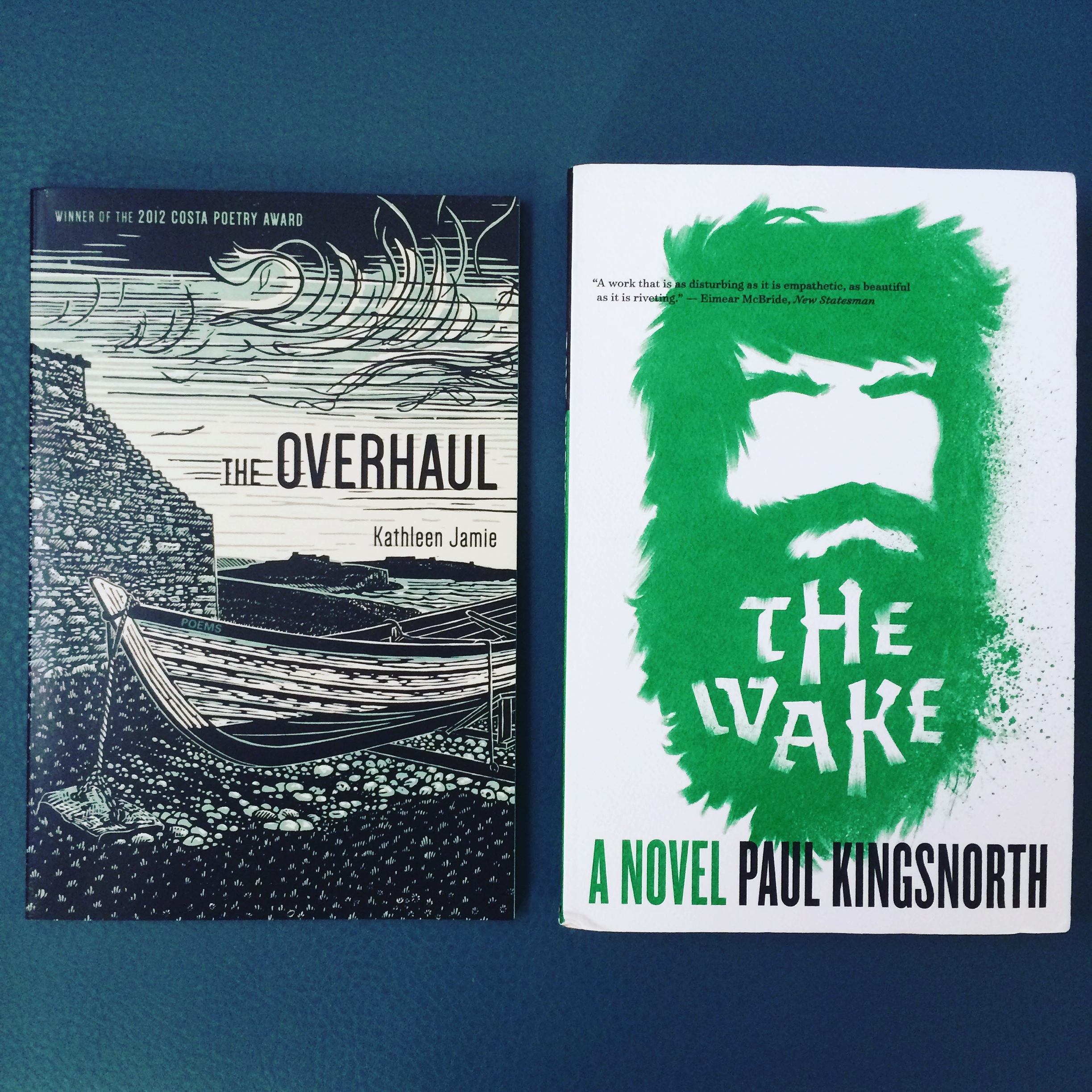
Recommended Reading: The Wake by Paul Kingsnorth and The Overhaul by Kathleen Jamie

be waery of the storm.

be most waery when there is no storm in sight

Friends, it’s time to talk about The Wake*.

IMG_5197I’ve had my eye on this book for months, ever since I read Kay’s review, and when it arrived and I started reading, it was incredibly hard to pry myself away from it for food, sleep, parenting, and other adult-type endeavors.

Let’s chat history for a second. What do you know about the Norman conquest? Here’s my list as of ten days ago:

  • It involved the Normans.
  • There was a conquest.
  • It happened in 1066.
  • It involved the Battle of Hastings.
  • William the Conqueror was the big winner.
  • Normans are the bad guys in Robin Hood.

And there you have it. I’m willing to bet that for most of us, that’s pretty much the extent of our knowledge. After all, when’s the last time you saw a movie or read a novel about the Norman conquest? Truth may be stranger than fiction, but art brings history to life, and keeps it living in the minds of readers (and viewers) for hundreds of years, or thousands. And when there isn’t much, or any, art about a culture or a period or a people, it or they will tend to fade in our collective memory. (Cue Galadriel’s Lord of the Rings preamble here.)

Read Paul Kingsnorth’s The Wake and the Norman conquest will be seared in your mind. You won’t forget it. This is an amazing book, terrifying and beautiful all at once. Its pacing is exquisite, its language revelatory, its protagonist a marvel of extended characterization.

When 1066 begins, The Wake‘s narrator, Buccmaster, is a socman of Angland, a landowner who owes allegiance to no thegn (if that word sounds familiar, think Macbeth), only the king.  He has a wife and two teenage sons, as well as three servants (two laborers and one servingwoman for his wife). Proud and stubborn, he comes to feel that signs in the natural world are speaking to him of something momentous that is coming.

That something is the Norman army. Soon Buccmaster has lost everything of value in his world—his wife, children, land, servants—with the exception of his grandfather’s sword, which his grandfather claimed was given him by a mythical figure named Weland the Smith.

Taking his sword, Buccmaster retreats into the forest and over the next two years recruits a small band of green men to conduct what is essentially guerrilla warfare against the French invaders, with increasingly disastrous results.

“now Angland is but a tale from a time what is gan,” says Buccmaster early in the novel. His account, flawed and madness-filled, is the tale of a lost England, but it is of course his tale too, one that he controls with varying degrees of dexterity. He includes tales of the old gods, like the set pieces in the Iliad or the Odyssey, tales of his own history, tales of the recent past (his own and others’) that he reframes without shame to suit his present audience. But in the end, it is a tale told by a woman—and women in this book are almost always marginalized, oppressed, almost always objects of violence (Buccmaster is an unapologetic wife-beater)—that undoes the story he’s told about himself.

It becomes increasingly apparent that he’s becoming unhinged, like a slow-burning Lear; for him, the invasion is not the first unwelcome advance of a foreign power. Though he is economically privileged, Buccmaster is also an outsider because like his grandfather, he despises “the crist” (Christ), viewing Angland’s weakened state as a result of its people turning away from the old gods (Norse, as we would think of them). Thus his quest to rout “the frenc” and return Angland to what he thinks are its roots is doubly doomed.

There’s so much in the novel to think about: madness, pride, grief, colonization, memory, religion, storytelling, vengeance. Buccmaster’s unreliability is mirrored in the reader’s realization that what we know, what we’ve been taught, is inevitably incomplete. We are accustomed to recognizing that the English, the French, the Dutch colonized parts of the world that have yet to recover from imperialism’s yoke (and hopefully we realize that the descendants of those colonized peoples are often still treated terribly unjustly; for a literary example, see The Round House). It’s harder to grasp that England itself was colonized, violently and more than once, in this case by an enemy with superior technology (steel, horses, chainmail), an enemy that re-shaped the land itself (through the building of castles, which Buccmaster and his men regard as devilish).

How far back does this chain of suffering extend? What does it mean to be English, French, any one people?

There is no single answer to that question, but one possible answer has to do with language, the stuff from which we build our stories. Buccmaster wonders how his language will survive and the answer is before us, since so much of it did; The Wake is almost an experiment in how language itself—sounds, really—can re-create a lost world.

Citing his dissatisfaction with historical novels written in modern language**, Mr. Kingsnorth wrote the book in what he calls a “shadow tongue,” Old English updated with enough modern grammar and sentence structure to be readable by people (like me) who’ve never studied it. Mr. Kingsnorth writes almost exclusively with Anglo-Saxon, not Latinate words, and provides a brief glossary to catch those that might not be understandable phonetically and in context. It takes a few pages of getting used to, but after about ten pages I was hooked, just awash in this not-English English. (Sci-fi readers: the experience is a bit like reading Chris Beckett’s Dark Eden.)

The difference of the language, the requirement of focusing on each and every word, and the unusual orthography (there are no commas, colons, semicolons, or question marks that I noticed; proper names are rarely capitalized; paragraphs end without periods) ensure that the reader is locked into the world of the novel. For the first fifty pages or so, I felt almost overwhelmed by dread. By the end of the book, my hair was quite literally standing on end***. It’s just harrowing, completely harrowing. Read the first two pages and you’ll see****.

a storm saes the gleoman cums from heofen it cannot be feoht only lifd through

[a storm says the storyteller comes from heaven it cannot be fought only lived through]


A week or two ago, I pointed readers toward “The Whales,” a poem by Scottish poet Kathleen Jamie. I’ve had the chance to read the rest of the collection in which it appears, called The Overhaul*, which is stellar. I highly recommend it.

In some ways, Ms. Jamie’s voice reminds me of a sparer Mary Oliver; the two poets share a keen sense of the detail in nature and spin that detail into larger observations, but Ms. Jamie’s poems are less conversational. I loved her striking images, like the stags who “hold” the speaker and her companion in “civil regard” as their  antlers rise “like masts in a harbour, or city spires.”

In an odd way, The Overhaul resembles The Wake in its evocation of the landscape and in its occasional dip into Scots (as in the poem “Tae the Fates,” in which the speaker begs the powers that be for just “ane summer mair” to make “ane perfect poem”) to conjure up a sense of a different time. While these poems develop a sense of sadness for the things of this world that are passing away, like the young eagle in “The Halfling” leaving its youth behind or the seasons that fade, there is also a sense of hope in them, which I found refreshing and necessary after the marathon of The Wake; I’ve gone back to these poems more than once after reading them.


*I received a copy of this book from the publisher for review consideration, which did not affect the content of my review.

**One wonders, though, if he’s read Hilary Mantel.

***(I took a picture to prove it, but the whole disembodied-arm thing didn’t really seem like the best choice here).

****Or get in touch with me (e-mail, Twitter, instagram) and I’ll send you an audio file of me reading them. This book is built to be read aloud.

Recommended Reading: The Witches by Stacy Schiff

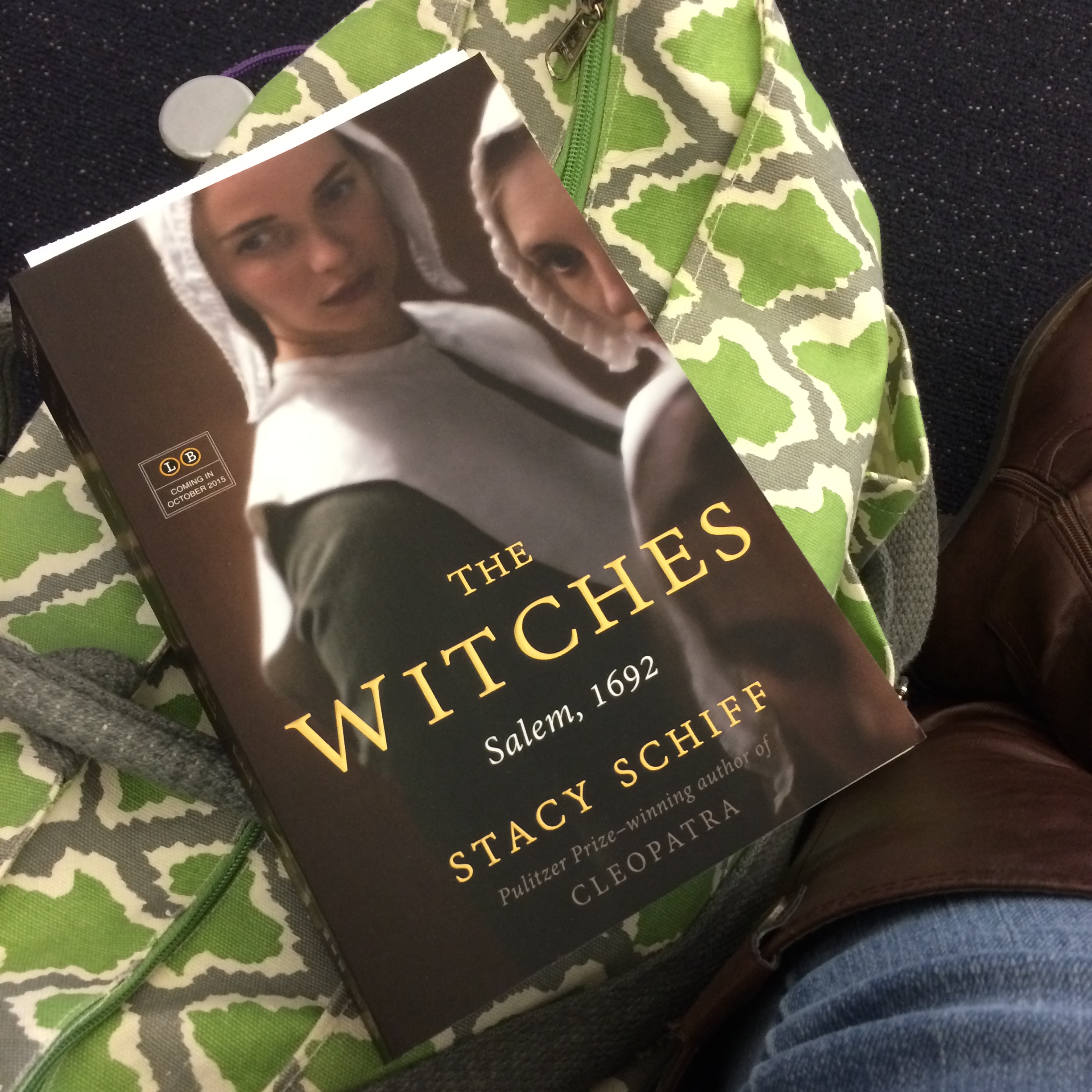
The Witches flying off to Ohio with me a few weeks ago.

The Witches flying off to Ohio with me a few weeks ago.

Nothing like history to make the week of Halloween really scary. As in, “this book makes me grateful for our modern legal system” scary.

“The Puritans come to most of us today,” noted biographer Stacy Schiff writes, “through The Scarlet Letter and The Crucible, which we read, appropriately enough, as adolescents” (415). Her new book, which could be considered a biography of crisis, is The Witches,* an account of the 1692 mayhem wrought by mainly teenage girls in Salem, Massachusetts (or the Massachusetts Bay Colony, more properly). I enjoyed Ms. Schiff’s recent biography of Cleopatra, and I looked forward to reading her treatment of the Salem witch trials, especially since I live in Boston and have thus spent a fair amount of time in Salem (pro tip: parking is hard to come by in October). 

The current Salem, which is pretty kitschy and also home to a sizable community of Wiccans (I once went to an October Wiccan wedding in Salem, which was surprisingly traditional) is a far cry from the late seventeenth-century Puritan enclave of infighting neighbors that Ms. Schiff describes, itself a web of relationships much more complex than the communities of Hawthorne (descended from one of the Salem judges) and Miller. The village of (separate from the town of) Salem had a tendency to cycle through preachers rather too quickly, and tensions were high over any number of matters, including land disputes, slander accusations, and attacks from nearby Native American tribes.

The winter of 1692 was particularly bleak (the accusing girls, Ms. Schiff points out, tended to describe demonic activity in a riot of color), but soon the weather was the least of anyone’s worries. Accusations of witchcraft started flying (no pun intended) and by summer accused witches and wizards were filling jails—at their own expense. Neighbors turned against each other; daughters accused mothers, brothers their sisters. Children under the age of ten were jailed and manacled hand and foot. Before the end of the terrible epidemic nineteen people were hanged and one man was quite terribly pressed to death. Those who confessed (with one exception) were spared; those who were executed were those who fought spurious charges (some were condemned on “spectral” evidence, which is just as preposterous as it sounds).

Ms. Schiff goes beyond the sensational to explain the backgrounds and complicated histories of the major players (accused, accusers, judges, and observers)—a list that fills four pages in small type—and the political situation of Salem, Boston, Massachusetts, and other towns (the epidemic consumed Andover, for instance; about 1 in 10 inhabitants was accused of witchcraft). She thoroughly investigates the workings of the court and its observers, powerful men like William Stoughton (as in the town where Ikea lives, fellow Bostonians), Wait Still Winthrop, and Cotton Mather.

It is her focus on the authorities’ failure to contain or mitigate the crisis, or try the accused with even a semblance of fairness, that will make you want to hug the first lawyer you meet. The accused were often not permitted to face their accusers directly; they had no counsel; they were presented with what we would now view as literally incredible evidence. It impossible not to be horrified that elderly women like 71-year-old great-grandmother Rebecca Nurse, who was arrested from her sickbed, were thrown in fetid jails, despite long histories of piety and kindness. Rebecca Nurse was excommunicated and hanged.

The Witches is a detailed, interesting, and frankly horrifying account of one of the worst episodes in American history. Recommended.

And happy Halloween.

*I received a review copy of this book from the publisher for review consideration, which did not affect the content of my review.

Books, Boston, October

Well, Dear Readers, I’ve had quite the literary month, getting out and about much more than I usually do in my quiet life. Perhaps you’d like the rundown? If so:

Hamlet: Yes, that one. I thought, London travel not exactly in my budget, that Benedict Cumberbatch as the brooding Dane was not a performance I’d be able to see. And then by chance I heard it was going to show in movie theaters, after which I promptly bought the last two tickets for that showing.

Verdict: Very good. Mr. Cumberbatch was intense, thrilling, athletic, funny, outshining most of the cast with the exception of the fabulous Ciarán Hinds (aka Frederick Wentworth in the only film adaptation of Persuasion you need to see) as Claudius. I wasn’t sold on this production’s take on Ophelia (played a bit unhinged before Polonius’s death), but her final exit was remarkably well done. I agree with the review my husband told me about later that suggested the play was overproduced after intermission. Still, nice set design, and I liked the costuming, which seemed like a bit of an homage to various earlier interpretations of the play. Funniest Rosencrantz (or was it Guildenstern?) I’ve ever seen.

I hear it’s coming back to theaters; if so, do go.

Nick Offerman: Okay, technically he was doing his humorist act (sans spouse Megan Mullally, sigh), but I’m calling this literary since he’s written two books (one of which is waiting on my nightstand/bookshelf to be read) and he’s in rehearsals for a Boston theatrical adaptation of A Confederacy of Dunces.

Verdict: Very Good. Funny (of course), with ridiculous songs, anecdotes, life advice, talk of woodworking, etc. Basically, it was like watching an alternate-universe version of Ron Swanson who actually enjoys the company of others. Best moment: He didn’t mention Parks & Rec until the very end (and you know how much I love that show, right?), but then had the entire audience singing along to “Bye, Bye Lil’ Sebastian.” Yeah, it was amazing.

Boston Book Festival

This is the first year I’ve been able to spend more than ten minutes at the BBF, and I’m very glad I did, though I din’t see much of the vendors (magazines, small presses, etc.) since they tore down pretty early on Saturday evening (just after 5). However . . .

Margaret Atwood in conversation with Kelly Link: So happy I got tickets this summer, because the crowd was huge (and appreciative).

Verdict: Excellent. Margaret Atwood is hilarious–just truly, wickedly funny, and Kelly Link was understatedly comic as she asked really interesting questions. I was expecting the conversation to focus mostly on The Heart Goes Last, Ms. Atwood’s most recent book, but instead it ranged over her childhood reading habits, how she approaches writing (like going into a dark wood, and with a character or scene in mind, not a message), reading the Victorians, and more. Wonderful. And bonus: both writers did a signing afterward, and Ms. Atwood signed my 1970 copy of an early book of poems (yes, I did tell her that I liked her Milton references in the new book, and she said “I’m glad.” Swoon).

James Wood: Mr. Wood is a professor at Harvard and a literary critic for the New Yorker; some would argue (and have) that he’s the foremost literary critic writing in English. His approach is aesthetic rather than, say, historical or psychological.

Verdict: Very good. I haven’t heard an academic talk in quite some time, and this one was geared toward a wide audience, but one that would understand references to Flaubert and Nabokov, for instance. Mr. Wood talked about detail in fiction—why details stick with us after we read, how they function, why they function. Fascinating (and just when I was starting to worry that he wasn’t going to mention any woman writers, he referred to nearly half a dozen). He also did a signing at the end of the event, which was delightful since I’d just picked up his new book (The Nearest Thing to Life).

Colum McCann in conversation with Claire Messud: Amazingly, given how popular these two authors are, this event wasn’t ticketed, but there was once more a lively and interested crowd (great job by the BBF organizers in making sure the audio was top-notch). Colum McCann’s most lauded book to date is probably Let the Great World Spin (I haven’t read it, but loved Everything in This Country Must). Claire Messud is an acclaimed novelist, most recently of The Woman Upstairs (she also happens to be married to James Wood, who spoke just before this event).

Verdict: Good. The writers are friends and former colleaugues, which made for a relaxed rapport. Mr. McCann read from his new book (Thirteen Ways of Looking), and while his reading was very well done and affecting, I though it slowed down the pace of the conversation. I was interested to learn about the charity called Narrative 4 that he works co-founded, and saddened to hear of a terrible incident in which he was brutally beaten for trying to stop a man from beating his wife.

Amanda Palmer interviewed by Neil Gaiman: I’ll be honest with you, Dear Readers: I came for Neil Gaiman, one of the most reliably readable authors working today. And charming and philanthropic and all that good stuff. To be honest, I had, before hearing this talk, almost no opinion on Amanda Palmer (Mr. Gaiman is her husband), though I know she provokes Feelings of all sorts in various people (generally love or hate, from what I can tell).

Verdict: Very good. Ms. Palmer talked about the process of writing her memoir, The Art of Asking, and seemed no more self-indulgent than anyone else who’s interested in writing a memoir. She was genuine, honest (as far as this listener could tell), amusing, and shared a charming rapport with Mr. Gaiman. At the end of the talk, I decided I’d rather like to read her book, so well done there. Bonus: An appearance by Maria Popova (of Brain Pickings, which I commend to you; Ms. Popova has every metaphysician/Jeopardy nerd’s dream job), tempered slightly by I think a too-rosy view of Thoreau. Bonus 2: Ms. Palmer sang, and I loved her voice, which I was hearing for the first time (yes, your friendly neighborhood blogger was not cool enough to be listening to the Dresden Dolls in high school).

[Boston book blogging friends: Meet up next year at the 2016 Boston Book Festival?]

Whew. And that’s all she wrote. For now.

Recommended Reading: Lafayette in the Somewhat United States by Sarah Vowell

American author, French subject, British teapot.

American author, French subject, British teapot.

I am very, very late to the Sarah Vowell party that apparently the rest of the reading public has been attending for years, but guess what? Still a great party.

Lafayette in the Somewhat United States* is an irreverent, hilarious, completely engaging narrative account of the adventures of the Marquis de Lafayette, the “teenage French aristocrat” who volunteered to fight for a country not his own.

Ms. Vowell begins her tale with Lafayette’s triumphant return to the United States in 1824, during which a truly remarkable percentage of the population turned out to welcome him (great Melville anecdotes in this part, if you were on the lookout for those) in a fractious political year. Then she rewinds to give us a sense of LaFayette’s background and his shenanigans that led to his transatlantic crossing (including skipping out on his pregnant wife, NBD), continuing on through his participation in the American Revolution. Along the way, she gives quick but information-filled sketches of the figures we all know much better than LaFayette, like Washington and Jefferson, and less well-known fellows like Henry Knox (the one the fort is named after), Rochambeau, and Admiral Howe (a Brit).

If you like your history peppered with sarcasm and one-liners, this is just the book for you. A few of my favorite gems include quips about the “traditional Parisian generosity of spirit” (17), the best one-line take-down of Versailles I’ve ever read, which makes me feel better about never seeing it (includes the word “flimflam”), and, with regard to Henry Knox, “that old Yankee proverb that if you can sell a book, you can move sixty tons of weaponry three hundred miles in winter” (84).

But the book is also astute in its analysis. For instance, Ms. Vowell points out that one of the reasons the American Revolution succeeded and the French decidedly did not (as Lafayette found out in an unpleasant fashion) is that Americans had been self-governing, effectively, for years before they took up arms; their idealism was backed up by practical experience. Of a philosophical disagreement with some learned Quakers, she remarks, ” I don’t think I see American history as war. I see it as a history of argument” (114). And she even contemplates what might have been had we–Americans plus the French, that is–lost the war; since Great Britain abolished slavery in 1833, the abhorrent practice might have ended thirty years earlier here, too. A sobering thought.

If you read this book (and I recommend that you do), you may find yourself wishing, as I did, that Ms. Vowell will return to 1824 and Lafayette’s visit in another book. I wanted to know more about the visit itself (and Lafayette’s life after it, especially his personal life—how did that marriage turn out, really?) but also more about the divisive election during Lafayette’s grand tour and the political environment in the 1820s. And let me tell you—until I read Lafayette in the Somewhat United States, I never thought I’d write that last sentence.

*This is a review of a publisher’s advanced copy of the book, which in no way affected my review.

Recommended Reading: The Tsar of Love and Techno by Anthony Marra

I read this book in the best company: my new niece's.

I read this book in the best company: my new niece’s.

Anthony Marra’s debut novel, A Constellation of Vital Phenomena, was so breathtaking that I felt sincere trepidation when his new collection of short stories, The Tsar of Love and Techno*, arrived in the mail.

I shouldn’t have.

These linked stories, though they don’t swell with the emotional buildup made possible by the length of the novel, are nonetheless beautifully constructed, achingly sad, grimly funny. If A Constellation of Vital Phenomena had me sobbing, The Tsar of Love and Techno made a lump rise in my throat more than once (and to be fair, the former’s depiction of torture made me ill, and this book made me only faintly queasy in comparison).

Again, Mr. Marra finds his subjects in violence-torn Chechnya, where a placid hillside depicted in a minor nineteenth-century painting is a touchstone that winks in and out of nearly a century of darkness in St. Petersburg (and its other names), Siberia, and Grozny.

The stories begin in 1937, when a prolific censor begins painting his brother into each work he “corrects,” and then they expand outward in time and space. We meet the beautiful granddaughter of an exiled ballerina, the bereft self-appointed curator of a Chechen art museum, two young brothers on the edge of a chemical-swollen manmade lake, a boy thinking about getting himself arrested so he won’t be drafted, a middle-aged woman desperate to connect with her daughter and make sense of a daunting half century of change.

The level of detail in the stories is exquisite, the settings unforgettable (a wolf-haunted forest of fake trees, a mine-strewn hillside, piles of rubble that used to be apartments) and the characterization unfolds from tale to tale with great skill. Each story could stand alone, but one or two later you’ll find a character is more nuanced than when you first read about him or her. Sometimes all it takes is a sentence: “she had long ago learned to ignore her largest moral failures by attending to the smallest social proprieties” (233).

It’s a testament to the brilliance of this book that Mr. Marra shows the sheer terror of Stalinism and the icy cruelty of Putin’s oligarchy and yet still finds a way to convey humor and even a little beauty (besides that in the writing, which is extensive), and the human, individual mystery that sends the same man almost mad with a longing for home, and then the implacable determination to return to war.

The Tsar of Love and Techno is a marvelous book. Highly recommended.

*I received a review copy of this book from the publisher for review consideration, which did not affect the content of my review.