Recommended Reading: Mr. Penumbra’s 24-Hour Bookstore, by Robin Sloane

Mr. Penumbra’s 24-Hour Bookstore is a great big love letter to bookstores, technology, history, urban life, and, above all,  friendship. I loved it. Mr. Penumbra's 24-Hour Bookstore photo by CR Oliver

However, it’s difficult to talk about without giving away plot, so I’ll be brief: Clay is a laid-off designer who finds himself working as the night clerk (I know — how much do you wish your bookstores were open twenty-four hours a day?) at a small bookstore in San Francisco. The bookstore’s clientele is mysterious, weird, and impossible to ignore. Soon, Clay is drawn into cryptography, the world of Google, and his employer’s confidence.

I loved that the line between real and not-real is faint, and might shift over time. Someone reading this in 2020 may accept as fact some of the things that Kat, the novel’s main Googler, says that Google can do. The self-driving car? Check. We’ve read about that already. But some of the other stuff strains the imagination. Except when it doesn’t.

(Read the novel. It was published in 2012. Go ahead. I’ll wait. Ok. Now read this, published in September 2013. See what I mean?)

As we follow Clay on his gallivanting, we also meet his friends, all brilliant and different and skilled in fascinating ways. I love books in which friends are the focus, instead of love interestes (uteruses before duderuses, as Leslie Knope would say), because friendships are often the closest, longest-lasting relationships of our lives, pre-dating marriages, for example. Clay comes to rely on his friends, and I hope Mr. Sloan will too — I want to find out what happens to the roommates.

When’s the last time you said that about a book?

An Eighteenth-Century Gentleman Who Hated Exercise Even More Than I Do

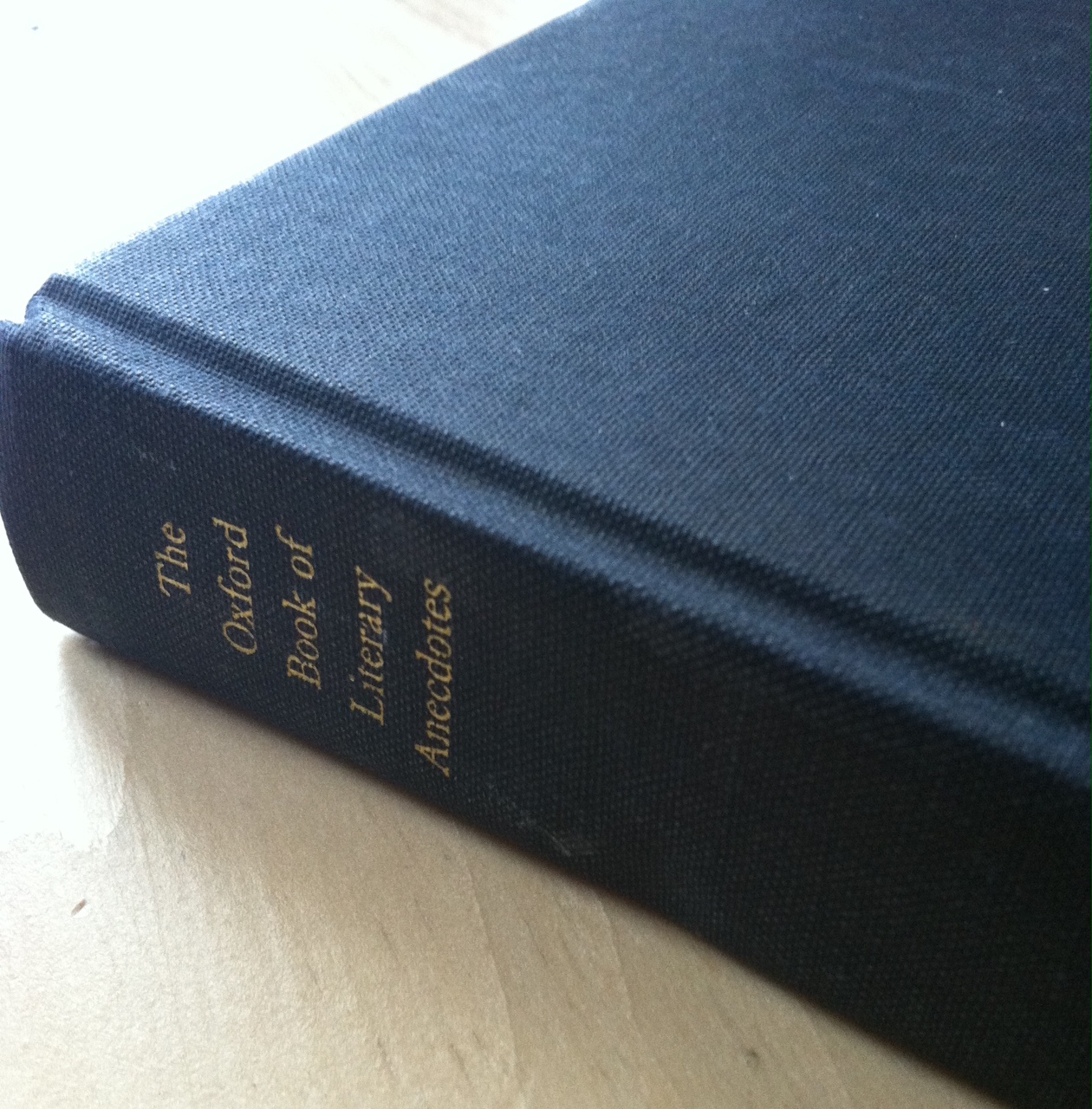
One of my favorite acquisitions from my summer of bookstore love is this little gem, The Oxford Book of Literary Anecdotes (1975). It’s just what the title suggests: little anecdotes about famous literary figures, from Caedmon to Dylan Thomas. The Oxford Book of Literary Anecdotes photo by C.R. Oliver

Now, as I’ve written before, my parents are prolific readers who read aloud to me and my siblings well into our teenage years. My dad read me Queen Margot (Dumas), From Dawn to Decadence (Barzun), and Moby-Dick, among others.

But we never made it through Edward Gibbon’s History of the Decline and Fall of the Roman Empire, not because I disagreed with his analysis of the decline in civic virtue, but because I was bored to tears. Gibbon is a renowned stylist, and his footnotes are chatty and ironic. But frankly, my dear Gibbon, I don’t give a damn. I’m fairly certain that this was the start of my distaste for the eighteenth century’s history and literature. After all, it’s pretty difficult to top Paradise Lost and the Defenestration of Prague.

However, reading this little anecdote—

Gibbon took very little exercise. He had been staying some time with Lord Sheffield in the country; and when he was about to go away, the servants could not find his hat. ‘Bless me,’ said Gibbon, ‘I certainly left it in the hall on my arrival here.’ He had not stirred out of doors during the whole of the visit. (109)

—made me feel as if perhaps the pudgy English lord and I would have gotten along after all. As long as we didn’t talk about the Roman Empire.

“This is the barrenness / of harvest or pestilence.”

Better late than never, right? It’s been three days since All Souls Day, but I’m still mulling over Louise Glück’s creepy and just-right poem, “All Hallows.

Image Hay Bales On Freshly Harvested Fields" Courtesy of Franky242/ freedigitalphotos.net

Image Hay Bales On Freshly Harvested Fields” Courtesy of Franky242/ freedigitalphotos.net

I like that the particular line I’ve quoted in the post’s title captures the dichotomy of the end of fall (well, at least here it feels like the end of fall, even if there are technically six more weeks until winter) — it’s difficult to discern, sometimes, whether it feels like the ground underfoot is dying or bursting with life.

Just now the first stanza of the poem, which begins, “Even now this landscape is assembling.” suggests to me a painting, I think a Monet, of the gathered hay covered in lavender snow. Come to think of it, I can bring to mind several summer and spring paintings, and not a few decked with snow, but I’m having a difficult time coming up with a fall painting (if you have one you like, let me know!). Maybe that’s because, as the first line suggests, autumn “is assembling” itself for winter; it’s a flux-state, not even, really, itself.

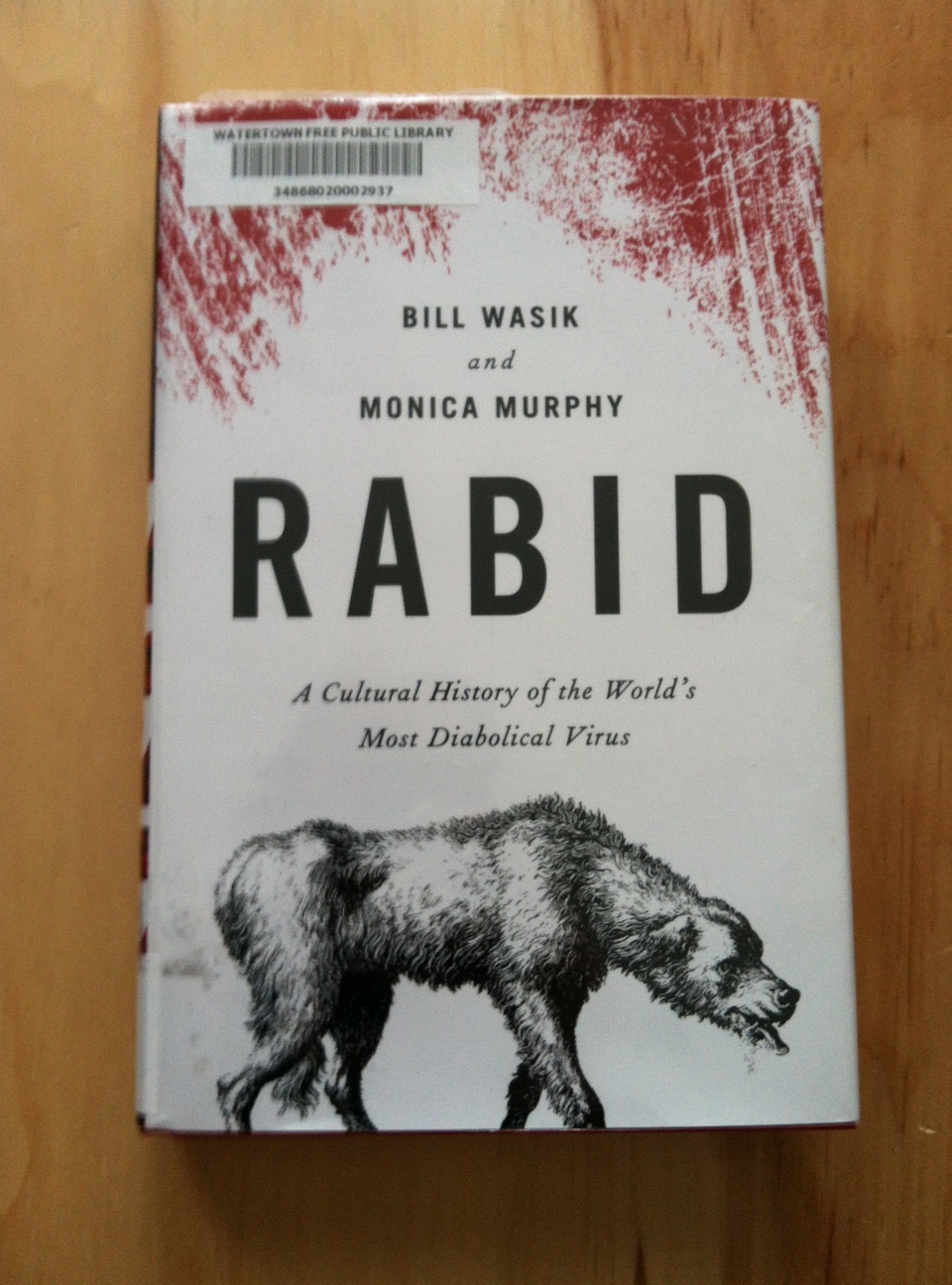
Scary Read: Rabid: A Cultural History of the World’s Most Diabolical Virus, by Bill Wasik and Monica Murphy

RabidA tip o’ the hat to my friend Kate, who pointed me to a podcast about the most fascinating story in this already-fascinating book a couple months ago.

Rabid, by veterinarian Monica Murphy and her husband, Wired editor Bill Wasik, examines rabies from a cultural standpoint — but you probably got that much from the title. I went in with the my knowledge of rabies confined to that one episode of The Office, something about twenty shots in your stomach, and a settled dislike for raccoons.

Now on the other side, I’ve got a better handle on the whole subject. The rabies vaccine is only four shots in one’s arm, for one thing. And rabies is the most deadly virus identified, with 100% human mortality (as far as we know) if the disease goes untreated. And 55,000 people die from rabies every year. I guess it’s only a joke if you live in Scranton.

The best chapters in Rabid deal with Pasteur, who invented the rabies vaccine, and with human survivors of rabies, Jeanna Giese in particular (whose case is the subject of that podcast), and how an island community like Bali deals with a sudden outbreak of the disease.

Less mesmerizing are the book’s forays into literary subjects the authors associate with rabies (the bit about the Iliad is particularly unfortunate); the authors are much better equipped to deal with the scientific and veterinary aspects of the disease’s history. Based on the last three chapters alone, Rabid is worth a look. And you’ll definitely look twice the next time you see a raccoon. Or a skunk. Or a stray dog.

Recommended Reading: The Niagara River, by Kay Ryan

Back in late July, I featured a poem called “Thin,” by Kay Ryan.  I liked it so much that I went to the library that week to find a full-length book of hers, and the library obligingly provided The Niagara River. As a child, I spent many happy summer afternoons jumping into the Niagara River from my Uncle Bill and Aunt Mary Kay’s dock, so the whole thing seemed beshert.

Image courtesy of  George Stojkovic / Freedigitalphotos.net

Image courtesy of George Stojkovic / Freedigitalphotos.net

I love these poems. They’re unlike any others in my pretty extensive poetry library. They’re short, rarely flowing from one page onto another, and the lines are short as well, often just three or four syllables in length. I found the rhythm, and the occasional rhymes, jarring, but not unpleasantly so. Many of the poems end with a subtle twist, a line that forces the whole poem into sharper focus. These poems call for slow reading and then re-reading; I wanted to savor and remember them.

Some of my favorites in this volume are “Carrying a Ladder,” “Sharks’ Teeth,” “Green Hills,” “Ideal Audience,” “Hide and Seek,” and “The Well or the Cup.” I hope you’ll have a look at them for yourself.

November News

Winner-180x180Hiya folks. This November, I’m going to act like a crazy person and do NaNoWriMo again. Let me know if you’re on board too, and then we can commiserate about word counts like a couple of college sophomores during finals week.

I have the usual array of posts stacked up for the month, but I’ll be a bit slower on the uptake with comments and reading your lovely blogs, so please do forgive.

Also, if anyone has a spare plot lying around . . . ?


“And what rough beast, its hour come round at last, / Slouches towards Bethlehem to be born?”

Halloween approaches, friends, and what better way to ring it in than with the scariest freakin’ poem in the English language? That’s right: we’re bringing out W.B. Yeats’s “The Second Coming.”

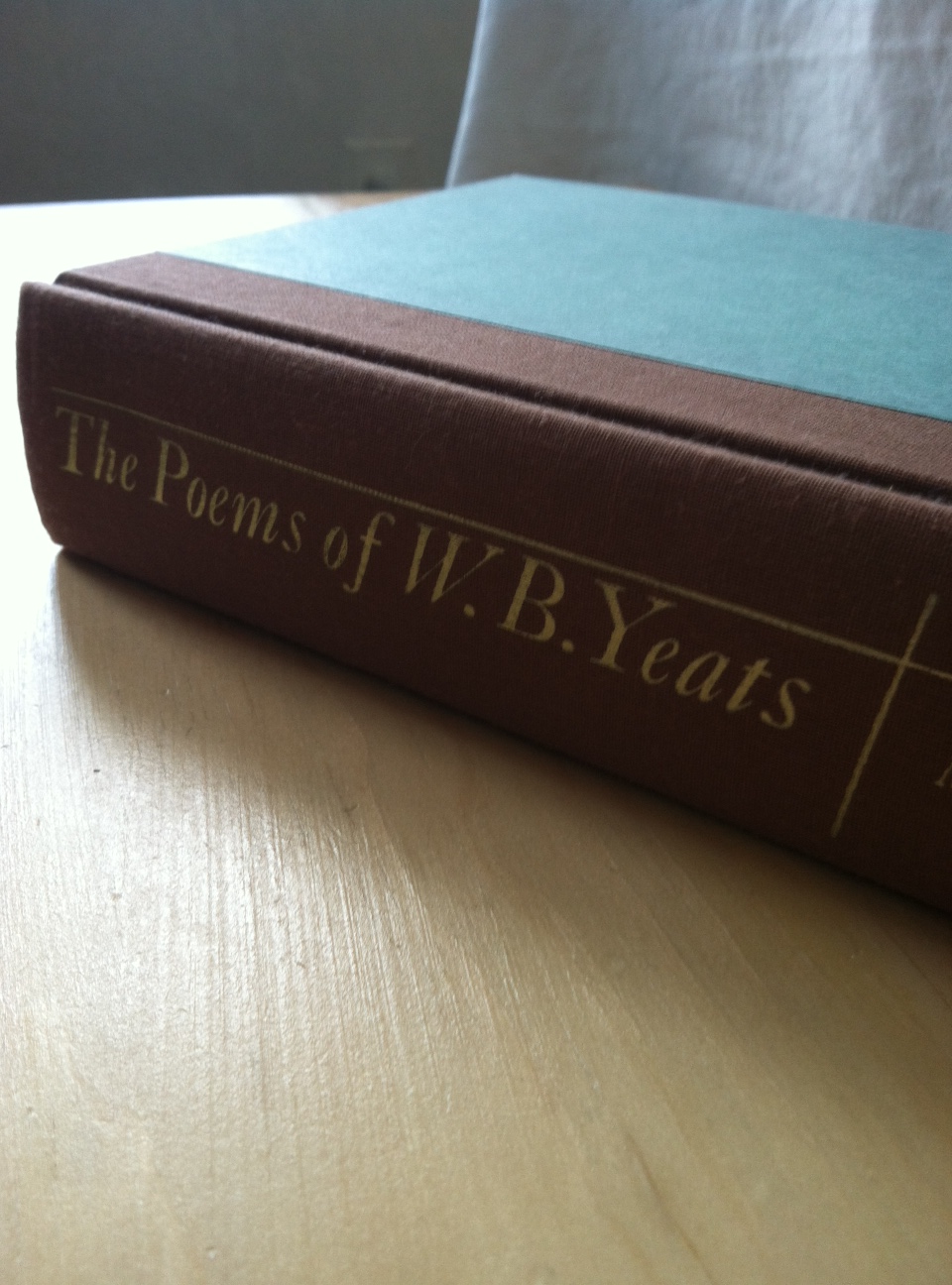
Collected Yeats

You know it’s bad when “Mere anarchy is loosed upon the world” (l.4). I mean, anarchy is bad, not just “mere,” right? Really bad, à la The Dark Knight Rises? Turns out that’s just the start:

The blood-dimmed tide is loosed, and everywhere
The ceremony of innocence is drowned;
The best lack all conviction, while the worst
Are full of passionate intensity. (ll.5-8)


And then there’s the Big Bad, as fellow Joss Whedon fans* might say: a thing, its gaze “blank and pitiless as the sun,” “A shape with lion body and the head of a man.” It’s the formlessness that’s frightening; there’s no sign of intelligence in the blank eyes. It’s inexorable, this shape. It’s not a lion with a man’s head, but a shape. And get this: it’s “moving its slow thighs.” It’s in no great rush to destroy the world, because the destruction is inevitable.  If that doesn’t give you the creeps, I don’t know what will.

Wait a second. Yes I do. This will:

The darkness drops again; but now I know
That twenty centuries of stony sleep
Were vexed to nightmare by a rocking cradle,
And what rough beast, its hour come round at last,
Slouches towards Bethlehem to be born?

*First Evil, anyone?

[Honorable Mention, Children’s Category: “Seein’ Things,” Eugene Fields]

What’s your pick for scariest poem?

Recommended Reading: Fahrenheit 451, by Ray Bradbury

Yes, it’s another installment in Books Carolyn Is Utterly Embarrassed Not to Have Read by Now.

Image courtesy of Manostphoto/ Freedigitalphotos.net

Image courtesy of Manostphoto/ Freedigitalphotos.net

As a voracious reader and lover of sci-fi, it’s pretty amazing that Fahrenheit 451 has missed my to-read pile for so long. Maybe it’s because the contours of the story are so familiar; I felt going in as if I already knew the plot.

Something that startled me was the sheer number of technological advances that Bradbury saw coming in 1953 (because of his long career, I’d always assumed that Fahrenheit was a late 60s/ early 70s book — quite wrongly): wall-sized TV screens, in-ear headphones, drones. I wonder if Suzanne Collins was thinking of the Mechanical Hound when she created some of the monsters in The Hunger Games trilogy.

I’ll skip the plot summary, since you’ve probably got the gist of it, and instead highlight my favorite section: Montag’s meeting with Grayson and the other people of the book, who remind themselves, “we’re nothing more than dust jackets for books, of no significance otherwise.” Grayson goes on to tell Montag how great works of literature are preserved: “Why, there’s one town in Maryland, only twenty-seven people, no bomb’ll ever touch that town, is the complete essays of a man named Bertrand Russell” (179; the grammar’s a little off, but I can’t tell if that’s Grayson’s overexcitement or a faulty edition at work). I found the work of memory, the instinct to preserve ideas and language, deeply moving.

I wonder, though, if regarding oneself as merely a dust jacket for a book is entirely admirable. Certainly there’s a sense embedded in this idea of taking a larger, longer perspective (I’m reminded of Carl Sagan and the blue dot, or Rick’s speech at the end of Casablanca), a way of realizing our individual insignificance over the span of time. On the other hand, one person with a great deal of insight, or fortitude, or kindness, can change the world for the better. But I suppose you do need the world.

“There were ten thousand thousand fruit to touch, / Cherish in hand, lift down, and not let fall.”

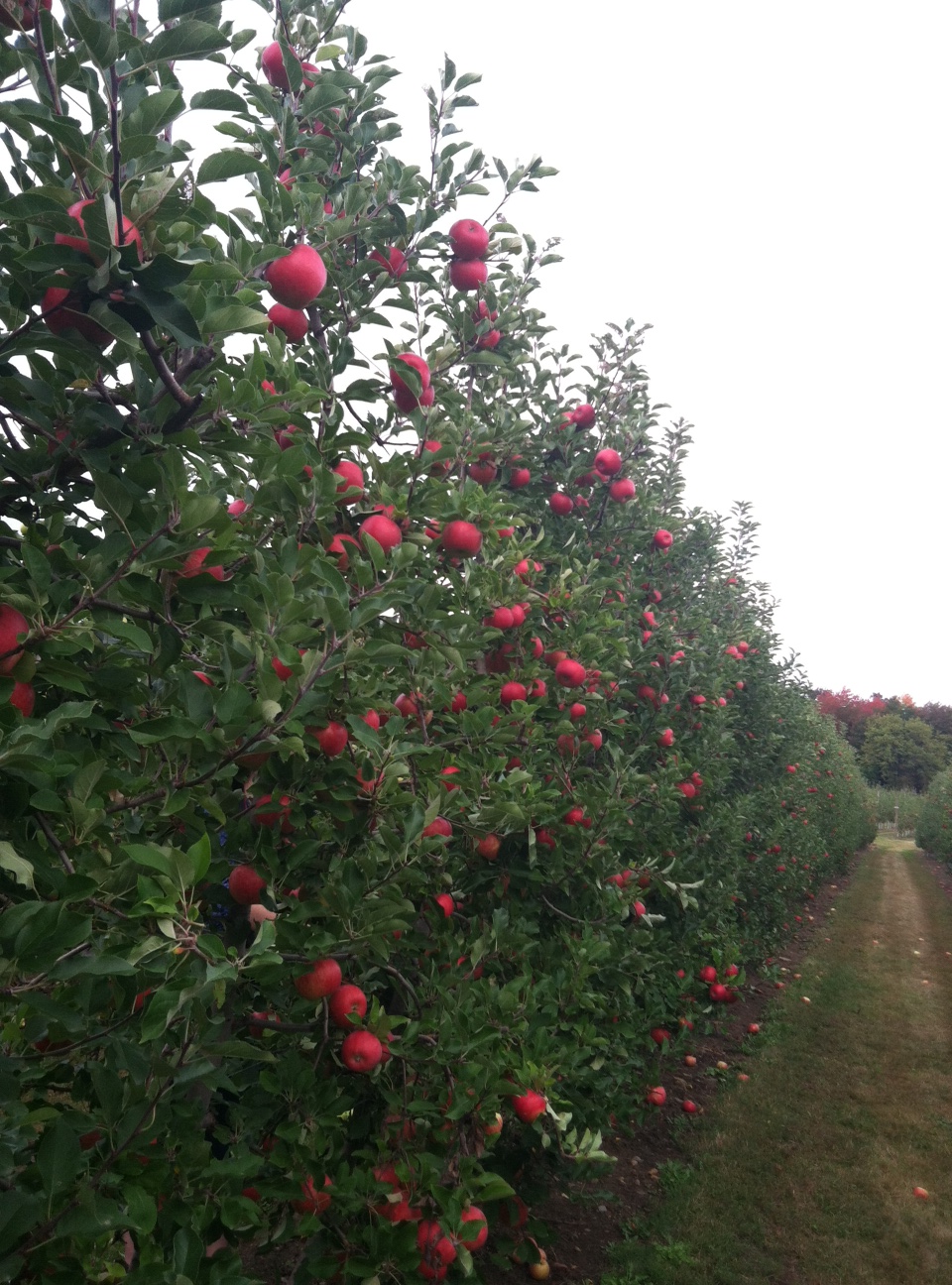
Tougas farm, apple season Photo by CR OliverI remember assigning Robert Frost’s “After Apple Picking,” along with “Birches” and “Mending Wall” to my first-ever college class. I was twenty-two, and at least one of the seniors in the class was older than I was. A clerical error had given me a class of thirty instead of twenty, and we were assigned a narrow, windowless room on the second floor of the library. The heaters clanged on in August and the noise of campus construction somehow reverberated in that room.

It was glorious.

I loved being a newly-minted teacher, choosing readings and building a course that I wanted to teach (and take). I loved practicing my students’ names so that they would feel comfortable in class (one Thai last name was a real tongue twister!), and I loved watching their ideas spill onto the chalkboard. There’s no better job than being a tour guide through literature.

I chose to teach Frost because we’re in New England, after all, and he’s THE New England poet, and I encouraged my students to get out of the city and see the beautiful blend of colors in the trees. I’ve gone apple picking each fall with Mr. O since we started dating, and there’s nothing like the blue sky and the fiery trees and the red, red rows of apples.

“After Apple-Picking” is a dreamy meditation on life and death, sleep and wakefulness. Maybe we too will look back on moments both missed and remembered, and think,

“There were ten thousand thousand fruit to touch,
Cherish in hand, lift down, and not let fall.”

Updated: Dragon Bound, Part the Third: Pregnant Unicorns and Other Things I Wish I Never Had to Read About

dragonboundreadalongbutton-01I feel as if I’ve gone through all the stages of grief reading this book:

Denial:  I’m not really doing this, right? 

Anger: See Part 1 reaction, please.

Bargaining: “If I read one more chapter, I can have a glass of wine, and this will all go away and I can go back to reading real books . . . ”

Depression: “Oh my god. This was published and people read it. Like, for fun. For enjoyment. What’s the point any more? I can’t believe I brought a child into the kind of world where people like reading about emotionally abusive, repulsive relationships. Where’s the wine again?”

Acceptance: “It’s over, it’s really over! I still have to write about it, but I never have to read it again! I don’t care that other people read this, right? And that maybe feminism is dying?”

So here we are at last. I’ve accepted that Pia is a unicorn, that she’s carrying Dragos’s über-weird dragon-baby, and that Dragos is just going to inform her that they’re getting married after yet another bout of ultra-aggressive and strangely boring sex, and that the book will end with her slipping a giant diamond on her finger. For realsies.

I hate this book with the fiery passion of a thousand exploding suns, if you needed it spelled out.  I hate it so much that I don’t really have anything productive to say about this last third. It was predictable and infuriating at the same time.

I can tell you with assurance, dear readers, that it will be many a year before I read another romance novel. I loathed Dragon Bound and even the tiny bits that were amusing couldn’t save the gag-inducing whole.

I’m glad I read it, though, because I like to uphold my claim to be an omnivorous reader (even though omnivorous is taking on all kinds of new meanings thanks to the spectacularly awful ‘devouring’ scenes in Dragon Bound), and because now I’ll never wonder if I’m missing out by skipping the Romance Buffet.

To entertain you, I will now cast the movie version of Dragon Bound. You’ll have to click the links for pictures because I am way paranoid about posting copyrighted images. My apologies to all of you, dear actors, for associating you, even fictitiously, with this book.

PiaKate Mara

DragosJason Momoa (Khal Drogo on Game of Thrones. I don’t watch Game of Thrones, but good lord is hard to not know about it.)

Rune, Dragos’s second-in-command and best bro, despite the episode in which Dragos almost kills him for conducting self-defense training with Pia: Brad Pitt circa Legends of the Fall

Tricks, the perky, tiny, Fae PR person: Kristin Chenoweth. Honorable Mention: Kristen Bell.

Graydon, another one of Dragos’s bros, the one who actually likes Pia, despite annoying habit of calling her “Cupcake” : Tyrese Gibson (yeah, I’m ignoring the physical description. I’m bored with all the tan/tawny-haired guys.) Honorable Mention: Tahmoh Penikett.

Urien, the Dark Fae King or Lord of the Sith or whatever: Tom Hiddleston (extra apologies to you, Mr. Hiddleston, because of all your fine Shakespeare work.)

Aryal the Harpy, by far the most interesting unexplored character: Eva Green.

Pia’s dead unicorn motherConnie Neilsen

Quentin, Pia’s only friend, dreamy, mysterious, and possibly half-Elf: Lee Pace

That was pretty fun! Like I said, I’m glad I read this, even if I hated it. I liked the whole reading-with-others-separately experience, so much so that I’m going to host my own (VERY DIFFERENT) read-along in 2014. All of 2014. Guess what has twelve parts and a few characters who fly?

Stay tuned, dear readers.

In the meantime, perhaps the other readers-along have something more intelligent to say about this last third of the book: