An Interview with Chris Beckett, Author of Dark Eden

Yesterday I reviewed Chris Beckett’s excellent new novel, Dark Eden. Mr. Beckett graciously agreed to be interviewed via email. 

How would you describe the inception of Dark Eden? What was the writing process like?

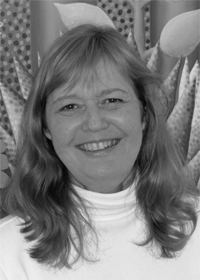
Chris Beckett Photo courtesy of the author.

Chris Beckett
Photo courtesy of the author.

CB: As is often the case with my stories, Dark Eden grew very slowly.   In 1992, I came up with a short story called ‘The Circle of Stones’, which included one of the crucial scenes from the book, was set in a sunless world, and centered on four characters who were to evolve in the book into John, Tina, Jeff and Gerry.  In 2006 I wrote the short story ‘Dark Eden’ which provides the back story for the novel (it can be found in my collection The Turing Test).   Although I had the idea from the beginning that there might be the basis for a novel here, the prompt to start work on it in earnest actually came from my daughter Nancy, who saw the title ‘Dark Eden’ and said it would be a great name for a book.  (So it is!  So good that there are at least two other books and a computer game with the same name!)

As I’ve said elsewhere, I believe the idea for a sunless world with luminous trees probably came from staring at the screen of the antiquated computer I owned in 1992: one of those ones with shining green letters on a black screen.   But at the core of the book were two things: the idea of a loss which cannot be undone (the loss of Earth), and the idea of a violent, ugly transgressive act which is nevertheless in some way necessary.  These were the things I needed to write about (for whatever reason), the incentive to keep going I suppose you could say, and the sunless world proved to be a perfect setting for what I wanted to do.   Once the book was underway, it seemed to flow pretty easily.  Perhaps you’d expect that, since it had been marinating in my head for the better part of twenty years!

You write on your website that your experience as a social worker has informed your writing. Was this the case for Dark Eden?

photo (65)CB: The book that is most obviously linked with my career as a social work is my second novel Marcher (which will come out later this year in an extensively rewritten new edition).   However, since my social work career involved dealing with unhappy families, that may well have made a contribution to my conception of the troubled Family of Eden, clinging together in their dark world.   (I don’t know though.  That could just have come from my own childhood!)

How did you go about conducting research for the novel?

CB: I did no serious research at all.   I think I’m a reasonably well-informed person, and I just relied on my own knowledge, imagination and my ability to think things through.  (I knew for instance, that bioluminescent life forms are found on Earth in the depths of the sea where the light of the sun can’t reach.)  I’m rather proud of the fact that some of the things I dreamed up back in 1992 turn out, on further reading, to have a scientific basis.  There really are rogue planets without suns, it really is possible that a planet with a hot core could sustain life and liquid water, there really are whole ecosystems, right now and here on Earth, which are powered by geothermal energy rather than by sunlight.

Which writers do you read while writing? Do your reading choices change depending on the writing project at hand?

CB: I don’t have a conscious strategy about what to read while I’m writing.   I guess I avoid reading anything too similar to the project I have underway, so as to avoid getting my own ideas tangled up with someone else’s.   I think it may also be the case that when I’m in the thick of writing a book, I become less interested in reading fiction generally, and more inclined to read non-fiction. (The fuel for fiction-writing should be reality, perhaps, rather than other fiction?)   Sometimes I don’t read at all.  At night, my wife will lie in bed reading a novel and I’ll just stare at the ceiling mulling over the story I’m working on.

I understand that a sequel to Dark Eden will be published in the UK this year. Are there any other writing projects on your horizon?

CB: Yes, the sequel to Dark Eden is called Mother of Eden, and is set some two Earth centuries on.   It will indeed be coming out in the UK later this year – and in the US also, though the date has not yet been fixed.

As I mentioned above, my novel Marcher will also come out in a new UK edition this year, and I have begun work on a new novel, provisionally entitled Slaymaker, which is set on Earth in the near future and deals with the politics of a hotter and less habitable world.   But it’s early days on that one, so I won’t say any more about it at present.

I have the beginnings of an idea also for a third Eden novel, but let’s see how the second one goes down first.

I hope to find time to write some more short stories too.  Short stories were what I was first known for and I love writing them, but I haven’t done many for a while.

My thanks again to Mr. Beckett for his time and generous answers. You can read an excerpt from Dark Eden here, and you can learn more about Mr. Beckett and his work on his website, http://www.chris-beckett.com/

New and Recommended Reading: Chris Beckett’s Dark Eden

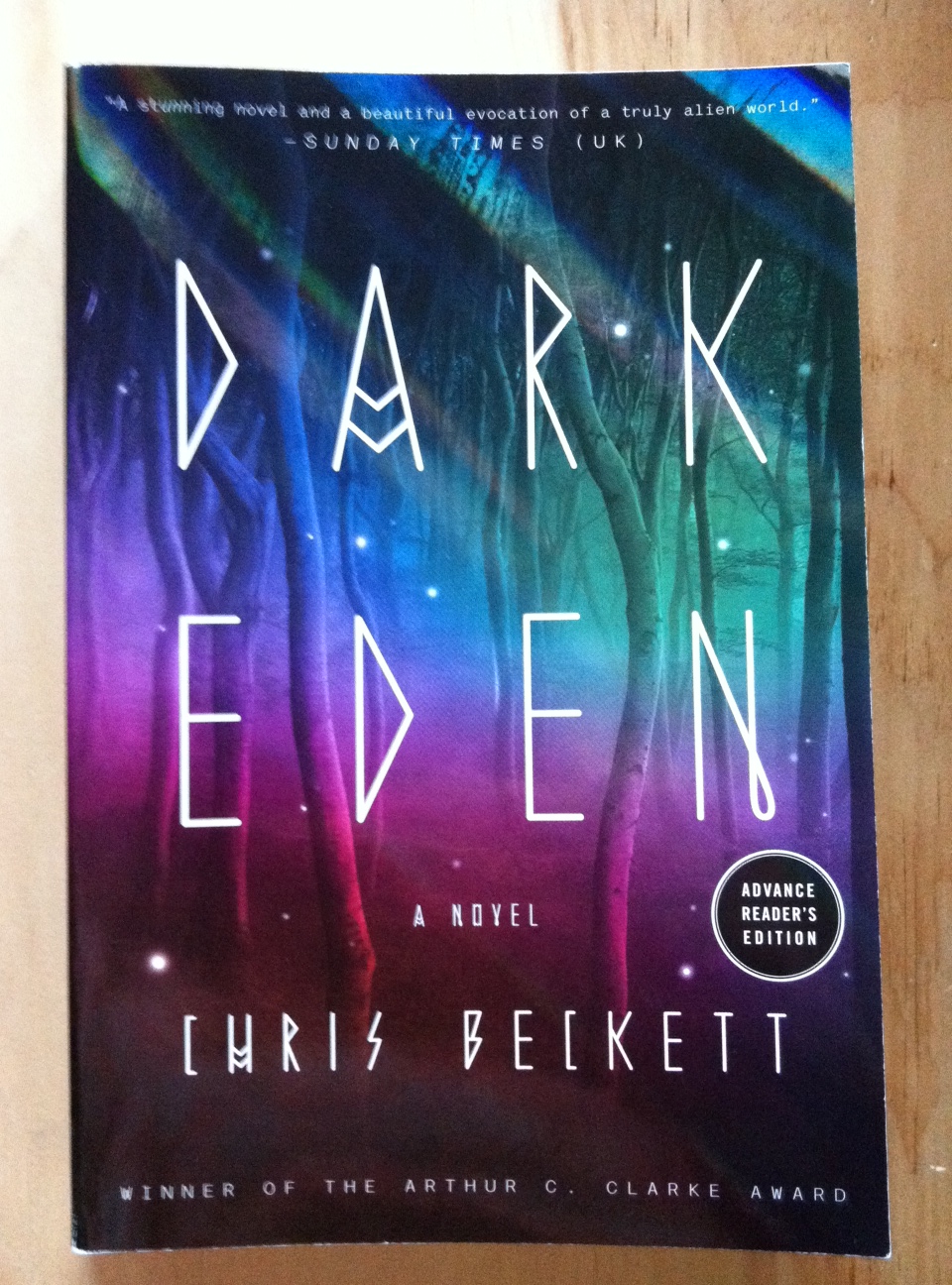
Anthropology meets sci-fi meets adventure meets myth-making meets bildungsroman meets philosophy in Chris Beckett’s remarkable new novel, Dark Eden*.

photo (65)On a planet without a visible sun, the Family lives in the glow of phosphorescent trees, waiting to be rescued by the people of their ancestors. Time is measured in terms of “wakings” and “womb-times”; Siren-like singing panthers kill in the forest, and giant worms lurk in the glowing trees. Eden is a frightening place even before the Family’s internal problems are taken into account. Years of inbreeding have produced genetic abnormalities in the small population; their vocabulary is dwindling; their oral tradition and laws and methods of keeping the peace are all strained to the point of breaking. Even food is becoming scarce.

The 532 inhabitants of Eden hear legends of a world where “lecky-tricity” made things move, where there was a sun in the sky, where people could make ships that left the world itself. And soon, the stories tell them, a “Landing Veekle” will take them back to that world.

But young John Redlantern isn’t content to wait. A cross between Prometheus and Cain, John wants to explore beyond the Family’s living area and hunting grounds, to remake Eden as a permanent home for the Family. He wants to do the unthinkable: traverse Snowy Dark, where the cold can kill and the darkness is absolute. It’s dangerous, and worse, it’s heretical. What will happen to the Family if their most closely-held beliefs are challenged?

Dark Eden‘s world-building is excellent, and refreshing, since it’s neither Star-Trekkian (gadgets and gizmos and talking computers) nor Hunger Games-style dystopian (our own world in a terrible mess). Don’t get me wrong — I love Star Trek and The Hunger Games. But it’s wonderful to read something fresh, that answers a question I wish I’d thought to ask: what would a primitive culture look like if it evolved on an alien planet from a tiny population with prior experience of technology and advanced culture?

It turns out that the intentions of the initial population matter a great deal; the Family’s founders attempted to give their children a good chance at long-term survival, insisting, for instance, that children go to school, that histories be preserved, that women and men are equal. As I mentioned above, the gender politics in the novel are fascinating; the Family doesn’t quite have a matriarchal power structure, but paternity isn’t tracked and sexual violence is unheard of in Eden.

One of Dark Eden’s best aspects is the author’s attention to linguistic detail. Over generations, vocabulary changes and some kinds of speech atrophy (oh, my poor subjunctive!). So, for example, in the Family’s oral/aural culture, some pronunciations are off (“lecky-trickety”), and intensifiers like “very” have been lost. To convey that something is “very cold,” John Redlantern or Tina Spiketree would say, “cold cold.” On the other hand, English slang (“bloke”) and personal euphemisms (“slipping” for “sex”) remain, perfectly out of place in an alien world.

Dark Eden‘s story is John Redlantern’s, in many respects, but he is not the sole narrator. Mr. Beckett chooses his other narrators carefully to give a rounded perspective on the world and John’s actions. Given the limited vocabulary all the narrators work with, the resulting polyphony is all the more impressive. This is literary sci-fi at its best, and highly recommended reading.

Tomorrow: An interview with Chris Beckett, author of Dark Eden

*My thanks to the publisher for sending me advance copy of this novel in exchange for an honest review.

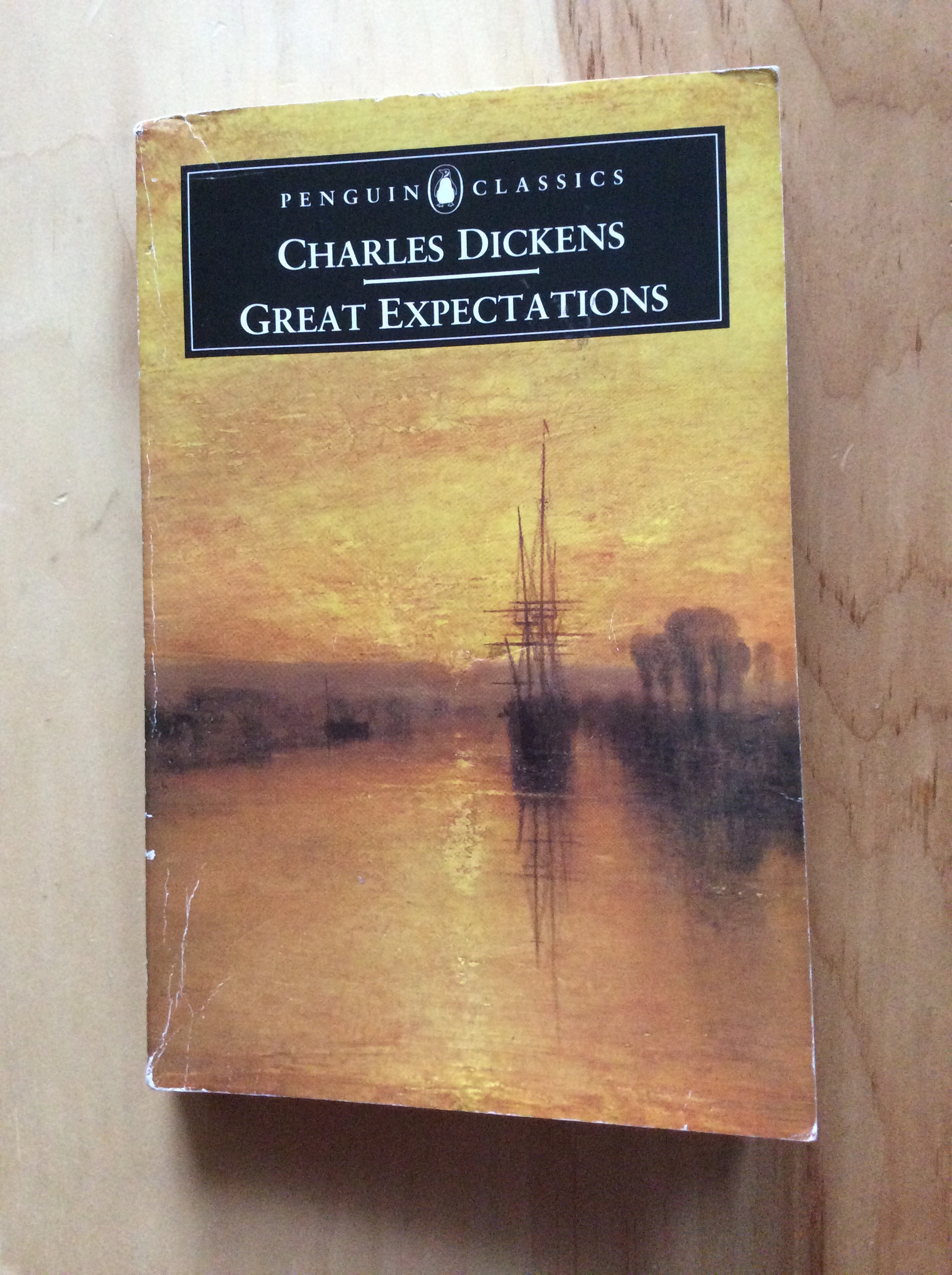
What Larks!: Dickens Re-evaluated

My fourteen-year-old self is going to think I’m Madame DeFarge. And not just because I learned how to knit a few years ago. No, it’s more the face-of-evil-betrayal thing.

I liked Great Expectations.

Horror of horrors: it appears that Mr. Dickens and I have come to an understanding.

I last read Great Expectations in the ninth grade — fifteen years ago, give or take. The following photo (64)year brought A Tale of Two Cities, which I will never read again thanks to truly irritating Lucie Mannette and her golden thread, and then I had a long break from Dickens until Hard Times popped up in a graduate seminar six or seven years ago, a break punctuated only by sporadic forays into David Copperfield.
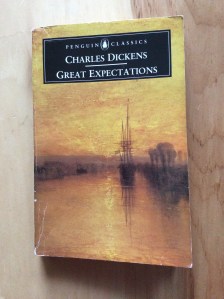
Before this reading of Great Expectations, my major Dickensian complaints consisted of: Dickens’s long-windedness, his lack of subtlety, the tidy way that characters prove related to one another. Seriously. It felt like reading a nineteenth-century version of Crash sometimes.

Honestly, I put Great Expectations on my Classics Club list not from any noble intention to re-evaluate my own notoriously long-lived literary grudges (see: Steinbeck, Faulkner), but because at the time I thought I might like to read Havisham (still haven’t gotten around to it), and I like to read literary reimaginings with the original text firmly in mind. (Why I wanted to read Havisham is a story for another post.) When I decided was peer pressured into participating into the Classics Club Spin selection, I popped Great Expectations onto the spin list in position number 20, dead last, never thinking for a moment that it would really be picked.

I suppose I’ll be taking 5% chances more seriously from now on.


Great Expectations is Dickens’s penultimate completed novel, and though my edition clocks in at 484 pages (excluding notes and introduction), it’s one of the shortest of Dickens’s novels (which may halfway explain my change of heart). Unrequited love, the pursuit of wealth and status, the plight of the poor, and the nature of guilt are themes traced through the novel.

On the bleak marshes of Kent, Pip, a young orphan, has no expectations at all when the novel begins, except perhaps a slap upside the head from his sister, or a kind word from her blacksmith husband, Joe Gargery (the pair are raising him). A chance encounter with a runaway convict causes Pip no end of fright and guilt, until those emotions are eventually crowded out by his love for and anxiety over Estella, the cold and contemptuous ward of the ghastly Ms. Havisham. Notified one day that a mysterious benefactor wishes Pip to become a gentleman, Pip leaves his home, Joe, and Estella behind, setting out for London and the issuance of his “great expectations.” Once there, however, the new wealth that confers upon Pip the status of gentleman also separates him from the people he loves, and, often, the best parts of himself. Great Expectations is largely concerned with the forces, both internal and external, that shape Pip’s character.

The novel’s narration is an older (and perhaps wiser) Pip, who looks on his childhood self’s foibles and his adolescent self’s willful errors with an uncompromisingly honest eye. His narration is wry, emotional, often funny. Pip meets a typical cast of Dickensian characters on his road: Jagger, the unscrupulous, clever, perpetually hand-washing lawyer; Joe, the gentle blacksmith, unfailingly tender-hearted, too convinced of his own unworthiness to correct Pip’s faults; Mr. Wopsle, the ridiculous cleric-turned-actor; Miss Havisham, withering and decaying in her own bitter memories.

And Wemmick, my favorite character in the novel. Wemmick is, I think, Dickens’s embodiment of modernity and practicality. While tender-hearted and thoughtful at home, caring for his deaf father (“The Aged Parent”) and sneaking his arm around proper Miss Skiffins’s waist, Wemmick transforms into an entirely different creature at Jaggers’s office, where he works as a clerk. He remonstrates with clients, ignores their tears, and carries out his duties without any regard to the suffering around him. It’s as if he shuts down his emotions as a form of self-preservation; otherwise, how could he bear what he sees every day? I suspect that this is Dickens’s commentary on the kind of person one must become to survive in — though not change — the modern world.

I know I didn’t appreciate Wemmick fifteen years ago because he came as a total surprise to me. What I also failed to see as a fourteen-year-old was Dickens’s marvelous sense of humor — abundantly evident in caricature studies, if you will, but here particularly in bleak, black humor. The novel’s second paragraph, after Pip explains the origin of his name in the first, is an extended joke. Pip explains how he derived a sense of his parents’ characters and his siblings’ physical attitudes from their tombstones:

As I never saw my father or my mother, and never saw any likeness of either of them (for their days were long before the days of photographs), my first fancies regarding what they were like were unreasonably derived from their tombstones. The shape of the letters on my father’s, gave me an odd idea that he was a square, stout, dark man, with curly black hair. From the character and turn of the inscription, “Also Georgiana Wife of the Above,” I drew a childish conclusion that my mother was freckled and sickly. To five little stone lozenges, each about a foot and a half long, which were arranged in a neat row beside their grave, and were sacred to the memory of five little brothers of mine,—who gave up trying to get a living, exceedingly early in that universal struggle,—I am indebted for a belief I religiously entertained that they had all been born on their backs with their hands in their trousers-pockets, and had never taken them out in this state of existence.

The tragic death of five infant boys transmuted into the image of children born with trousers on, relaxed and jaunty — how strange, how macabre, how childishly innocent!

Take, then, the next paragraph:

Ours was the marsh country, down by the river, within, as the river wound, twenty miles of the sea. My first most vivid and broad impression of the identity of things seems to me to have been gained on a memorable raw afternoon towards evening. At such a time I found out for certain that this bleak place overgrown with nettles was the churchyard; and that Philip Pirrip, late of this parish, and also Georgiana wife of the above, were dead and buried; and that Alexander, Bartholomew, Abraham, Tobias, and Roger, infant children of the aforesaid, were also dead and buried; and that the dark flat wilderness beyond the churchyard, intersected with dikes and mounds and gates, with scattered cattle feeding on it, was the marshes; and that the low leaden line beyond was the river; and that the distant savage lair from which the wind was rushing was the sea; and that the small bundle of shivers growing afraid of it all and beginning to cry, was Pip.

Pip introduces us to his child-self at the moment of self-realization, at the moment when he places himself within the context of his surroundings. And we learn what remains, for most of the novel, Pip’s defining characteristic: fearfulness. As a child, Pip fears his sister and her abuse, fears for his own safety once he’s met the convict, fears Estella’s coldness, fears becoming trapped in his provincial town with a respectable profession. Later he fears what people will think of him if acts a certain way; he even fears the boy he hires to be his valet. And of course he fears losing Estella, and fears that his convict will not forget him.

Though Pip-the-narrator never excuses his own (sometimes deplorable) behavior, in the background Dickens always seems to be saying, “consider the circumstances!”; take, for example, the paragraph I have just cited. Dickens emphasizes that Pip’s parents and brothers are dead; the churchyard overgrown with nettles suggests that the church (or religion) will be of little help to Pip (and indeed religion plays little role in the story); and the bleakness of the physical environment suggests that even nature will not be a comfort to Pip. Great Expectations provoked more marginalia for me than any other book this year — just look at the layering of adjectives that describe Pip’s surroundings: raw, bleak, overgrown, dark, flat, low, leaden, distant, savage. A fearsome environment for a “small bundle of shivers.”

Here’s part of Dickens’s description of the convict: “A man who had been soaked in water, and smothered in mud, and lamed by stones, and cut by flints, and stung by nettles, and torn by briars.” Textbook “good” writing — all action verbs — but the convict is the object of the actions; all these things have happened to him. What wonder then that he wants to become a man of action, to make things happen himself? What wonder then that he acts savagely to instill fear in a mere child?

(The characters for whom Dickens reserves real contempt are those who lack circumstances dire enough to mitigate their behavior: the second convict, Pip’s sister, the pompous bully Pumblechook, Herbert’s non-maternal mother.)

I’ve rambled on and only covered the first two pages of the novel — as you might imagine, the rest provoked plenty of commentary in the margins. I couldn’t help but think, as I read, that I must be missing things that would be obvious to people who specialize in Victorian literature (hi, Joanna!), people I’ve regarded with incredulity for years because they make a regular habit of reading Dickens. I’m sorry that it’s taken me so long to remake Wemmick’s acquaintance, and Joe Gargery’s, and I plan on reading Great Expectations again.

But don’t count on me reading Tale of Two Cities anytime soon.


A final aside, Dear Readers, for those who’ve read Milton and those who are considering the plunge: here are the last lines of Volume I, as Pip is about to embark upon his “great expectations”:

We changed again, and yet again, and it was now too late and too far to go back, and I went on. And the mists had all solemnly risen now, and the world lay spread before me.

Compare these passages, from Paradise Lost, Book XII:

from the other hill
To their fixed station all in bright array
The cherubim descended, on the ground
Gliding meteorous as evening mist
Ris’n from a river o’er the marish glides
And gathers ground fast at the laborer’s heel
Homeward returning.

and

The world was all before them, where to choose
Their place of rest, and Providence their guide.
They hand in hand with wand’ring steps and slow
Through Eden took their solitary way

See what Dickens did there? Pip may be off to find his great expectations, but Paradise is behind him. And then, we must ask, what kind of paradise was it?

Double the Fun: Shepherds and Nymphs and Elizabethan Poets, Oh My!

Happy National Poetry Month!

To celebrate, here are two poems that together form a little poetic conversation. Nothing says spring like four-hundred-year-old pastoral poetry, right?

The Passionate Shepherd to His Love
Christopher Marlowe

Source: Wikimedia Commons

Source: Wikimedia Commons

Come live with me and be my love,
And we will all the pleasures prove,
That Valleys, groves, hills, and fields,
Woods, or steepy mountain yields.

And we will sit upon the Rocks,
Seeing the Shepherds feed their flocks,
By shallow Rivers to whose falls
Melodious birds sing Madrigals.

And I will make thee beds of Roses
And a thousand fragrant posies,
A cap of flowers, and a kirtle
Embroidered all with leaves of Myrtle;

A gown made of the finest wool
Which from our pretty Lambs we pull;
Fair lined slippers for the cold,
With buckles of the purest gold;

A belt of straw and Ivy buds,
With Coral clasps and Amber studs:
And if these pleasures may thee move,
Come live with me, and be my love.

The Shepherds’ Swains shall dance and sing
For thy delight each May-morning:
If these delights thy mind may move,
Then live with me, and be my love.

The Nymph’s Reply to the Shepherd
Sir Walter Ralegh

Source: Wikimedia Commons

Source: Wikimedia Commons

If all the world and love were young,
And truth in every Shepherd’s tongue,
These pretty pleasures might me move,
To live with thee, and be thy love.

Time drives the flocks from field to fold,
When Rivers rage and Rocks grow cold,
And Philomel becometh dumb,
The rest complains of cares to come.

The flowers do fade, and wanton fields,
To wayward winter reckoning yields,
A honey tongue, a heart of gall,
Is fancy’s spring, but sorrow’s fall.

Thy gowns, thy shoes, thy beds of Roses,
Thy cap, thy kirtle, and thy posies
Soon break, soon wither, soon forgotten:
In folly ripe, in reason rotten.

Thy belt of straw and Ivy buds,
The Coral clasps and amber studs,
All these in me no means can move
To come to thee and be thy love.

But could youth last, and love still breed,
Had joys no date, nor age no need,
Then these delights my mind might move
To live with thee, and be thy love.


See also: William Carlos Williams, “Raleigh Was Right”

An Interview with Helen Oyeyemi, Author of Boy, Snow, Bird

Yesterday I reviewed Helen Oyeyemi’s marvelous (in every sense of the word) new novel, Boy, Snow, Bird. Ms. Oyeyemi graciously agreed to be interviewed via email. 

How would you describe the inception of Boy, Snow, Bird? What was the writing process like? 

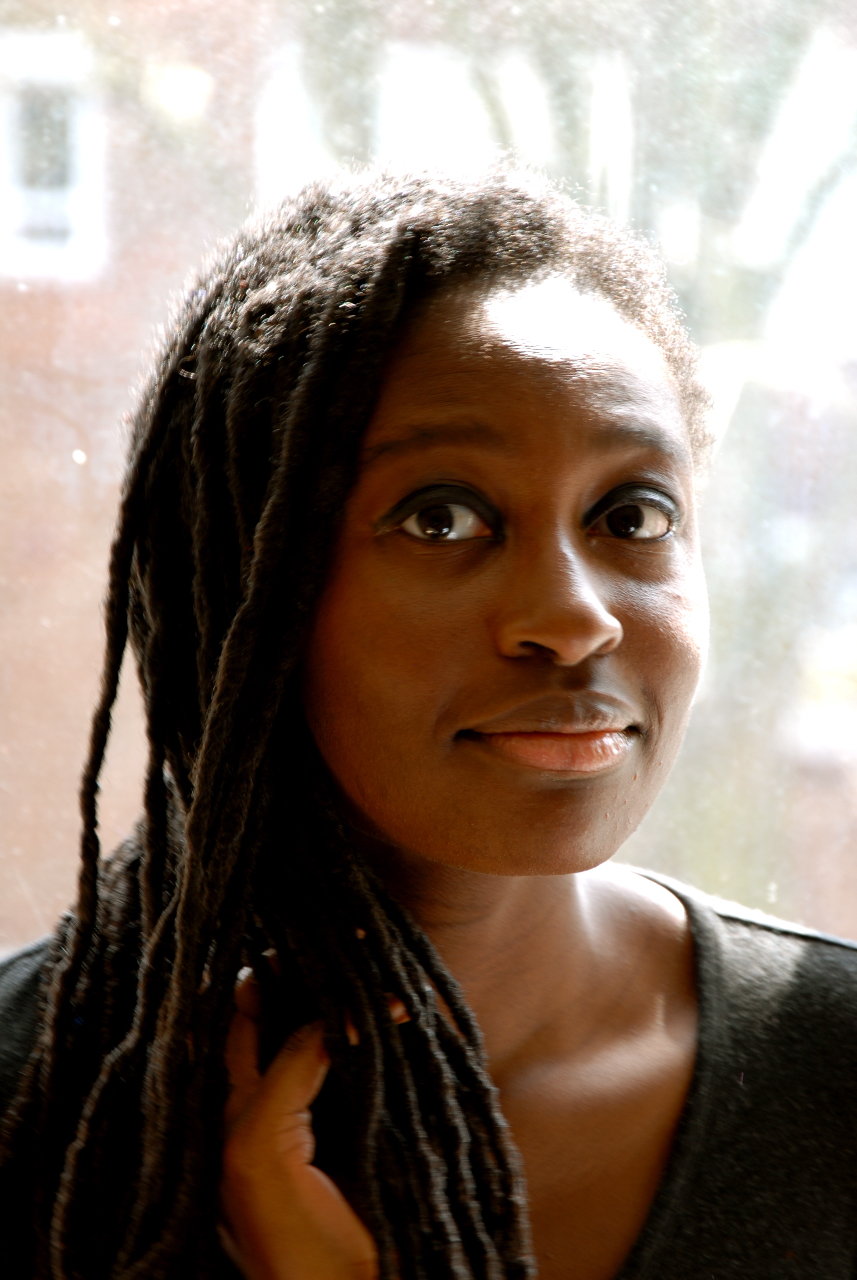
Helen Oyeyemi  (c) Piotr Cieplak

Helen Oyeyemi
(c) Piotr Cieplak

HO: the idea of writing a wicked stepmother story had been in my mind ever since i’d read Barbara Comyns’ novel, The Juniper Tree, which is a retelling of the fairy tale of the same title from the perspective of the wicked stepmother (poor, poor woman – i mean the wicked stepmother, not Comyns…Comyns’ narrative voice is so wonderfully eldritch, a mix of light and grit in proportions that only she can master.) it took me some time to get into Boy’s voice – perhaps i was worried about the difficulties she was going to have in terms of trying not to do harm when she’d been harmed herself.

Much of the novel takes place in a small town in Massachusetts. Was there a particular reason for this choice? Did you visit the area to get a sense of the landscape, or conduct other kinds of research for the novel?

HO: i have a dear friend who lives in boston; we drove up to worcester after i’d finished writing the book so i could see how completely imaginary the small town near worcester in my book is. massachusetts is linked to emily dickinson and louisa may alcott in my mind, so i think of it as a place where my kind of woman can flourish: a good place to send Boy to, i think.

photo (63)Boy, Snow, Bird is in part an adaptation of the Snow White fairy tale. Did other contemporary retellings of folktales and fairy stories inform your writing? 

HO: Anne Sexton’s take on Snow White, in her collection, Transformations, affected the way that i read snow white – that image at the end of the poem, the wicked queen dancing herself to death in red hot shoes. for me Anne Sexton’s retelling exposes a notion that’s woven into the story: where there are two beautiful women, one must pay a price – a price for both women’s beauty, perhaps. most of the characters in my own retelling are wise to this notion, and don’t accept it.

Boy, Snow, Bird confronts — always with grace — difficult issues of race, gender, family, and aesthetics. What’s one question you hope readers ask as they come away from the novel?

HO: i hope a reader leaves the story wondering how to get better at seeing other people, or at least seeing through our own halls of mirrors.

 As readers may know, you’re a prolific writer, with five novels and two plays to your credit already. What’s next on your writing horizon?

HO: o dear…your guess is as good as mine. but i’m looking forward to it, whatever it is.

My thanks again to Ms. Oyeyemi for her time and her thoughtful answers.

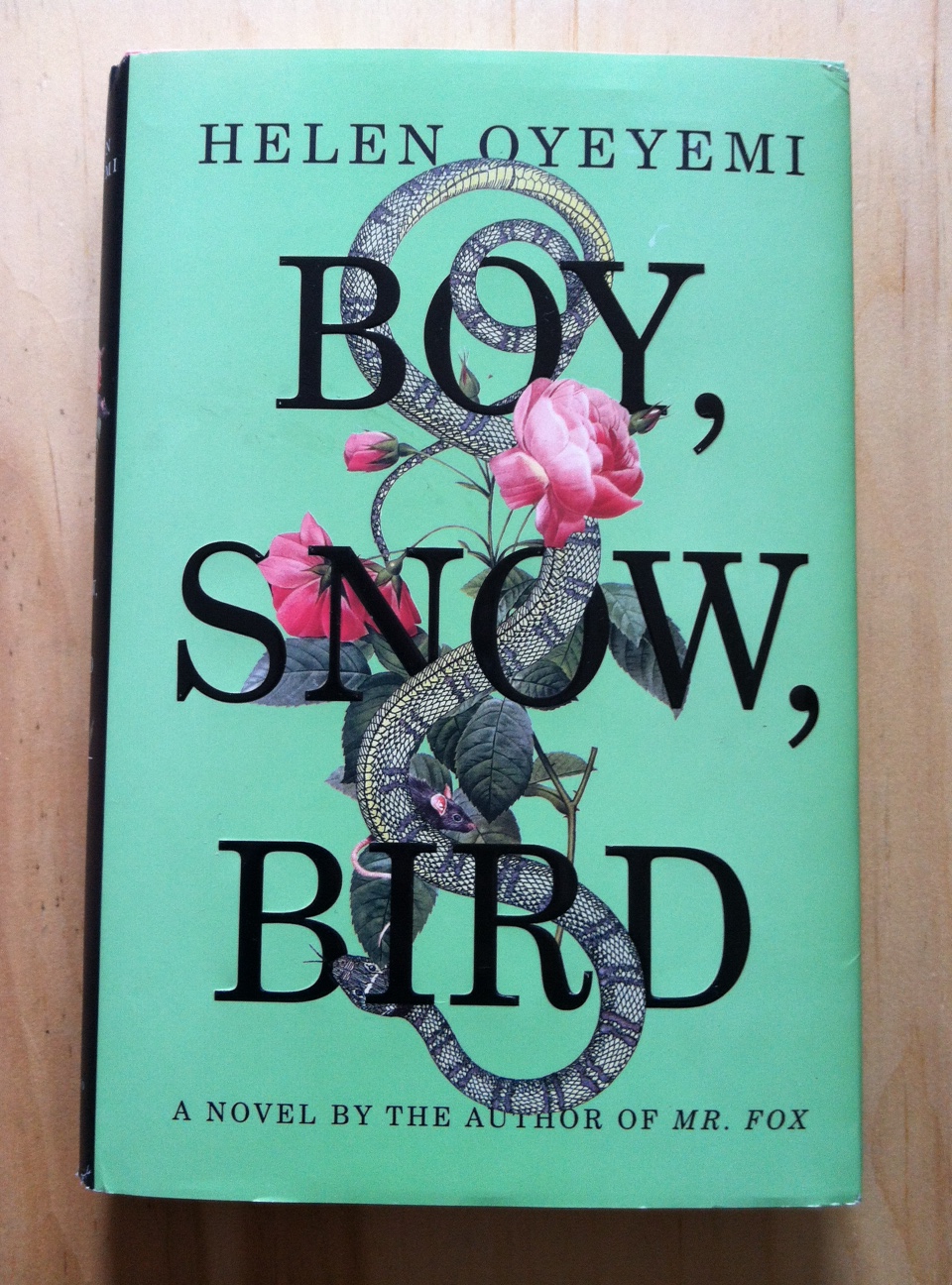
Recommended Reading: Helen Oyeyemi’s Marvelous Boy, Snow, Bird

photo (63)Helen Oyeyemi’s Boy, Snow, Bird* deserves all the attention it’s attracting; it’s a beautiful, lyrical novel, thrumming with life and grappling with difficult issues of love, aesthetics, race, trauma, and identity.

Boy Novak flees both home (New York City) and her abusive father for life in small-town Massachusetts. Drifting from job to job, and occasionally frightened by her own strangeness (“It wasn’t that I didn’t want to speak; it just seemed smarter not to. All of a sudden it felt as if I had far too many teeth, more teeth than it was decent to show” [45.]), Boy eventually settles down with a former professor (now jeweler) Arturo Whitman and his beautiful, enchanting daughter, Snow. However, when Boy’s daughter, Bird, is born, a secret is revealed that leads Boy to send Snow away when “Snow’s daintiness grew day by day, to menacing proportions” (142). Boy becomes a wicked stepmother in absentia.

Time passes, however, and Snow and Bird prove themselves determined to reunite, to find out the whole truth (Bird is a budding journalist) — because there’s another woman missing from their story.

I loved Boy, Snow, Bird. The characters’ voices are distinct, witty, and smart, and the reworking of the Snow White fairytale surprised me at nearly every turn. While it deploys the same tactic that makes C.S. Lewis’s Til We Have Faces so brutally brilliant — that is, telling an established myth from the point of view of the “evil” character — Boy, Snow, Bird is even more expertly layered. The veneer of magic both conceals and reveals our own preoccupations with perception and the practice of looking.

Reviewers and readers have, justifiably, focused on the novel’s engagement with race (Ron Charles in the Washington Post has a particularly good paragraph about it, which you can read here). I’d also like to point out that the novel consistently reminds us of what it’s like to be a woman, and therefore constantly looked at (by others and by yourself). One of Boy’s teenage friends from the bookstore where Boy works, a girl named Sidonie, is catcalled every day on her way home from school (disturbingly, street harassment hasn’t changed much from the book’s 1953 setting); one of the ways that Snow is initially marked as “young for her age” is that “she hadn’t yet learned to smile even when she didn’t feel like it” (71). She hasn’t learned, in other words, the right face to show the world that’s looking at her.

And then there’s the lead up to a terrifying episode of abuse that Boy’s father, a rat catcher, perpetrates. Two weeks before her escape, Boy walks home with her boyfriend of sorts. Boy’s father greets them at the door: “‘I’ve seen the way you look at my daughter. You think she’s pretty, don’t you?'” Then:

They both turned to me and went on a looking spree. I left them to it and wished I could sail over their heads and into the acid blue sky. They didn’t look for long, it was more a practiced series of glances; they knew what they were looking for and seemed to find it. It was a wonder there was anything left by the time they were through looking. (120)

After the rat catcher (as Boy thinks of him) threatens to mar Boy’s beauty, to scar her badly enough that only a “true love” could accept her, Boy comes to the conclusion that “no matter what anybody else said or did my father saw something revolting in me, and sooner or later he meant to make everyone else agree with him” (123). Is it any wonder that Boy fears the face that looks back at her from the mirror, the face that sometimes isn’t hers?

It’s in articulating the tension between the fear of beauty and the craving for it that Ms. Oyeyemi truly shines.

Tomorrow: An interview with Helen Oyeyemi, author of Boy, Snow, Bird

*My thanks to the Riverhead Books for sending me a copy of this novel in exchange for an honest review.


“with one hand under our head / and with the other in a mound of planets”: Zbigniew Herbert’s “I Would Like to Describe”

This weekend I finished reading Diane Ackerman’s book The Zookeeper’s Wife,  which I’ll be reviewing for the Literary Wives group on April 7 (it’s a quick read, so there’s still plenty of time to hop aboard if you’d like to join the discussion). The book is full of interesting facts; for example, during World War II, the Polish underground movement managed to keep students in high school and college (which had been outlawed for Poles by Nazi decree) — and even grant degrees — through a system of “floating” classrooms.

One of those students was Zbigniew Herbert, who went on to become one of Poland’s most famous post-war poets. For many years he refused to submit his work to state-sanctioned venues, and was throughout his adult life an opponent of communism and censorship.  His work has been translated by, among others, Czeslaw Milosz.

His poem “I would like to describe” expands on the poet’s frustration at his own inability to summon just the right word or words to describe emotion. While bemoaning the inadequacies of metaphor, the speaker nonetheless conjures up some beautiful examples. “I would like to describe courage / without dragging behind me a dusty lion” (l. 12-13) is one of my favorites.

I confess that I didn’t know much about Herbert before I researched this week’s post, but now I’m going to go off and get my hands on a copy of his selected poems.

Who’s a poet you’d like to learn more about?

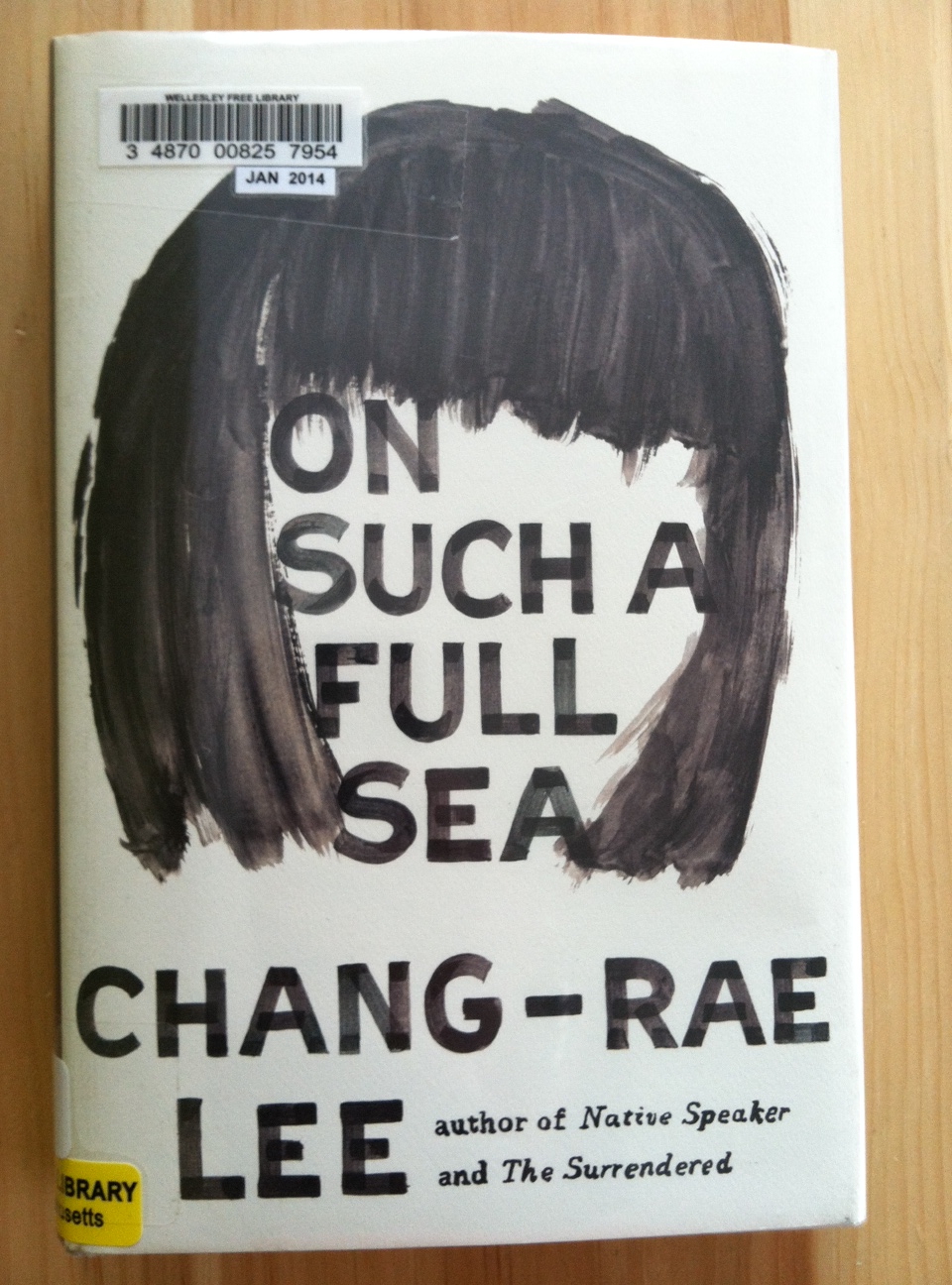
Review: On Such a Full Sea, by Chang-rae Lee

I wanted so much to love this book so much.

photo (60)(Yes, I meant that both ways). I’ve read two of Chang-rae Lee’s other novels, A Gesture Life and Native Speaker, and came away amazed that a writer could approach brutality with such gorgeous prose — without once letting the reader escape from the cruel reality of history. And one of the best books I’ve read in the last three years is another instance of a “literary” writer venturing into the realm of speculative fiction — Kazuo Ishiguro’s Never Let Me Go. I hoped On Such a Full Sea would become another great entry in the genre. The title comes from Shakespeare, after all.

Alas, ’twas not to be. Pretty much everything I feel about this novel has been better expressed by the grande dame of speculative fiction herself, Ursula K. Le Guin, in this pitch-perfect review for the Guardian.

The novel is framed as a quest narrative: a young woman named Fan leaves her (relatively) safe home to find her beau, Reg, who’s been spirited away to a mysterious lab thanks to a genetic quirk that makes him impervious to ‘C’ — a group of diseases that virtually everyone eventually succumbs to (cancer, unless I’m misreading, and I don’t think I am). Fan and Reg live in B-mor, a future Baltimore stripped of its former residents and converted into a city, built in the novel’s past, for Asian immigrants and their descendants to live and work in — a sort of hive for producing high-quality food for Charters (for these think The Hunger Games‘s Capital, without the outrageous get-ups), towns where the rich competitively and conspicuously consume income derived from white-collar type employment. Between these centers of production and consumption lie “the counties,” where there is loose governmental structure, if any, and survival is never a safe bet.

Fan sets off into the counties, of course, with almost no preparation, preparing to rely on her wits and her physical strength (she’s a fish-minder, and an incredibly strong swimmer, despite her small size) as she searches for Reg.

The novel is narrated in the first-person plural by an amorphous group of B-More citizens, who somehow have access to what goes on during Fan’s journey, and to what goes on in her head. It’s a technique that works well when describing life in B-Mor, and what little we get of this new world’s history, but it’s incredibly off-putting when it turns to Fan. And Fan herself remains a cipher, with very little personality to hold on to. She’s quiet, single-minded, quick-thinking, but somehow cold, not life-like.

As you can probably tell, On Such a Full Sea reads like a contemporary American liberal fantasy of what the world will come to if global warming goes unchecked and economic inequality isn’t ameliorated. That would be all well and good — one of the functions of science fiction, after all, is to critique the present world — but Mr. Lee doesn’t attend to the conventions of the genre (in particular, cohesive world-building), with detrimental results.

Here’s an example. Commodities in the novel are simultaneously difficult to acquire and unreasonably available. At one point Fan is offered a carton of soy milk, and then another, and while it’s impressive that her counties host has access to comestibles, at the same time it seems impossible that a world that can’t repair roads is still producing single-serving soy milk containers. As Ms. Le Guin writes,

Neglect of such literal, rational questions in imaginative fiction is often excused, even legitimised, as literary licence. Because the author is known as a literary writer, he will probably be granted the licence he takes. But social science fiction is granted no such irresponsibility, and a novel about a future society under intense political control is social science fiction. Like Cormac McCarthy and others, Lee uses essential elements of a serious genre irresponsibly, superficially. As a result, his imagined world carries little weight of reality. The whole system is too self-contradictory to serve as warning or satire, even if towards the end of the book the narrator begins to suspect its insubstantiality.

Exactly. So very disappointing.

However, Mr. Lee’s prose is still gorgeous as ever, and (again, as Ms. Le Guin points out) he embellishes standard tropes and themes with creative details and few unexpected plot twists. I suspect that we’ll be enjoying Mr. Lee’s contemporary fiction again soon.

An Interview with Hailey Leithauser, Author of Swoop

On Monday I reviewed Hailey Leithauser’s award-winning debut collection, Swoop. Ms. Leithauser graciously agreed to be interviewed via email.

Your biographical note on The Poetry Foundation’s website indicates that you started writing again after a ten-year break. What precipitated your (triumphant) return to poetry? 

Hailey Leithauser Photo by Sandra Beasley

Hailey Leithauser
Photo by Sandra Beasley

HL: Actually it was more like a twenty year break. I can actually point to a specific moment when I began writing again; I was on a lunch break from work, at the National Gallery standing in front of Van Gogh’s Pieta, of all things, when a poem about the painting began streaming in front of my eyes. But those tickles in the brain had really been building for several months. My mother had died that spring, and  I think that overwhelming pain had shaken things loose. Also I was about to receive her inheritance which would enable me to retire, at least for a few years.  I knew I wanted to use that time to write again, so my subconscious had been gearing up.

How did Swoop come together as a collection? 

HL: Swoop started when my brother sent me a palindrome, and said it looked like a line from one of my poems. I agreed and I loved the idea of the music inherent in a palindrome so I started writing them and putting them into poems, and really very quickly, in maybe three years, I had a book length collection. At first when I gathered them up I didn’t see any other unifying theme, but as I read them together I saw the idea of excess, a celebration of excess, both in emotion and in linguistic play, seemed to be framing the manuscript.

When reading Swoop I noticed often that the effect of a particular poem was amplified by its predecessor — and “Zen Heaven” is such a powerful closing poem. How did you go about ordering the poems in Swoop

photo (62)HL: I wish I could take credit for that, but when I first tried organizing the book it was terrible, truly, truly awful. I had all the poems clumped together, all of the curtal sonnets next to each other, all of the Grandiloquent Dictionary poems together, the four poems “Scythe,” “Guillotine,” “Brass Knuckles,” and “Crowbar” in one string. One of my co-winners from the Discovery Prize, James Arthur, was in town for AWP and I gave it to him for critique. He wrote me a few days later to say he loved the poems but it was like eating a pizza with all the pepperoni on one slice, all the mushrooms on another. So then I broke up all the poems, sort of scattershot, and I showed that version to Sandra Beasley. She told me I was right to break them up, but now it was too random and so she did the very difficult  job of ordering the book.  I made a few changes here and there to that version, but I stuck pretty close to her basic framework. Honestly, without their help, I can’t imagine that the people at the Poetry Foundation would have chosen Swoop.

The poems in Swoop are exuberantly musical — do you listen to music while writing? Who or what are your musical influences, and who are your favorite “musical” poets? 

HL: I’ve been asked this before and the truth is I would be much too distracted it I had music on while I wrote. My favorite kind of music is blues, but I don’t see that reflected in my writing. Unless you would consider bird song to be music. I do like listening to that when I’m working in the back yard.

As far as musical poets, there are so many! Off the top of my head, I love Seidel, Stallings, Szymborska, Brooks, Ryan, and Beeder.  And Stevie Smith, Terrence Hayes,  Estes, Boss, Kevin Young, Videlock.  I’ve recently gotten into Gjertrud Schnackenberg and would like to read through all of her work. And I enjoyed Carol Light’s first book, “Heaven from Steam.”

Some of your poems refer to the Grandiloquent Dictionary, and all of them showcase a rich and dynamic vocabulary. What are  some of your favorite resources for discovering new words? 

HL: I used to be a reference librarian and own a fairly decent selection of dictionaries and thesauri, and whenever I see books on interesting and archaic words I snap them up. I bought one this fall, “The Word Museum,” that gave me the word “SNOUTFAIR”  (handsome) that I put right into a poem. I recently wrote two poems about the Renaissance characters Tom o’ Bedlam and his counterpart, Mad Maudlin, and for those poems I read through a few online dictionaries of Elizabethan slang.

After the success of Swoop, what’s next on the writing horizon?

HL: I’m in between the second and third drafts of a new book, The Cannibal’s Song,, and hoping to have it ready to show to Graywolf this summer. Now that I’ve done with palindromes, my new obsession is acrostics so there are quite a few of them in Cannibal.  And about a third of it is poems that pre-date Swoop. Some of these poems first appeared in magazines ten years ago so I’m excited about finally finding a home for them.

My thanks again to Ms. Leithauser for her time and generous answers. You can read more about Swoop, and purchase the book directly from Graywolf Press, here

“Joy-buzzer buzz”: Hailey Leithauser’s “‘Was You Ever Bit by a Dead Bee?'”

photo (62)Hey, remember yesterday when I wrote about how much I loved Swoop, Hailey Leithauser’s debut collection? Remember how I bet that you wanted to read the rest of “‘Was You Ever Bit by a Dead Bee?'”

Well, want no more! Here’s a link to the full text of the poem, with a special bonus: an audio recording of the poet herself reading it!

Joy-buzzer buzz!