The Classics Club Spin #6 (the second for me).

Classics Club Spin #5 — which landed me with Great Expectations — was, to my surprise, a great success, so I’m throwing my hat into the ring again. Same list, just swapped in a new number 20.

Here’s my (randomly chosen) list, from my larger List o’ 51, for the Wheel of Fortune to choose from on Monday:

  1. Homer, The Iliad
  2. Thomas Hardy, Tess of the D’Urbervilles
  3. Anne Brontë, Agnes Grey
  4. Nathaniel Hawthorne, The Scarlet Letter
  5. Henry Miller, Tropic of Cancer
  6. Ray Bradbury, The Martian Chronicles
  7. Margaret Atwood, The Blind Assassin
  8. Chinua Achebe, Things Fall Apart
  9. Sherwood Anderson, Winesburg, Ohio
  10. Robertson Davies, The Rebel Angels
  11. Edgar Lee Masters, Spoon River Anthology
  12. Willa Cather, O Pioneers!
  13. Wilkie Collins, The Woman in White
  14. Doris Lessing, The Golden Notebook
  15. Iris Murdoch, The Sea, The Sea
  16. James Baldwin, Another Country
  17. Wallace Stegner, Angle of Repose
  18. Flannery O’Connor, Wise Blood
  19. Sherman Alexie, The Lone Ranger and Tonto Fistfight in Heaven
  20. Vladimir Nabokov, Pale Fire

Wish me luck!

An Interview with Andy Weir, Author of The Martian

Yesterday I reviewed Andy Weir’s debut novel, The Martian. Mr. Weir graciously agreed to be interviewed via email. 

Andy Weir; Photo (c) Andy Weir

Andy Weir; Photo (c) Andy Weir

When you were writing The Martian, how did writing and science go hand-in-hand? Did you stop to make calculations as the plot came along, or did you have the science planned out parallel to the plot? Or did you have another method altogether?

AW: I did a lot of stuff in advance. But as specific plot points came up I usually had to get much more detailed information. So there was pretty much constant research throughout the process. 

What kinds of books did you read while you were writing, if any? Survival stories? Sci-fi? Nonfiction about the space program?

AW: I actually didn’t read much at all during that period. I had a full time job during the day and I was sinking most of my spare time in to writing. I just didn’t have the time for other leisure activities.

What would be on your data stick if you were headed to Mars? For that matter, what’s on Watney’s?

AW: It’s funny, but I never defined what was on Watney’s data stick. Presumably not a lot of entertainment; probably botany papers and articles. As for me, I guess I’d want tons of TV shows and movies.

photo (74)You dedicated The Martian to your mom and dad; how did they support your scientific and creative inclinations when you were growing up?

AW: Dad and I would make model moon-bases and such when I was a kid. And his collection of classic sci-fi paperbacks is what got me interested in the genre. Mom always pushed me to take my shot at writing. It’s kind of backwards from the usual dynamic. I was usually the one saying I need to be cautious and have a stable career and Mom was encouraging me to take a chance.

What would wisecracking, ingenious (and sweet) Mark Watney give his mom for Mother’s Day before taking off on a mission to Mars?

AW: I hate to cop out, but if I were going to write that in to a book, I would engineer a sweet backstory for the present. Some childhood story that makes a mundane item the perfect gift for his Mom. Off the top of my head: When he was a little kid, he wanted an expensive toy. His mom got it for him and he immediately broke it and she was mad. He found it later in an old box. Knowing his mother is worried sick about him going on the mission, he repaired the toy (he’s good at that sort of thing). He gives it to her and asks her to hold on to it for him till he’s back. 

After the success of The Martian, what’s next on your writing horizon?

AW: I’m working on my next book. I’m keeping the details quiet at the moment because I haven’t pitched it to the publisher yet. I’d like them to hear about it from me first.

My thanks again to Mr. Weir for his time and his thoughtful answers.

My Mother and The Martian

Which book does one choose as a Mother’s Day gift when one’s mother (a) loves to read and (b) deserves the highest-quality reading material but (c) has very different bookish taste from oneself?

Herewith, Dear Readers, a case study.

My mom sometimes jokes that when she grows up she wants to be a fighter pilot or Ripley, the Sigourney Weaver character in Alien.  I hate to break it to her, but I think she’s grown up, because she is Ripley.

No, really. She’s a steely-eyed missile (wo)man who takes care of threats to her kids the way Ripley deals with the queen in Aliens. Sometimes there’s even salty language involved. She’s ferociously protective of people she loves, fiercely committed to helping those in need (pretty sure she’d want me to tell you here that you should give blood), she works harder than anyone you’ve ever met, and she’s accomplished in her chosen profession, brilliant, practical, and cool as a cucumber in stressful situations. Also funny. She gave me and my siblings the priceless gift of growing up with a mother who kicked ass and took names at a professional level. Metaphorically speaking, of course.

And I’m pretty sure she could drive a powered cargo loader if the opportunity presented itself.

Oh, and once she saved my life (and my brother’s) by jumping into a swimming pool (while she was pregnant) after we fell out of our inner-tubes. So, you know. That’s kind of a big deal. I think I still owe her a lanyard for that one.

In addition to her impressive personal attributes, my mom has great taste: She read us Laura Ingalls Wilder when we were kids (she’s still reading to my youngest sister, and had her three adult children and their spouses transfixed by her reading of By the Shores of Silver Lake recently), and Little Women, A Secret Garden, and Jane Eyre to me. She organized our grandparents and other relatives to record themselves reading chapters of Watership Down as a gift for my brother.

And it’s not just books: We were raised on Twister (so bad it’s good, and one of my favorite Philip Seymour Hoffman movies), All About Eve, Apollo 13, the Jane Eyre with Timothy Dalton & Zelah Clarke, and Star Trek: The Next Generation. She hates cartoons and she won’t watch kids’ movies. And yet: My mom took me — then 13 — to see Titanic three times in the theater (out of seven total times — she’s only human), and it was only the third time that she broke down and started whispering “glug glug” when it looked like Leonardo DiCaprio had had it. I laughed through my tears.

Not being terribly sentimental, Mom doesn’t have much use for Mother’s Day, but since her birthday is in the vicinity, and since I don’t live close enough to “clean something” (the only gift she ever asks for) I feel justified in sending her a present now and then on the family timeline (+ or – 18 months from the event). Naturally, this year I’m sending her a book.

As you might suspect, my mom isn’t lining up for the latest Nora Roberts novel. She’s a brilliant woman, but she doesn’t like Shakespeare, poetry in general, contemporary fiction (aka navel-gazing) or Virginia Woolf. And yet we’re genetically related . . .

She does like Jane Austen (mordant wit), Jane Eyre (independent heroine with strong convictions), and nonfiction about mountain climbing, Antarctic exploration, the history of medicine, and space. She thinks I should blog more about nonfiction, and she’s probably right.

In other words, finding a book for my mom is tricky, very tricky (just like book shopping for Ripley would be, I imagine). However, I’m going (boldly, of course) to throw caution to the winds and send my mom her very own copy of Andy Weir’s debut novel, The Martian*.photo (74)

Mark Watney is a wisecracking MacGyver-type who specializes in botany. He’s also stranded on Mars.

Alone after his crew accidentally leaves him behind during a hurried evacuation, Watney decides to try his damnedest not to be the first person to die on Mars. With grim determination, creative engineering skills, long-term strategizing and way too much 70s tv, he takes painstaking steps to save himself, recording them in detail in his mission log.

The Martian is fiction that reads like nonfiction, which is part of why I think my mom is going to dig this book. Mr. Weir conducted painstaking research for the novel; as he notes in an author Q&A, “All the facts about Mars are accurate, as well as the physics of space travel the story presents. I even calculated the various orbital paths involved in the story, which required me to write my own software to track constant-thrust trajectories.”

Yes, you read that right.

The novel is chock-full of Watney’s nitty-gritty calculations for survival, which heighten the realism and the tension of the work. The pacing is fast, but Watney notes the long stretches of days when not much happens except survival in the wilderness against daunting odds; there’s no tedious day-by-day, blow-by-blow replay, but neither are we to believe that Watney survives a new catastrophe daily. The novel also features tense Mission Control scenes; the only thing missing is Ed Harris in a white vest. (Maybe not for long — the movie rights have already been sold).

Thanks in no small part to Watney’s sense of humor, his plight evokes sympathy rather than sentimentality; The Martian is a good old man vs. the elements survival thriller. The emotional payoff is comparable to a viewing of Castaway or Apollo 13, to which The Martian is often compared, but with fewer scenes calibrated as tear-jerkers. You’ll also learn a hell of a lot about potatoes and atmospheric regulators, and have a pretty great time in the process.

In other words, it’s the perfect novel for the resourceful and resilient woman who happens to be my mom.

Book’s in the mail, Ripley.

UPDATE, Christmas 2014: Ripley loved the book. So did my grandma, my brother, three uncles, and one cousin. So far.

Tomorrow: An interview with Andy Weir, author ofThe Martian

*I received a copy of this book from the publisher for review consideration, which did not affect the content of my review.

P.S. Bonus points, Dear Readers, for those who know the literary connections in Alien and Aliens.
The Poetry Concierge Recommends: Sharon Olds

[The Poetry Concierge is an occasional feature here on Rosemary and Reading Glasses wherein I select a poem, poet, or book of poems for individual readers based on a short questionnaire. Come play along! Read the introductory post here, my first recommendation here, and then email me at: rosemaryandreadingglasses [at] gmail [dot] com. ]

This week, our pilgrim in search of poetry is Laura, who writes about things bookish at Reading In Bed.

1. When you read fiction, who’s your go-to author?

This is hard, there’s no one author who is perfect in my eyes. I might say Michael Ondaatje because I’m in love with him right now. Or I might say David Adams Richards, who if you haven’t read him, lists Faulkner, Dostoyevsky and Emily Bronte among his influences, which sounds about right.

2. If you read nonfiction, which subjects are most likely to interest you? (cultural history, science, biography, memoir, survival stories?)

Personal essays, feminism

3. If you were stuck on a desert island for a week, which five books would you bring to keep you entertained?

Astray by Emma Donoghue
The Many Lives and Secret Sorrows of Josephine B, Sandra Gulland
The Crimson Petal and the White, Michel Faber
High Fidelity, Nick Hornby
The Tenant of Wildfell Hall by Anne Bronte (haven’t read it yet FYI but it’s calling to me)

4. If you were on a five-year mission to Mars, which five books would you bring to keep you sane?
Love in the Time of Cholera
A Confederacy of Dunces
The Stone Angel
Mercy Among the Children
Having trouble with #5!

5. What kinds of questions are most likely to keep you up at night? (death, the nature of love, politics, environmental issues, meaning of life, end of the world, justice and injustice, etc?)
 

Nature of love 80+% of the time

6. If you’ve read poetry before, what have you liked? What have you disliked?

I like prose that reads like poetry. See comment about The English Patient above. In high school I liked John Donne. I liked The Inferno.


Like Kay last week, Laura’s given me lots to work with here: a wide range of authors (not surprising, I guess, since her one of her reading lists is 1001 books long), varied in tone, themes, and style; defined interests; and an openness to poetry in general.

Now, I was tempted to cheat a little and recommend Michael Ondaatje right off (maybe The Cinnamon Peeler?), but I suspect Laura’s thought of that one already. Given her interests in feminism and personal essays, though, I started thinking about feminist poets: Audre Lorde, Adrienne Rich, Carol Ann Duffy, Katha Pollitt, Carmen Giménez Smith (by no means is this an exhaustive list). I think Laura would like the work of any of these poets (and I was inches from choosing Audre Lorde’s “Now That I Am Forever with Child” but I can’t find an online source with copyright permission, so try your local library for her Collected Poems.).

That said, I think the work of Sharon Olds would appeal to Laura, and so I’m recommending Strike Sparks: Selected Poems 1980-2002, which I think gives a rounded view of her work up until that point (she’s published two collections since then; Stag’s Leap won the 2013 Pulitzer for poetry.

Ms. Olds draws on her personal experiences and familial relationships (and not infrequently, her sex life) to construct poems that are simultaneously deeply personal and startlingly universal. While her work is sometimes controversial because of its sexual content, I’m guessing Laura won’t bat an eye after that time we read a paranormal romance.

For now though, Dear Readers, here’s a G-rated but jarring poem to get you started with Sharon Olds:

“I Could Not Tell”

Laura, I hope you’ll find poems you love in this book (Michael Ondaatje did!).  Thanks for writing in!


Would you like the Poetry Concierge to make a recommendation for you? Check out the introductory post, and send your answers to the questionnaire, along with the name and/or blog you’d like posted with the reply, to rosemaryandreadingglasses [at] gmail [dot] com.

The Poetry Concierge Recommends: Two Books (oh my!)

[The Poetry Concierge is an occasional feature here on Rosemary and Reading Glasses wherein I select a poem, poet, or book of poems for individual readers based on a short questionnaire. Come play along! Read the introductory post here, my first recommendation here, and then email me at: rosemaryandreadingglasses [at] gmail [dot] com. ]

This week, our pilgrim in search of poetry is Abby, who blogs about invertebrate marine biology over at The Spineless Life. Weren’t expecting that, were you? Abby and I attended the same high school, walked the boards of the same stage, and now she’s an awesome scientist-ninja.

1. When you read fiction, who’s your go-to author?

My go-to authors change as I read through all of their material. Among people still writing, I am partial to John Irving and Ian McEwan, but also have a very strong liking for Steinbeck, Zola, and Edith Wharton (among recent favorites). Oh, and C.P. Snow.

2. If you read nonfiction, which subjects are most likely to interest you? (cultural history, science, biography, memoir, survival stories?)

I spend all day reading technical science writing, but I still love popular science, as well as travel memoirs. I frequently pick up histories and biographies but rarely make it through.

3. If you were stuck on a desert island for a week, which five books would you bring to keep you entertained?

5 books for a week? Oof. Let’s go with a book of nature essays by David Quammen, The Glass Bead Game (Hesse), Atonement, Slaughterhouse Five, and Wuthering Heights. (actually, that’s a nice cross-section of my strange reading habits right there.)

4. If you were on a five-year mission to Mars, which five books would you bring to keep you sane?
5 books for 5 years is actually easier, because my to-read list is full of long ones that would require that sort of time. War & Peace (no really, Anna Karenina is a favorite of mine), In Search of Lost Time (does that count as a single book?), Stephen Jay Gould’s The Structure of Evolutionary Theory, and to balance all of this heft, Paris to the Moon (Adam Gopnik, already read and loved), and A Tree Grows in Brooklyn (also a favorite).

5. What kinds of questions are most likely to keep you up at night? (death, the nature of love, politics, environmental issues, meaning of life, end of the world, justice and injustice, etc?)
 

Hm. Climate change. My love life. The meaning of family. The state of the academic job market.

6. If you’ve read poetry before, what have you liked? What have you disliked?

I love things that rhyme and have meter, and really don’t like things that don’t. I adore Poe and Longfellow, and “O Captain My Captain” and “The Charge of the Light Brigade” and “In Flanders Field” and pretty much everything else that you would find in an anthology of familiar, comforting verse. When I find something new that I really like, it has some element of familiarity — the rhyming scheme or the rhythm. French surrealism and I did not mix well.


There may have been a fist pump in my vicinity when I read the first phrase of Abby’s last answer: “I love things that rhyme and have meter.” Me too, ladyfriend, and while I’ll read pretty much any kind of poetry out there, there’s something sweet and satisfying about ye olde formalism.

Or, for that matter, the New Formalism. Yes, my Dear Readers, just like 90s fashion, formalism is back. Well, it never really went away (neither did 90s fashion, judging by the amount of flannel that’s lived in my closet for the intervening years), but let’s set that aside for the moment while I recommend post-World War II poetry for Abby.

Given Abby’s fearlessness toward long reading assignments (War and Peace, In Search of Lost Time), I’m going to be daring and recommend two books:

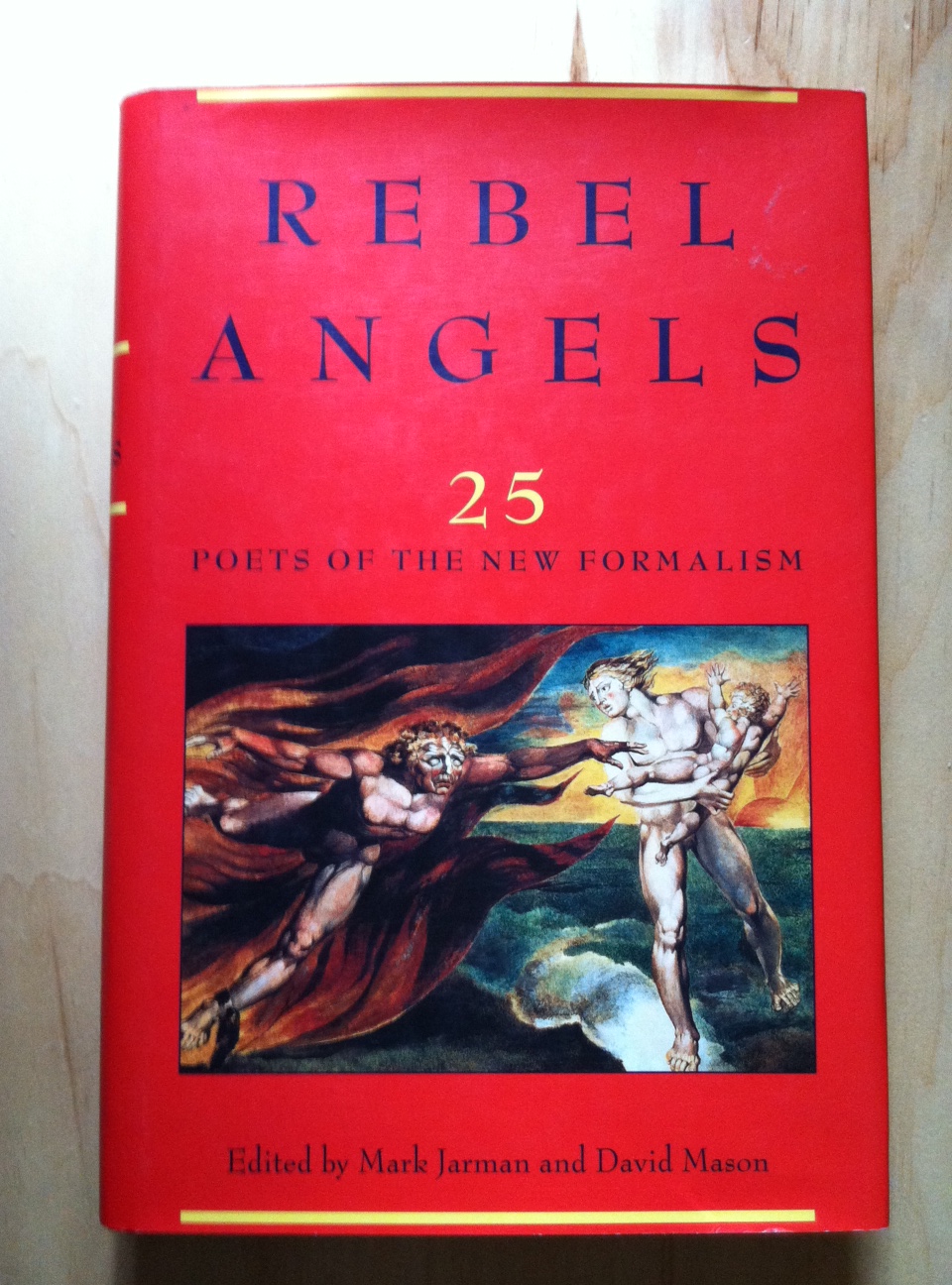
photo (73)Rebel Angels: 25 Poets of the New Formalism came out in 1996, and it’s a great sample of newer formalist work. As with all anthologies, not every poem will appeal to every reader, but I think Abby will find lots to like here. I’d especially recommend the poems by Andrew Hudgins, professor of poetry at The Ohio State University, fabulous reader, and friend of several friends.


photo (72)One of Professor Hudgins’s former students is Ashley McHugh, and it’s her luminous debut, Into These Knots, that I’m also recommending. (Full disclosure: Ashley is a friend, and I’ve met Andrew Hudgins a few times, and been regaled with tales of his workshops more times than I can count.)  Ms. McHugh is an especially accomplished sonneteer, as you’ll see when you read this poem, “The Unquarried Blue of Those Depths is All But Blinding,” which she wrote for her now-husband.

Abby, I hope you’ll find poems you love in these books. Thanks for writing in!


Would you like the Poetry Concierge to make a recommendation for you? Check out the introductory post, and send your answers to the questionnaire, along with the name and/or blog you’d like posted with the reply, to rosemaryandreadingglasses [at] gmail [dot] com.

Coming Soon: The Bees, by Laline Paull

When I was a child, I hated Watership Down.

I think most of my dislike was bound up in the movie, which I found frightening — to this day, the only memories I have of it are images of cartoon rabbits spouting blood — because the writing itself didn’t make an impression on me. Reading synopses now, I suspect that if I tried it again I’d find it deeply aggravating for its attitude toward female characters.

imageI bring this up because Laline Paull’s The Bees* (out May 6 from Ecco) is garnering praise that compares it to Watership Down, and so I’m here to tell you that if you didn’t like Watership Down, you might still like The Bees — I did, very much.

Like Watership Down, The Bees‘s main characters are nonhumans, in this case — you guessed it — bees. Flora 717 is born ugly, deviating far enough from the norms of her hive that she’s about to be killed when an older, powerful bee steps in to save her life. Flora, she thinks, might be useful; she decides to allow Flora to live on a temporary basis.

As a member of the lowest caste of bees — a sanitation worker — Flora is surprised to find herself in the nursery feeding infants, but that’s just the first twist that’s in store for her. The hive mantra is “Accept, Obey, Serve,” which Flora, devoted to the queen (as are her sisters) tries desperately to follow as she faces dangers both within and without the hive: the vicious Fertility Police, a marauding wasp, and the unwelcome attentions of the hive’s overfed and pampered drones. Flora’s role in the story changes as she grows and learns; sometimes she seems like a Cinderella figure, or a questing knight, or Katniss Everdeen, or Offred. She’s a compelling heroine with six legs and an acute sense of smell — courageous, loyal, fierce, hardworking.

The Bees is not a book suitable for children; Ms. Paull does not shy away from the violence and cruel practicalities of life in the hive (an interviewer suggested that some scenes were reminiscent of Game of Thrones, to which Ms. Paull replied: “Game of Drones!”). The book doesn’t suggests that bees — one of the most complex and successful animal species — survive despite the violence, but that their society in some ways requires it. In fact, some of these scenes are so strange that I thought “there’s no way bees behave this way’; after a little research, I realized, yes, they do. I loved that this book prompted me to learn something outside of my general areas of interest.

While the novel’s environmental message is none too subtle, Ms. Paull does keep the focus on character development and extraordinary descriptions of hive structures and practices from the bees’-eye view. The pacing is brisk and careful, and the bees’ world feels totally new (believe me, you’ll never look at a candle or a jar of honey the same way again). The Bees is an absorbing, imaginative debut, and perfect late-spring reading.

*I received a copy of this book from the publisher in exchange for an honest review. 

The Poetry Concierge Recommends: Dorothy Parker

[The Poetry Concierge is an occasional feature here on Rosemary and Reading Glasses wherein I select a poem, poet, or book of poems for individual readers based on a short questionnaire. Come play along! Read the introductory post here, my first recommendation here, and then email me at: rosemaryandreadingglasses [at] gmail [dot] com. ]

This week, our pilgrim in search of poetry is Kay, who blogs about books over at WhatMeRead.

1. When you read fiction, who’s your go-to author?

I don’t know that I have just one go-to author, but maybe Jane Austen. I reread all her books every few years.

2. If you read nonfiction, which subjects are most likely to interest you? (cultural history, science, biography, memoir, survival stories?)

History and biography/memoir (but not usually celebrity biography/memoir) are my favorite nonfiction subjects. I read mostly biographies about figures from history, and literary people or artists.

3. If you were stuck on a desert island for a week, which five books would you bring to keep you entertained?

I would need a big book for the island, so that might be Bleak House. I would need something funny, so that might be something by Georgette Heyer, maybe Cotillion. I would need something I hadn’t read before, maybe another book by Halldor Laxness. I have The Fish Can Sing on my Wish List, so let’s pick that one. I would need something that makes me cry about someone else, so maybe Sense and Sensibility. I would need something about resourceful people to keep me encouraged, so maybe Life After Life by Kate Atkinson. I just read Robinson Crusoe, so I would NOT take that!

4. If you were on a five-year mission to Mars, which five books would you bring to keep you sane?
Hmmm, you’re really trying to make me think, aren’t you? If I was on a five-year mission to Mars, at least I would know I was coming back, so maybe that would be a different choice than the island all right. I’m thinking big books that feel like friends and I can read over and over again: David Copperfield, Jane Eyre, Cloud Atlas or The Thousand Autumns of Jacob De Zoet, maybe read The Luminaries again, and something with beautiful language I can puzzle over, maybe something I haven’t read by Nabokov.

5. What kinds of questions are most likely to keep you up at night? (death, the nature of love, politics, environmental issues, meaning of life, end of the world, justice and injustice, etc?)
 

I actually write reviews in my head at night after I finish a book. Sigh. Also, sometimes work.

6. If you’ve read poetry before, what have you liked? What have you disliked?

I have liked Frost, ee cummings, Shakespeare’s sonnets, some Yeats that isn’t too obscure, some Edna St. Vincent Millay. I have not liked Ezra Pound, because I don’t understand him at all. I have not liked some of the romantic poets, because they have too many allusions to things I don’t know enough about to understand them. Also, I think Keats and Wordsworth are boring. I generally don’t like really long poems, because I find I can’t concentrate on them long enough.


Well, I admit that I’m nervous with this pick, because not only is Kay a very sophisticated

reader, but she’s also read everything (it seems), and she doesn’t pull her punches. On the

Dorothy Parker | Image courtesy Wikimedia commons

Dorothy Parker | Image courtesy Wikimedia commons

other hand, someone who’s liked Shakespeare, ee cummings, and Edna St. Vincent Millay (oh Edna, you’re my favorite) gives me lots of leeway in choosing a poet to recommend. I thought about Howard Nemerov, Seamus Heaney, and Louise Glück, and I think their poetry (judiciously selected) would have been just fine for our purposes.

But Kay makes me laugh with her often acerbic reviews, and for someone whose go-to author is Jane Austen, I think urbane, mordant wit is called for. Enter: Dorothy Parker.

A screenwriter, poet, and satirist, Dorothy Parker is celebrated for her impeccable way with the bon mot, her short and snappy poems with the bite at the end, and her perennial quotability (seriously, she’s on this Kate Spade tote.).

Here are two of her poems, with characteristically deceptive titles: “Interview” and “Love Song.”  Let’s also call “Interview” our poem of the week, shall we?

Kay, I hope these poems make you laugh. Thanks for writing in!


Would you like the Poetry Concierge to make a recommendation for you? Check out the introductory post, and send your answers to the questionnaire, along with the name and/or blog you’d like posted with the reply, to rosemaryandreadingglasses [at] gmail [dot] com.

Recommended Reading: Evie Wyld’s All the Birds, Singing


20140423-140244.jpgEvie Wyld’s All the Birds, Singing* is a terrifying novel, combining bump-in-the-night horror with the kind of terror inspired by the cruelty of ordinary human beings. More than once I had to put the book down because the writing was so intense I could feel my heart pounding, and that’s pretty unusual in my reading experience.

Something — or someone — is killing Jake Whyte’s sheep. She lives alone on an unidentified British island with only her sheep and her dog (named Dog) for company, resolutely refusing calls to socialize with other locals. She’s an outsider in more way than one, though isolated, it seems, by choice. But the death of her sheep forces her into contact with other people as she searches for answers: Don, a kindly neighbor; Lloyd, a stranger whose agenda is unclear; and neighborhood kids with maybe more than mischief on their minds.

While Jake wonders who’s gutting her sheep, the reader wonders how Jake ended up on island by herself, and why she’s so gruff and frightened. As Jake works on her mystery in the present day (using the past tense), alternating chapters take us back to the past, in which Jake narrates the events that led to her leaving Australia for England, and how, exactly, she started raising sheep. These past-chapters unfurl backwards, but are narrated in the present tense, lending a firghtening immediacy to Jake’s memories of violence and fear.

Ms. Wyld’s writing is fierce, clear, and perfectly detailed. Her deft touch finds the perfect balance between intimacy and mystery as she brings Jake to life. Take this paragraph, from the first chapter:

I slammed the fridge and leant my head against it. Stupid to have become so comfortable. The fridge hummed back in agreement. Stupid to think it wouldn’t all fall to shit. That feeling I’d had when I first saw the cottage, squat and white like a chalk pebble at the black foot of the downs, the safety of having no one nearby to peer in at me — that felt like an idiot’s lifetime ago. I felt at the side of the fridge for the axe handle.

It’s the kind of writing that offers new questions even as it answers others. All the Birds, Singing is brilliant and brutal, and highly recommended.

*My thanks to the publisher for sending an advance review copy of the book in exchange for an honest review.

An Interview with Mark Wunderlich, Author of The Earth Avails

Yesterday I reviewed Mark Wunderlich’s new book, The Earth Avails. Mr. Wunderlich graciously agreed to be interviewed via email. 

How did The Earth Avails come together as a collection? How did you go about putting the poems in order?

Mark Wunderlich Photo (c) Nicholas Kahn

Mark Wunderlich
Photo (c) Nicholas Kahn

MW: I knew early on which poems I wanted as the first and last poems in the collection.  I opened with a poem which I think of as perhaps one of the only unadulteratedly happy poems I’ve written as it describes walking out into the natural world and feeling fully alive.  The book ends with a sort of extended argument with God, in which the speaker gives over control to a God whose attention is elsewhere, and who is ambivalent to the suffering happening on earth.  This is not a new or original argument to have, but I felt to compelled to have it anyway.  In between these two bookends, I chose and ordered the poems to create variation, modulation of tone and subject.

About half the poems in The Earth Avails take the form of prayers or “heaven letters”; who is the “you” addressed in these poems?

MW: The second person to whom many of the poems are addressed is God.  Mind you, I’m not a believer.  There is no deity. So the God I’m addressing is an emotional and intellectual construct–the center around which I wound a long skein of rhetoric and heightened speech which are poems.  Though I don’t believe in a deity, I do believe in the mystery and glory of the natural world, and I am regularly in awe of it.  The natural world is full of such intelligence, so many patterns and complex interactions, and in my mind these are sacred.  The God in The Earth Avails is a conflation of a Christian God (whom I beg, praise, admonish, flatter and to whom I complain and sometimes eroticize), and my own notions of that which is sacred.

Readers may know that you teach writing and literature at Bennington College. How has teaching affected your writing?

photo (70)MW: I am lucky in that teaching is my vocation–my calling.  I love being in the classroom, and I love teaching my students at Bennington.  Just this week, I was introducing Leaves of Grass to a class of undergraduates at Bennington, and I could see on their faces that the work was opening up to them, and that it was becoming their own–their inheritance.  I teach a variety of writing and literature courses–literature to undergraduates, and writing courses to graduate students–and both sustain me in various ways, particularly because I have a great deal of freedom as to what I teach and how I teach it.  Teaching has allowed me to continue my education and to read more deeply, and teaching also requires that you articulate you thoughts.  As a teacher of writing, I think a great deal about the mechanics of writing, particularly syntax, and the ways in which that influences forms of poetic expression.  I have learned to break down the different components of poems in order to explain them to other people.  These activities have made me a better writer.  That said, teaching takes a great deal of energy–energy not spent on one’s own poems.  Sometimes I do feel as though I am burning my own work so someone else might write theirs, but that’s a false notion.  One can always find twenty minutes.

“Sand Shark” brought to mind Elizabeth Bishop’s “The Fish,” and The Earth Avails is a collection keenly attentive to the natural world. Were you influenced by any nature writers in particular as you were working on these poems? How do you envision poetry’s role in preserving the natural world?

MW: I spent a lot of time reading Virgil’s Georgics as I worked on this book.  I love the sweetness and melancholia of those poems, and I love the ways in which he explains various agricultural tasks and husbandry in poetic form.  He was one of my primary literary influences with this book.  I am also completely entranced by Jorie Graham’s most recent book called Place, in which she contemplates, among other things, the degradation of the environment.  As for the role poetry might play in preserving the natural world, I’m not sure it’s a significant one.  If only it were! Poems can expand our sense of the importance of a subject by creating in readers a greater sense of mystery.  Poems, by applying language to the world, can heighten our sense and also name those things we admire or are moved by, but that heretofore were unsaid or unspoken. I’m afraid, however, that the larger forces that hold sway in the material world–global capitalism and the petroleum economy–are much too powerful.  I’m afraid we are past the point of no return, as far as the level of greenhouse gasses we have put into the atmosphere. The problem is so large and there are so many contrary demands and desires in play that I’m afraid we’ve passed the point of no return.  The future–as far as climate change goes–does not look good for us.  The title of my book, however, is a tiny reminder that the earth itself is indifferent.  The earth will last, but the current patterns of the climate, the current forms of life may not.  The earth will win out.  We will be the ones to lose.

What kinds of projects are you working on now?

MW: It’s spring now, so I’m gardening.  I’m looking after my beehives.  I’m teaching and traveling to give readings.  I’m grading countless student essays.  As far as writing goes, I have a nonfiction project in the works which stems from my travels to places north of the Arctic Circle.  I’m also trying to write new poems.

My thanks again to Mr. Wunderlich for his time and his thoughtful answers.

“Once I walked out and the world / rushed to my side”: Mark Wunderlich’s The Earth Avails

photo (70)Brimming with life and color, Mark Wunderlich’s collection The Earth Avails* is the perfect book to read on Earth Day. In these poems, the natural world is both celebrated and mourned in a speaker’s voice that is sometimes measured, sometimes impassioned, and always thoughtful.

In his Notes on the poems, Mr. Wunderlich explains that upon reading a nineteenth-century small book of German prayers found in his family’s home, as well as Heaven-letters, “folk-religious documents” from the eighteenth and nineteenth centuries, he adapted these documents into poems (69). Roughly half the poems in The Earth Avails take the form of prayers or Heaven Letters; in their posture of supplication, in their evocations of simple desires (“spare the orchards from hail”), they nonetheless suggest that the power addressed is the power of language itself, building in rumbling, crescendoing couplets.

In adapting these older forms, Mr. Wunderlich has written poems with an utterly fluid sense of time. A poem might include charms against flooding or pests or disease — common enough nineteenth-century agrarian concerns — but then mention at its end a detail that places the poem in a contemporary world. The juxtaposition is pleasantly jolting, showing us just how rooted we are in the past — and how far we are from it — while offering the promise that the sense of connection to the land we think we’ve lost could be recovered.

Many of the poems reflect the landscape, both interior and exterior, of Mr. Wunderlich’s home in the Hudson Valley. The word that kept coming to mind as a I read was “renovation,” not only in the sense of rebuilding a structure, like the house here with its “crumbling cow-hair plaster mending the wall,” but also in its etymological sense of “to make new again.” The poems in The Earth Avails make the natural world new again, giving us fresh eyes to see the coyote with mange, or “the green worms / ciphering the cabbages’ leaves” or the wild boar’s “rusty wool along the belly.”  These poems reflect engagement with other nature poets (Robert Frost came to mind more than once, and “Sand Shark” would be a perfect companion piece for anyone teaching Elizabeth Bishop’s “The Fish”), and since I’ve just read The Poetic Species, I couldn’t help thinking about the ways in which this volume works at the intersection of the humanities and the sciences.

I think you can probably tell that I loved these poems. I highly recommend The Earth Avails.

The featured poem of the week is “Prayer for a Birthday,” by Mark Wunderlich, which appears in The Earth Avails. You can read the poem, and a short comment from the poet, on Poets.org.

*My thanks to the publisher for sending me a copy of this book in exchange for an honest review.