An Interview with Darragh McKeon, Author of All That Is Solid Melts into Air

Recently, I reviewed Mr. McKeon’s haunting debut novel, All That Is Solid Melts into Air. Mr. McKeon graciously agreed to be interviewed via email. 

What first drew you to the Chernobyl disaster and its aftermath as a subject for the novel?

Darragh McKeon Author Photograph (c) Ana Schecter

Darragh McKeon
Author Photograph (c) Ana Schecter

DM: I’m from Ireland and it’s quite a present issue there due to the work of an Irish charity ‘Chernobyl Children International’. Since the early 1990s, they’ve brought about 20,000 children from the area to Ireland for recuperation. Some of these children came to my hometown when I was a teenager and they were amongst the first foreigners I’d ever met.

As readers may know, you’re a successful theatre director. How did working in theatre influence the composition of All That Is Solid Melts into Air?

DM: I’m sure it’s influenced me in many ways I’m not even aware of, but primarily as a director you learn to observe. I’ve spent countless hours watching actors in a rehearsal room and gradually I probably honed my awareness of all of the elements that impact upon the work – rhythm, pacing, personality, anxiety, lighting etc etc. Every scene in theatre must carry a certain dynamic. When it’s absent, the scene has no life. Identifying the central dynamic of a situation is a useful ability to carry into novel writing.

photo (85)Your four main characters are a doctor, a child piano prodigy, a dissident-turned-steelworker, and a teenage boy living in a Belarusian village. With such disparate occupations and perspectives to consider, how did you go about conducting research for the novel?

DM: By reading. A lot. I didn’t research with any particular direction or strategy, just ingested anything I could find. I did eventually travel to Moscow for specific research, but by that stage the novel was near completion.

Which writers do you read while writing? Do your reading choices change depending on the writing project at hand?

DM: On a basic level, writing a novel is a process of accumulating sentences. So I try to read and re-read great sentence writers: DeLillo, Ondaatje, Andrei Makine for a start, as well as plenty of poetry.

In the essay included with All That Is Solid Melts into Air, “The Empty City,” you make it clear that the devastating effects of Chernobyl are ongoing. How can readers help?

DM: The problems associated with nuclear energy are so vast and complicated that it’s difficult to suggest a starting point. I would encourage people to donate to Chernobyl Children International. I’ve seen their work first hand and they really are a lifeline to people in the region.

What kinds of writing projects will you be working on next?

DM: Right now I’m doing a lot of reading, I’ll hopefully be starting on another novel in the near future.

My thanks again to Mr. McKeon for his time and thoughtful answers. You can read more about All That Is Solid Melts into Air and Darragh McKeon’s work at www.darraghmckeon.com.
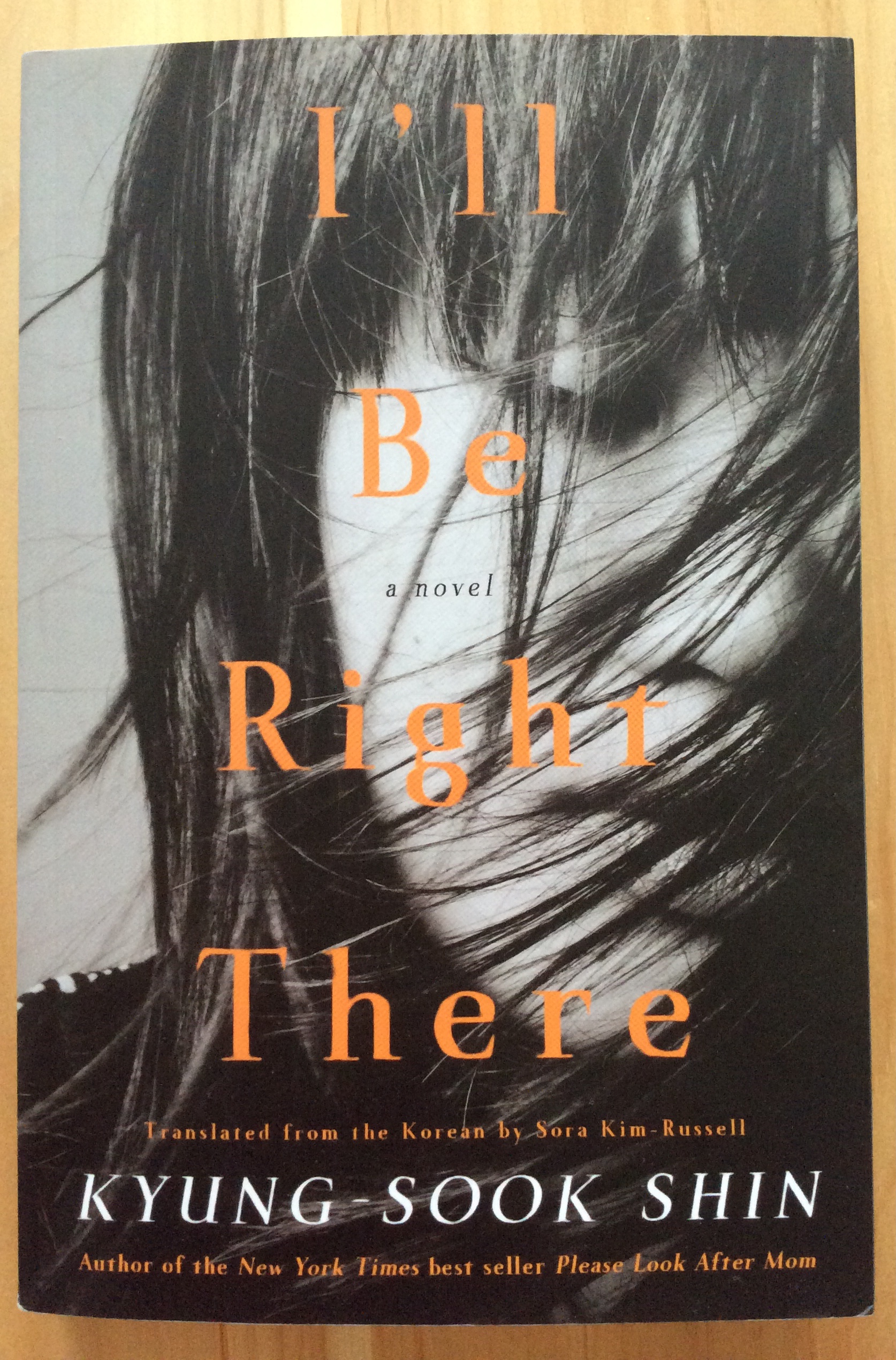
Recommended Reading: I’ll Be Right There, by Kyung-sook Shin

photo (88)I’ll Be Right There* is a gem of a novel, a quiet, masterful rendering of the emotional life of a young woman looking back on the formative years of her early twenties. Ms. Shin is one of South Korea’s most popular writers, and I’ll Be Right There is her second book translated into English (the first was the bestseller Please Look After Mom); Sora Kim-Russel’s deft translation flows smoothly and carefully through its pages.

Jung Yoon recalls the period that began with the illness and death of her mother, when Yoon attempts to navigate life on her own, university courses, friendships new and old, first love, and escalating political turmoil. Though the novel is loosely set in the late 1980s and early 1990s, Ms. Shin makes clear in her author’s note that she deliberately did not assign specific dates to the work:

[. . . ] I believe that what happens to the characters in I’ll Be Right There is in no way limited to South Korea. Everything that happens in this novel could happen in any country and in any generation. I believe that no matter how rough the world becomes, there will always be teachers and students learning from each other, and even when savage and violent powers obstruct our freedoms, there will always be earnest and heartfelt first loves and friendships being born. While writing, I was focused on and absorbed in giving expression to those moments. I believe those are the moments that define our lives. We may be the protagonists of tragedy, but we are also the heroes of our most beautiful and thrilling experiences. (324)

I loved Yoon’s thoughtful, melancholy voice from the beginning of the novel, and her three friends — Miru, lost without her absent sister; Myungsah, wavering between protest and study, and Yoon’s first love; and Dahn, Yoon’s childhood friend who abandons art for the army — are beautifully delineated through Yoon’s memories, as well as letters and diary entries.

A show-stopping passage in which Yoon’s favorite professor tells a version of the St. Christopher tale, about fifty pages into the novel, makes I’ll Be Right There a must-read; it resonates through the rest of the novel, to the very end. Like the professor’s story, I’ll Be Right There is about how we manage adversity and grief in all its forms. Delicately conveyed and beautifully human, it’s highly recommended reading.

*I received a copy of this book from the publisher in exchange for an honest review.

Recommended Reading: An Untamed State, by Roxane Gay

Critics have been calling Roxane Gay’s An Untamed State* “breathless” and “gripping” and “harrowing.” They’re right.

Tom Perrotta sums it up best: “An Untamed State is a harrowing, suspenseful novel about the connections between sexual violence and political rage, narrated in a voice at once traumatized and eerily controlled. Roxane Gay is a remarkable writer, an astute observer of Haitian society and a deeply sympathetic, unflinching chronicler of the compromises people make in order to survive under the most extreme conditions.”

Here’s the summary from the publisher:

Mireille Duval Jameson is living a fairy tale. The strong-willed youngest daughter of one of Haiti’s richest sons, she has an adoring husband, a precocious infant son, by all appearances a perfect life. The fairy tale ends one day when Mireille is kidnapped in broad daylight by a gang of heavily armed men, in front of her father’s Port au Prince estate. Held captive by a man who calls himself The Commander, Mireille waits for her father to pay her ransom. As it becomes clear her father intends to resist the kidnappers, Mireille must endure the torments of a man who resents everything she represents.

An Untamed State is a novel of privilege in the face of crushing poverty, and of the lawless anger that corrupt governments produce. It is the story of a willful woman attempting to find her way back to the person she once was, and of how redemption is found in the most unexpected of places.

I’m having a difficult time writing about the novel, which is unsurprising since I’m pretty sure that my usually low blood pressure was elevated to unhealthy levels while I was reading it. On every level –plotting, pacing, dialogue, characterization — the novel is pitch perfect. The subject matter simply makes it extraordinary difficult to read. An Untamed State is photo (87)an important book, because it lays bare the traumas —  emotional, sexual, racial, economic — that we don’t like to think about because of their painful nature.

One of my favorite people once asked me why I (sometimes) read fiction that’s so dark, that imagines such terrible things — isn’t there enough violence and sorrow in the world already? The news — no matter where you live — seems always to be showing us some new predator, some new house of horrors. No hometown is safe, not mine and not yours. People are ferocious creatures.

It’s a valid question, and I’ve struggled to find the right answer. I don’t read horror (rest easy, I’m not talking about Stephen King) or watch torture-porn (Saw, etc.) because I take no pleasure in being frightened, in watching the pain of others; it seems to me that no-one is served by that kind of violence. And I cannot watch those police procedurals that show only the aftermath of violence. I believe the creators of these shows have good intentions: to try to offer even a small measure of justice for victims and to draw attention to the impact and extent of sexual violence, but these shows never tell the full story.

But books like An Untamed State, Louise Erdich’s The Round House, and Evie Wyld’s All the Birds, Singing (and there are many more) give voice to victims and survivors of violence, particularly sexual violence, which has been so deeply stigmatized for so very long. We cannot expect real-life survivors to relive or retell their experiences for us — though we should be very, very grateful when they do — and so fiction offers us a way to empathize with survivors without infringing on their privacy. Fiction gives us access to thoughts and emotions with nuance and depth that can’t be conveyed on a screen; books contain enough pages to tell what comes after, and what came before.

Rory, in her review of Cynthia Bond’s Ruby (another difficult-but-necessary novel), pointed to an essay by Ms. Bond in which she discussed her own experience (scroll down to find the essay), and these words have stayed with me every since: “Somewhere along the way, working with at risk and homeless youth in Los Angeles for 15 years, living with my own abuse, and hearing stories of such pain and torment, I thought—If you can bear to have lived it, I can at least bear to listen.”

Exactly. I read An Untamed State because somewhere out there, someone has lived it. And I can at least bear to listen.

* I received a copy of this book from the publisher in exchange for an honest review.


RAINN (Rape, Abuse, and Incest National Network): https://www.rainn.org/get-involved

National Violence Against Women Research Prevention Center: https://www.musc.edu/vawprevention/

What Men Can Do to Stop Violence Against Women: http://www.stsm.org/sexual-assault-and-abuse/what-men-can-do-stop-violence-against-women


An Interview with Alexi Zentner, Author of The Lobster Kings

On Monday, I reviewed Mr. Zentner’s new novel, The Lobster Kings. Mr. Zentner graciously agreed to be interviewed via email. 

How would you describe the inception of The Lobster Kings? What was the writing process like?

Alexi Zentner  Author Photo (c) Laurie Willick

Alexi Zentner
Author Photo (c) Laurie Willick

AZ: The day after I sold my first novel, Touch, in 2009, I drove out to Wyoming to spend a month at a writing residency, and that’s where I started writing The Lobster Kings. I’d been planning the novel for a while, however. I tend to brood on a story for months or years, until I’m ready to write it, but starting it in rural Wyoming was a bit odd, because so much of the inception of the novel came from the landscape down east. I was struck by the rugged beauty of the coast, and wanted to, at least partially, capture that. But a lot of the struggle of writing the book came from understanding who Cordelia was and capturing her voice, and once I had that a lot of the rest of the book followed.

The novel is inspired by King Lear, and in it myth and realism are tangled together. Did other contemporary retellings of folktales and fairy stories inform your writing? Do you have any favorite contemporary adaptations of Shakespeare?

AZThe Lobster Kings mixes common myths, like that of the selkie, with myths that are particular to Loosewood Island, where the novel is set, and while I used King Lear as a jumping off point, the novel is very much its own thing. It’s a riff on Lear rather than a retelling; I was more interested in the question of what does it mean for Cordelia to inherit the island than the question of what it means for the father to give it away. I’m fascinated by the way that certain aspects of folktales and fairy stories get tangled up in contemporary stories, and I’m more preoccupied with how to move those stories forward than how to retell them. And there are so many contemporary versions of Shakespearean plays – we see them in the movies, television, books. The Disney movie, The Lion King, is a version of Hamlet, and the television show, House of Cards, borrows from Macbeth.

Did you conduct research for The Lobster Kings? If so, how did you go about it?

photo (5)AZ: My goal as a fiction writer is to do as little research as possible. What I mean by that, is that I need to do enough research to make it feel real, without doing so much research that I end up writing some sort of a book report. I spent a fair amount of time in the area, talked to lobstermen, and did my research. But part of the reason I set it on Loosewood Island, which is fictional, is that I wasn’t trying to hold up a mirror to the life of a lobsterman. Fiction isn’t about the facts so much as it is about the truth, and I wanted to give a person, a family, an island, that felt real, and to do that, I had to base it in the truth but also imagine it fully.

The Lobster Kings is set about ten years ago; why did you choose a setting in the recent past?

AZ: I’m a big believer in the idea that it is easier to see where you were more clearly than where you are. I wanted to write a contemporary novel, one that deals with the questions we are dealing with now, but setting it just a few years ago – it’s set in 2005, and it was 2009 when I started writing it – gave me enough distance that I was able to capture some of the larger questions of the novel. I think if I’d set it right now, I would have missed some of those things. We often realize only later what was the important issue of the day.

The novel tackles weighty subjects — the pull of history (personal and otherwise), sibling rivalry, the incursion of meth into vulnerable communities, attitudes toward aging and work, just to name a few — but does so with a kick of humor. How did you find that balance?

AZ: So much of the humor comes from Cordelia herself. She’s tough and determined and can hold her own, but she’s also her father’s daughter, and her father – as traditional as he was in so many ways – was a bit of an odd duck. I think, for Cordelia, who is a woman in a job that has traditionally been a man’s, she’s had to have a slightly different way of looking at things. She’s the engine that drives the story, and though a lot of tough things happen, she’s not the kind of person for whom that can dampen things.

What kinds of projects are you working on now?

AZ:  I’m working on a story collection and a pair of novels. One of the novels is probably more in the literary vein, while the other is, I think, more toward the mainstream. The mainstream one is pretty scary. But it’s fun.

My thanks again to Mr. Zentner for his time and thoughtful answers. You can read more about The Lobster Kings and Alexi Zentner’s work at alexizentner.com


Isaac Rosenberg’s “Break of Day in the Trenches”

One of the undeservedly under-read poets of World War I is Isaac Rosenberg. Like Wilfred Owen, Rosenberg died in 1918, and so the promise of his poetry was cut short along with his life. The many contradictions in his work are perhaps best summarized in a paragraph from The Poetry Foundation’s brief biography:

Isaac Rosenberg may be remembered as a Jewish-English poet, or a poet of war, but his poetry stretches beyond those narrow categories. Since Rosenberg was only twenty-eight when he died, most critics have tended to treat his corpus as a promising but flawed start, and they wonder if he would have become a great poet had he lived. Rosenberg’s status as an English poet is thus still debated: he was a Jewish poet, he was an English poet; he was a war poet, he was a painter-poet; he was a young poet; he was a great poet and a minor poet. In his brief career, Rosenberg created a small selection of poems and a great many questions.

Self-portrait in a Pink Tie, 1914 Isaac Rosenberg Source: Imperial War Museum, via Wikimedia Commons

Self-portrait in a Pink Tie, 1914
Isaac Rosenberg
Source: Imperial War Museum, via Wikimedia Commons

“Break of Day in the Trenches” is, I think, a masterful poem, and the poem of Rosenberg’s featured today; his other poems aren’t to be missed, though. For example, his bleak humor breaks loose in “Louse Hunting,” and “Dead Man’s Dump” is sheer visceral horror in a poem.

Rosenberg’s speaker/soldier in “Break of Day in the Trenches” is a man who’s in the thick of war, watching the darkness “crumble” into dawn — a dangerous time favored for “going over the top” to attack enemy trenches. The only sign of life in the trenches, besides our speaker, is the “queer sardonic rat” who grazes his hand as he reaches for a poppy on the parapet. In the nightmare world of war, it’s only the rat who can afford “cosmopolitan sympathies” — moving freely (and feeding well) on both sides of no man’s land. The speaker addresses the rat bitterly:

It seems you inwardly grin as you pass
Strong eyes, fine limbs, haughty athletes,
Less chanced than you for life,
Bonds to the whims of murder,
Sprawled in the bowels of the earth,

The torn fields of France.

He wonders what the rat sees in the soldiers’ eyes as the mortars and shells fall from the sky, these soldiers who resemble the carefree youths of prewar poetry, or the boys marching in propaganda posters. As if turning from an answer he doesn’t want to hear, the speaker readjusts his focus in the poem’s final lines:

Poppies whose roots are in man’s veins
Drop, and are ever dropping;
But mine in my ear is safe—

Just a little white with the dust.

Poppies, associated with sleep and death, are the symbol of this war in particular; people in the UK, Canada, Australia, and New Zealand still wear the poppy on Armistice Day, or Remembrance Day as it’s known there, or Veterans Day, as it’s known here (the stars of Harry Potter attended at least one premiere with the red-orange flowers pinned to their clothes), and sometimes for the days in November leading up to the 11th.  You’ll notice here in the United States that around patriotic holidays the VFW hands out “Buddy” poppies in thanks for contributions to its veterans’ assistance programs.

In Europe during the Great War, the red poppy was a weed that grew over battlefields, no man’s land, and near the trenches. In Rosenberg’s poem, these poppies grow out the blood of killed men, perhaps men the speaker has watched die. Like the men, the poppies “Drop, and are ever dropping” — except for the one the speaker has tucked behind his ear, in small act of defiance toward the death that surrounds him. It’s not an uncomplicated gesture; the poppy, plucked, will die, and the dust suggests the inevitable end of humankind: “for dust thou art, and unto dust shalt thou return.”

Recommended Reading: The Lobster Kings, by Alexi Zentner

photo (5)Cordelia Kings was born into royalty — lobstering royalty, that is. Her father, Woody, is the most respected lobsterman on Loosewood Island, a small community on land claimed by both Canada and the United States. The Kings trace their family history all the way back to Brumfitt Kings, a painter who was the island’s first settler, and it’s a history in which the sea’s bounty goes hand-in-hand with a curse: the death of the first-born son in each generation.

Unlike her two sisters, Cordelia loves lobstering from the moment she sets foot on a boat, and considers herself her father’s rightful heir, in more ways than one. But as Cordelia grows up, Loosewood Island changes too. Threats both within and outside the community surface: people on the island are selling meth, and fisherman from a nearby town are making a power play for Loosewood’s waters.  Cordelia has her own problems, too: a married sternman she can’t help falling for, sisters whose proximity makes tensions rise, and a father she adores who isn’t getting any younger.

As you might have guessed, Alexi Zentner’s The Lobster Kings* was inspired by King Lear, but is not a retelling in the vein of, say, Jane Smiley’s A Thousand Acres. Like Lear, however, The Lobster Kings is a family drama with repercussions outside the family unit, and as you can imagine, since Loosewood Island is off the coast of northern Maine, you’re in for a hell of a storm.

Woody Kings may be a patriarch with three daughters, but he’s a cautious man (generally), and a loving father to all his children; his concern for his daughters’ welfare and theirs for him makes The Lobster Kings one of my new favorite father-daughter books. If Woody’s ever mad, it’s with the kind of madness that could overtake any of us in the throes of grief.  He’s feared by his enemies, and very well respected by his fellow lobstermen:

He was the king of the harbor, and his grandfather before, and there would come a day, probably, when I’d take over. We made decisions as a group–to shorten the season, to fish less traps, to stop letting cruise ships dock in the harbor–but anytime we made a decision, big or small, there was always a moment when every man would look to Daddy to see if he agreed. (111)

Cordelia’s love for her father is built on a foundation of respect. Lobstering is immensely difficult work, and after reading this novel, you’ll never look at your lobster roll the same way. Take ropes: “Warp scatters everywhere. Good lobstermen will keep their warps organized, lines coiled and out of the way, where they need to be, and so will the bad lobsterman. Highliners and dubs alike, they keep the ropes neat. The only lobstermen who don’t keep their ropes neat are dead ones” (47).

This kind of realism and awareness of danger permeates The Lobster Kings, even as Cordelia relates present events to analogues in the island’s semi-mythic past. Her narration is interspersed with accounts of Brumfitt Kings’s paintings and the stories behind them. In Cordelia’s view, “Brumfitt was just trying to capture the sea and its power and how little control we have over it. He was just trying to capture the darkness” (161). With lovely, evocative language, Mr. Zentner brings these paintings to brilliant life; you can almost see them hanging in the MFA. Here’s one of my favorite descriptions:

My favorite picture of Brumfitt’s wife is probably Marriage Bed. It’s dated from the first year of their marriage. Brumfitt’s wife’s hair is splayed down her naked back, the sheets billowing and creased around her lower body, leaving an amorphous shape below her waist that Daddy thinks looks like a mermaid’s tail. I’m not sure that I agree with Daddy, but there is something else in the picture that makes me think of the selkie myth instead; pushed partially under the table is a stool, and on the stool is what appears to be a coat made of sealskin. Maybe Brumfitt stole her skin, but loved her enough to offer it back. And maybe she loved him enough that she didn’t take it up, loved him enough that she refused the gift of her skin returned, loved him enough that she let him keep her skin, let him keep her bound to Loosewood Island, to Brumfitt Kings. (217)

It’s this kind of painting — in the nebulous space between the feel-good seascapes that grace dentists’ walls and threatening pieces beloved by art critics (Loosewood Island’s second major industry is tourism) — that draws in both Cordelia and her father. This blending of the real and the perhaps-real, the mythic, in swirls of artful description, is what will draw readers into The Lobster Kings.

*I received a copy of this book from the publisher in exchange for an honest review.

Wednesday: An interview with Alexi Zentner, author of The Lobster Kings.

Writer to Watch: Anne Leonard

Recently, I had the unusual experience of reading a book that didn’t really work for me as a whole, but that also ensured I’ll read the author’s next book.

photo (86)The author is Anne Leonard, and the book is Moth and Spark*.  Here’s the summary from Ms. Leonard’s website:

For three years, Prince Corin of Caithen has been waiting nervously for the Sarian army in the east to invade his kingdom. Now it is finally happening. But there are gaps in his memory and blank spots in his mind, his father is keeping secrets, and the Emperor’s dragons appear to be spying. The Empire which should protect Caithen may even be allied with the Sarians. If all that weren’t enough, the pressure is on for him to get married.

While Corin faces a world gone awry, Tam, the commoner daughter of a respected doctor, arrives at court as the guest of her sister-in-law. It is the season for making matches, but Tam has not come husband-hunting; she is insatiably curious about the court instead. Trying to control her impertinent attitude seems like enough of a challenge – until she begins having visions.

Chance leads Tam and Corin into meeting, and Tam is swiftly pulled into Corin’s life of war and politics. While they are falling into forbidden love, they learn there is another player in the war: the dragons themselves. Seeking to break free of their slavery, the dragons intend to use Corin and Tam as their tools. And the dragons demand whatever it takes, without regard for love or life or loyalty.

When I picked up the book, I had just finished Roxane Gay’s An Untamed State (review coming next week), and I needed a bit of a breather. I was expecting a literary-but-light read with plenty of escapism (see: dragons).  Moth and Spark confounded those expectations, since it is, at heart, a novel about court intrigue, through the lens of an accelerated Elizabeth Bennet/Mr. Darcy relationship. Yes, there were a few dragons, but not as many as you’d think, given the description of the book. The long middle section, which takes place at court, is quite tense.

Essentially, there’s so much going that the action sometimes felt truncated, and opportunities to elaborate on the culture, customs, and history of the world Ms. Leonard created simply passed by. Much as I love a standalone book, particularly in SF/F, I think Moth and Spark could have been and perhaps should have been three books: one that followed Tam and Corin in parallel, ending with their meeting; one about the intrigues at court and in the capital city; and one in the world at war.

It’s this sense of missed richness that makes me think Anne Leonard is a writer to watch. The Tam/Corin relationship is drawn from Jane Austen, as Ms. Leonard takes care to point out (though, for my taste, Tam is so perfect that she’s often annoying; “impertinence” is not something a character needs to overcome). The court politics and factions had some Dune-like overtones. The setting was a nice mix of the medieval and Victorian periods, with a few Gothic touches. The fantasy elements of the novel owe debts to Anne McCaffrey’s Dragonriders of Pern series, Greek mythology, and Tolkien (just a bit). It’s an unusual writer who can draw so many disparate threads together, and that’s why I’m looking forward to Anne Leonard’s next book.

*I received a review copy of this book from the publisher in exchange for an honest review.

Recommended Reading: All That Is Solid Melts into Air, by Darragh McKeon

photo (85)Darragh McKeon’s debut novel, as both an account of the Chernobyl disaster’s human toll and a portrait of Soviet Russia’s collapse, concerns itself with decay. As the familiar falls away, what’s concealed beneath is difficult to confront.

All That Is Solid Melts into Air* follows four characters. First, we meet Yevgeni, a nine-year-old piano prodigy mercilessly bullied by his peers. Yevgeni’s fingers are forced to hover over the keyboard — the family can’t afford a piano — in the tiny Moscow apartment he shares with his mother and aunt, because the neighbors can’t stand the “noise.”

His aunt, Maria, was once a writer who clandestinely circulated news of Poland’s Solidarity movement; revealed as a dissident, she now works at a factory, making car parts and wondering if all hope for reform is lost. She is wholly devoted to Yevgeni and loves her sister dearly, though the two struggle with tension stemming from their deceased father’s awful past.

Maria’s estranged husband, Grigory, is one of Moscow’s most promising surgeons when he’s called away on an urgent — and secret — matter: to advise the Soviet officials presiding over the Chernobyl disaster.  Outraged by the combination of blindness and cowardice he finds, Grigory attempts to protect refugees and residents of areas near the accident site, only to find himself swiftly deprived of authority. Instead of returning to Moscow, he stays in the displacement camps, operating on children who’ve suddenly developed thyroid cancer and witnessing firsthand the devastation radiation inflicts on the human body.

One of Grigory’s patients is Artyom, a teenage peasant who’s the first in his village to notice that something is terribly wrong: the cows are bleeding from their ears. It’s only the beginning of a hellish journey for Artyom, his parents, and his sister. Betrayed by the Soviet system, counted as expendables, the family is one of thousands who lose everything. Artyom is the only major character in the story who seems to fade from view — just like the people whose stories his is drawn from.

Mr. McKeon’s prose is careful, eschewing the sensational in favor of measured, occasionally lyrical depictions of everyday life in Moscow and Artyom’s village near the Chernobyl plant. The plight of people affected by the disaster, crushed under weight of Soviet indifference and forced invisibility runs parallel to the plight of ordinary citizens of Moscow, miles away, just as crushed by a system that breathes fear and breeds violence.

Only three years from the fall of the Berlin Wall, even would-be dissidents are more than cautious. Maria tells a friend, “Sometimes I hear these words, ‘glasnost,’ ‘perestroika,’ and they sound to me like the final breaths of an empire” — only to hear her friend remind her of dashed hopes thirty years before: “So we went back to doing what we do so well: watching, deluding ourselves with fragile hopes, with an occasional moment of grace or luck; holding on to these things as omens. Hoping ourselves into inaction. Perhaps in a year we’ll be shot for daring to tell a stupid chicken-farmer joke” (255).

Ultimately, All That Is Solid Melts into Air is Grigory’s story. He’s the hub of the novel’s spoking plotlines, intimately involved in the tragic aftermath of Chernobyl. Like Maria in Moscow, who lives in drudgery to help her nephew escape the same fate, Grigory finds in Artyom a child who helps him keep his hold on hope. He drifts, doing all the good in his power even though he knows it will never, ever be enough:

During these nights, he gazes at them in their cots. Nothing so unimaginable that it cannot be true, this is what he things, beauty and ugliness resting within the single body of a diseased infant, the two faces of nature brought into stark relief.

No officials have made their way here, despite his daily entreaties. He wants them to walk into this room, a place where ideology, political systems, hierarchy, dogma, are relegated to mere words, belonging to files, banished to some dusty office. There is no system of belief that can account for this. The medical staff know that, in comparison, nothing that has gone before in their lives has any significance. There are only these months, these rooms, these people. (198)

Decay is inevitable, surely. All That is Solid Melts into Air offers the consolations of memory and witness.

Coming Soon: An Interview with Darragh McKeon, author of All That Is Solid Melts into Air

* I received a review copy of this book from the publisher in exchange for an honest review.

Wilfred Owen, Rupert Brooke, and The Great War

As most of you know, this year marks the centenary of World War I. Although the war did not officially begin until the end of July 1914, its precipitating event — the assassination of Archduke Franz Ferdinand of Austria in Sarajevo — took place on June 28, 1914. To mark the centenary, this June, and for the rest of the summer, I’ll be writing from time to time about the literature of the Great War, since it’s a special interest of mine.

This month, weekly poetry posts will feature poetry of the First World War, and so you’ll notice that the Poetry Concierge will take a brief hiatus, appearing sometimes on Fridays before picking back up in July.

photo (84)Today I’d like to point out two of the war’s most famous poems, Rupert Brooke’s “The Solider” and Wilfred Owen’s “Dulce et Decorum Est.” I am neither the first nor the last to place the two poems side-by-side, but it’s an instructive experience, I think.

Both Brooke and Owen were British soldiers, and both were writing poetry before the war began. Both died during the war. Brooke died in 1915 of an infection following a mosquito bite, before experiencing the horrors of trench warfare. Owen, on the other hand, experienced the full terrors of life and death in the trenches. He was killed on November 4, 1918, and his mother learned of death on Armistice Day, just one week later.

Brooke was a writer of pleasant, light verse; had he lived, it seems unlikely that his work would have surpassed the popularity of his short sonnet sequence 1914, in which “The Soldier” appears. Like John McCrae’s “In Flanders Fields,” the poem approaches death with sadness, but concludes that death is noble in the service of patriotism. Here are “The Solider”‘s famous opening lines:

If I should die, think only this of me:
      That there’s some corner of a foreign field
That is for ever England.


“Think only this” — not “think about why I died, and others like me.” Such sentiments, of course — though they capture the  pre-war atmosphere with gracious diction and memorable phrasing — are obliterated by poems like Wilfred Owen’s “Dulce et Decorum Est“. Here are its opening lines:

Bent double, like old beggars under sacks,
Knock-kneed, coughing like hags, we cursed through sludge,
Till on the haunting flares we turned our backs,

And towards our distant rest began to trudge.

The juxtaposition of the verse’s formal components with its brutal content is just one part of Owen’s brilliance. The poem describes a gas attack; the speaker is haunted by the vision of the man who couldn’t get his mask on in time. Initially, the speaker is distanced from the dying man thanks to his own gas mask: “Dim through the misty panes and thick green light, / As under a green sea, I saw him drowning.” Then, an incredibly well-placed stanza break, and a switch from the past to to the present tense to bring the sense of immediacy, already created by the detailed language, home: “In all my dreams before my helpless sight, / He plunges at me, guttering, choking, drowning.” Drowning without water.

The poem deserves to be read in its entirety, but if you’re squeezed for time, here are its blazing final lines, addressed to the audience — Brooke’s audience — that hasn’t seen war firsthand:

If you could hear, at every jolt, the blood
Come gargling from the froth-corrupted lungs,
Obscene as cancer, bitter as the cud
Of vile, incurable sores on innocent tongues,—
My friend, you would not tell with such high zest
To children ardent for some desperate glory,
The old Lie: Dulce et decorum est

Pro patria mori.

For those of you who cut Latin class from time to time: Dulce et decorum est pro patria mori, drawn from one of Horace’s odes, means “How sweet and honorable it is to die for one’s country.”

Literary Wives: The Crane Wife, by Patrick Ness

literarywives2If you’re new to Literary Wives, here’s the summary: we’re an online bookclub of five to six book bloggers, and we post every other month about a different book with the word “wife” in the title. When we read these books, we have two questions in mind:

1. What does this book say about wives or the experience of being a wife?

2. In what way does this woman define “wife”—or in what way is she defined by “wife”?

This month, we’re talking about Patrick Ness’s latest novel, The Crane Wife*.  We invite you to join the discussion by commenting on our blogs (links below) or posting your own review on our shiny new Facebook page.

We also hope you’ll join us next time, on Monday, August 4, when we’ll be discussing Carol Ann Duffy’s The World’s Wife (poetry! hooray!).


photo (83)I’ve had my eye on The Crane Wife for a few months. I like novels that bend myths and folklore in new ways, and Patrick Ness has been the recipient of all kinds of praise. And isn’t the cover just gorgeous?

Here’s the summary from the publisher:

George Duncan is an American living and working in London. At forty-eight, he owns a small print shop, is divorced, and is lonelier than he realizes. All of the women with whom he has relationships eventually leave him for being too nice. But one night he is waked by an astonishing sound—a terrific keening, which is coming from somewhere in his garden. When he investigates he finds a great white crane, a bird taller than himself. It has been shot through the wing with an arrow. Moved more than he can say, George struggles to take out the arrow from the bird’s wing, saving its life before it flies away into the night sky.

The next morning, a shaken George tries to go about his daily life, retreating to the back of his store and making cuttings from discarded books—a harmless personal hobby—when a woman walks through the front door of the shop. Her name is Kumiko, and she asks George to help her with her own artwork. George is dumbstruck by her beauty and her enigmatic nature and begins to fall desperately in love with her. She seems to hold the potential to change his entire life, if he could only get her to reveal the secret of who she is and why she has brought her artwork to him.

You see where that’s going, right? I think we’re meant to; as we (the readers) read to understand how and why Kumiko and the crane are connected, George busies himself just trying to learn who Kumiko is — she’s evasive, to say the least; the most personal information she’ll share is a mythic story about a crane and a volcano that she’s depicting in a private series of works.

The novel is at its best when it focuses on the everyday lives of its characters. George is a thoughtful, kind man (a real treat to read about, in this day and age), and his daughter, Amanda, was my favorite character. Angry and overworked on both the professional and the domestic fronts, Amanda has trouble fitting in with other women at work, who discount her passionate opinions and remain oblivious to her particular brand of humor. She’s still in love with her ex-husband and delights in their rambunctious son. Like George, like everyone, she’s entranced by Kumiko. I was entranced by Amanda, by her intensity and her awareness and by how much she cares for her family. Throughout the novel, I preferred realism to the hazy sort of philosophy that Kumiko seems to represent.

I have three quibbles with the novel’s style. First, Mr. Ness italicizes words for emphasis, which drove me crazy. (See?) Once I could overlook, but it happens repeatedly. Second, the tone occasionally veers into the maudlin and sentimental, which was distracting. Third, several long sections consist entirely of dialogue (which is fine), with pauses indicated by ellipses in quotation marks. Would it have been so difficult to write, “He paused.”? And how is an ellipsis spoken?

The Crane Wife is a gentle, sometimes sentimental novel with memorable characters. If that’s your kind of book, I think you’ll like it.


And now, on to the Literary Wives questions:

1. What does this book say about wives or the experience of being a wife?

Despite the title, neither of the main female characters — Kumiko and Amanda — are properly wives. George’s ex-wife is refreshingly non-harpy-like, and happily remarried. Amanda’s experience of marriage — what little we see of it — was difficult because of the two personalities involved. There’s no cohesive picture of what it means to be a wife, and that’s just fine.

2. In what way does this woman define “wife”—or in what way is she defined by “wife”?

Again, a difficult question to answer, since, properly, the Crane Wife is a folktale/mythological/fairytale figure, and in this instance she seems to be the crane in Kumiko’s story, who must see the world for what it is, be willing to suffer for love, and ultimately forgive those who hurt her (this is all a bit fuzzy, to tell the truth). I don’t think I like this vision of what it means to be a wife — see feminist credentials, mine — but this is all wrapped up in the “hazy philosophy” I mentioned above, so I will forgo the rant for now.

*I, along with the other Literary Wives bloggers, received a review copy of this novel from the publisher in exchange for an honest review.

Please visit the other Literary Wives bloggers to get their takes on the book! 

Emily at The Bookshelf of Emily J. 

Ariel at One Little Library

Cecilia at Only You

Kay at WhatMeRead

Lynn at Smoke and Mirrors

(Audra at Unabridged Chick is on hiatus)