“philocaly, philomath, sarcophilous—all this love,”: “For you, anthophilous, lover of flowers,” by Reginald Dwayne Betts

Fall trees in Mount Auburn Cemetery

Fall trees in Mount Auburn Cemetery

I love lists. So, apparently, does the rest of the world (see: Buzzfeed), and poets are no exception. Virtuoso lists are a feature of epic poetry, like Homer’s catalogue of ships, or Milton’s list of demons, or my personal favorite, the list of trees in Spenser’s Faerie Queene:

And foorth they passe, with pleasure forward led,
Ioying to heare the birdes sweete harmony,
Which therein shrouded from the tempest dred,
Seemd in their song to scorne the cruell sky.
Much can they prayse the trees so straight and hy,
The sayling Pine, the Cedar proud and tall,
The vine-prop Elme, the Poplar neuer dry,
The builder Oake, sole king of forrests all,
The Aspine good for staues, the Cypresse funerall.

The Laurell, meed of mightie Conquerours
And Poets sage, the Firre that weepeth still,
The Willow worne of forlorne Paramours,
The Eugh obedient to the benders will,
The Birch for shaftes, the Sallow for the mill,
The Mirrhe sweete bleeding in the bitter wound,
The warlike Beech, the Ash for nothing ill,
The fruitfull Oliue, and the Platane round,
The caruer Holme, the Maple seeldom inward sound.

(No, your screen isn’t playing tricks on you; Spenser wrote the Faerie Queene in a deliberately archaic style).

I’ve been thinking about lists and poetry because the Valentine’s Day poem of the day from The Poetry Foundation was Reginald Dwayne Betts’s “For you: anthophilous, lover of flowers,” which I read and immediately fell in love with (well-played, Poetry Foundation). It’s a catalogue of lovers, but not exactly in the sense you expect, and it’s gorgeous.

I wonder: which one are you?

“Why, oh why, the doily?”: Elizabeth Bishop’s “Filling Station”

This weekend, I was reading a very interesting essay on the correspondence between Robert Lowell and Elizabeth Bishop (Austin Allen’s “Their Living Names”), when it struck me that I’ve never featured Elizabeth Bishop on the site.

My high school English classes featured shockingly little poetry; I can remember the novels we read, but the only poems that spring to mind, besides a sonnet or two, are Eliot’s “The Hollow Men,” Langston Hughes’s “Harlem,” Thomas Hardy’s “Channel Firing” (which I’m pretty sure was on a mock-AP test), Cummings’s “anyone lived in a pretty how town” and Elizabeth Bishop’s “Filling Station.”

I remember “Filling Station” in particular because nobody in our class knew that “Esso” was a brand of gasoline (it’s an older name for Exxon-Mobile, still used in countries outside the United States), and so we found that line frustrating as we worked on the poem as a class. Bishop’s “big hirsute begonia” is the first time I remember hearing the word “hirsute,” and I’ve never forgotten it.

The details of the poem serve to highlight absence and presence: the presence of the father and sons and the dog, all dirty and greasy, but seemingly content, and the absence of the figure who put out the wicker furniture, waters the plant, and who embroidered the doily.

I liked the poem in high school, for its leap from first to last line, and as an adult I think I better see the way Bishop points to the kinds of work people do: visible work, like running a filling station, and the quieter, almost invisible work of caring and beautifying. The results of that kind of work are often hiding in plain sight, even if the worker—the “somebody”—is absent.

Two Poems on Poetry

I love reading writers on writing — interviews with authors about how they work, where they work, why they write, and so on. The Guardian has a series on writers’ rooms that I love to pop into now and again; here’s Seamus Heaney’s.

This week I’m reading two very different poems about poetry and writing poetry. Charles Wright is the current United States Poet Laureate; his poem “Reunion” is short, and very personal. He ends the poem with,

I write poems to untie myself, to do penance and disappear
Through the upper right-hand corner of things, to say grace.

Archibald MacLeish’s “Ars Poetica” is a playful, self-contradictory riff on Horace’s famous work of the same name, a set of guidelines for the crafting of poetry. In his rather famous and formulation,

A poem should not mean
But be.

What are your favorite poems about poetry?


Two notes from the poetry world:

Apparently a treasure-trove of lost Neruda poems has been found. (The Guardian)

Charles Simic’s tribute to his friend Mark Strand is wonderful, moving, human. (NYRB)


“in a foyer of evenings”: Joanna Klink’s “Auroras”

It’s been cold—not brutally cold, but cold—in Boston lately, and as often happens in January, I’ve been thinking about summer, and all the things I like about it (I will forget all those things as soon as it is July, 95 degrees, and muggy). Recently, I also learned that there is such a thing as a dark sky park, a place low enough in light pollution to give you a great view of the stars, so now I’m daydreaming about a trip to one of them this summer.

“Auroras,” by Joanna Klink, makes me think of summer and stars. I love its opening lines: “It began in a foyer of evenings / The evenings left traces of glass in the trees.” That’s a wonderful image: the last of the daylight caught in the tree branches while the sky above them turns black.


In other poetry-related news:

Michael Klein’s review of Mark Wunderlich’s The Earth Avails in The Boston Review is excellent.

I thoroughly enjoyed this interview with Susan Howe on The Poetry Foundation’s website. I haven’t read much of her poetry, so if you can recommend the book I should start with, please leave a note!

Recommended Reading: Why Homer Matters, by Adam Nicolson

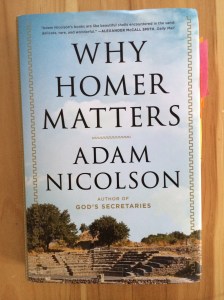
photo 1I wish I’d read this intriguing book before I picked up the Iliad for a re-read last year (lucky for me, I have the Odyssey still to go on my Classics Club list). Adam Nicolson’s Why Homer Matters* (published in the UK as The Mighty Dead: Why Homer Matters) is difficult to classify, genre-wise; it is part travelogue, part literary criticism, part history, part ethnography, part memoir. It’s beautifully written, for Mr. Nicolson deeply cares about his subject and its place in civilization:

This is also a book about epic poetry, and about the value of epic in our lives. Epic is not an act of memory, not merely the account of what people are able to recall, since human memory only lasts three generations [. . .] Nor is it a kind of history, an objective laying out of what occurred in a past to which have little or no access. Epic, which was invented after memory and before history, occupies a third space in the human desire to connect the present to the past: it is an attempt to extend the qualities of memory over the reach of time embraced by history. Epic’s purpose is to make the distant past immediate to us as our own lives, to make the great stories of long ago beautiful and painful now. (3)

The foundational belief of the book is that “Homerity is humanity” (31). Its specific premise is its author’s belief that Homer arises out of a meeting of two cultures: nomadic steppe warriors from north of the Black Sea, and city-based, literate, hierarchical Mediterranean societies. In Mr. Nicolson’s formulation, this clash or melding of worlds occurred around 2000 B.C.; for him, then, Homer’s origins are about a thousand years older than those ascribed to the poems by modern scholarship.

It’s a fascinating idea, but what matters more than its veracity is the way in which Mr. Nicolson illustrates his arguments. His travel has been extensive, and his descriptions of what he sees, at home and abroad, are full of evocative detail. In a bay in Scotland, for instance, “the seawater itself is green with the reflected woods, an ink of molten leaves and boughs” (36).

While I’d say the book leans more toward discussion of the Iliad, Mr. Nicolson, a keen sailor, is just as interested in the Odyssey. Here’s how he describes the relation of the two poems:

The Iliad is soaked in retrospect. The Odyssey, the twin and pair of it, is filled with heroic adventurism and the sense of possibility, as if it were an American poem and the Iliad its European counterpart. [. . .] where the Iliad is a poem about fate and the demands that fate puts on individual lives, the inescapability of death and the past, of each of us being locked inside a set of destinies, the Odyssey, for all its need to return home, consistently toys with the offer of a new place and a new life, a chance to revise what you have been given, for the individual—or at least the great individual—to stand out against fate. (64)

Put another way, “the Homeric condition” is “the Odyssean promise of delight enclosed within the Iliadic certainty of death” (71).

This book is steeped not only in knowledge of the ancient past, but in the more recent literary canon. Take, for example, Mr. Nicolson’s exploration of how the mines in southern Spain might relate to the poem; his description of the “toxic spoil” of the landscape (132) is chilling, filled with images and sounds and tactile effects. It is a portrait of Homer’s Hades:

There is a sense of transgression at Chinflón, a feeling that the this place was once alive and that the miners hacked at its life, as if they were hunting it, digging out its goodness, a form of rough and intemperate grasping, the masculine dragging of value from a subterranean womb. (134)

Consciously or not, I think Mr. Nicolson is channeling the description of another kind of Hell: one that belongs to Mammon and the other demons in Milton’s Paradise Lost:

Mammon led them on,
Mammon, the least erected Spirit that fell
From heav’n, for ev’n in heav’n his looks and thoughts 
Were always downward bent, admiring more
The riches of Heav’ns pavement, trod’n Gold,
Then aught divine or holy else enjoy’d
In vision beatific: by him first
Men also, and by his suggestion taught, 
Ransack’d the Center, and with impious hands
Rifl’d the bowels of their mother Earth
For Treasures better hid. Soon had his crew
Op’nd into the Hill a spacious wound
And dig’d out ribs of Gold. (PL I.678-90, emphasis mine)

It’s this kind of engagement, with both landscape and literature, that makes Why Homer Matters so endlessly interesting.

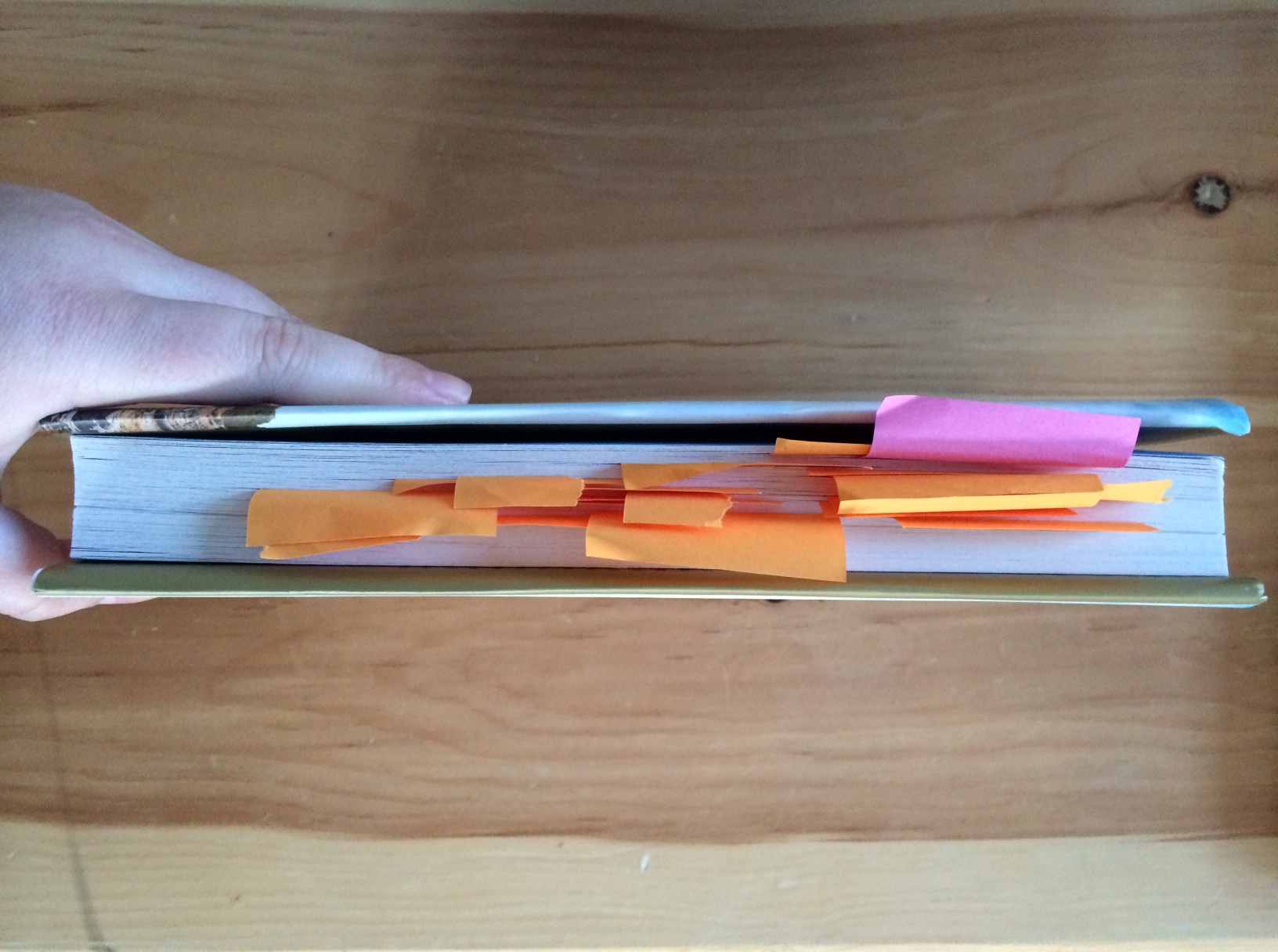
As you can see from the picture below, there were many passages that I found especially fascinating or moving, too many to reproduce here. However, for my reader who finds poetry to be a “difficult concept” (as a Vulcan might find humor), here’s an excellent way to think about poetry, especially epic poetry: “Epic is different from life. The present moment might be seen as a blade, cutting the past from the present, severing now from then, but poetry binds the wounds the that time inflicts” (102).
photo 2

This is a book that wanders, but never rambles; that contends, but refuses to be bogged down in certainty; that is erudite, but not didactic. It’s a book deeply interested in both the concreteness of place and the protean possibilities of language. To turn the pages of Why Homer Matters is to be transported. Highly recommended reading.

*I received a copy of this book from the publisher for review purposes, which did not affect the content of my review.

 

“erasing absence”: Christopher Buckley’s “On the Eiffel Tower”

1909687_520858518315_5793_nAfter the terrible events in Paris last week, I found myself looking for poems about the city, but none of the ones I came across really conveyed everything I wanted them to, which makes sense—how could they when I wanted to much?

In the end, I thought I’d recommend this poem about the Eiffel Tower. Christopher Buckley’s “On the Eiffel Tower” isn’t about crisis, or free speech, or facing the worst among us with all that we can muster of our best. What it is about is the way human minds can fill the sky with something beautiful, a monument of iron lace that’s stood for more than a hundred years of war and peace.

Vive la liberté.

Correction (August 23, 2020): The original version of this post mistakenly conflated Christopher Buckley, poet, with Christopher Buckley, satirist. I regret the error, and thank the reader who brought it to my attention.

“Letters swallow themselves in seconds”: Naomi Shihab Nye’s “Burning the Old Year”

Here’s a poem for the new year by acclaimed (and prolific) poet Naomi Shihab Nye.

It’s called “Burning the Old Year” and I love its mix of quotidian objects (“lists of vegetables”) and the blazing metaphor (papers “sizzle like moth wings / marry the air”). Then there’s the sharp turn to absence, like the strike of a clock, and a blistering finish:

only the things I didn’t do
crackle after the blazing dies.
It’s a neat, complex little poem, and I’d love to hear what you think of it.

“Arbolé, arbolé . . .”

Today’s poetry post is in honor of Joyce Wilson (1924-2014), who studied Spanish and French literature and was a writer herself.

I love this poem, called “Arbolé, arbolé” after its first line, by Federico García Lorca; it’s deceptively simple, almost fable-like in its repetition and use of color. But what is the “grey arm of the wind” around her waist? Does it hold her back? Protect her? Why this girl? As with so many others, I have more questions than answers about this poem.

I hope you’ve all had a wonderful holiday with family, friends, and happy reading.

“free it when they are freed”: Marianne Moore’s “The Paper Nautilus”

photo (2)I had wonderful luck at a bookstore yesterday, finding The Complete Poems of Marianne Moore and Margaret Atwood’s Selected Poems (1965-1975), which is particularly excellent because I already had the companion volume, and wondered if I’d ever come across the first volume in the wild.

Marianne Moore is one of America’s most revered poets, but I am afraid that my knowledge of her work is quite limited, so I’m happy to have the chance to puzzle over some of her very fine poetry. Her images are deep and complex, and her subjects often begin with animals, as in “The Paper Nautilus,” the poem I’m thinking about this week. At first I thought that the animal in question was a variety of nautilus, but the reference to “eight arms” tipped me off that it’s a type of octopus, named after its egg case, which Moore so beautifully describes. That was just the first of many surprises in a poem that turns and undulates like the argonaut underwater.

“The Paper Nautilus” is a fascinating, multi-layered poem that I feel I’m just beginning to get a feel for. I hope you’ll tell me what you think.

Two Poems for Knitting

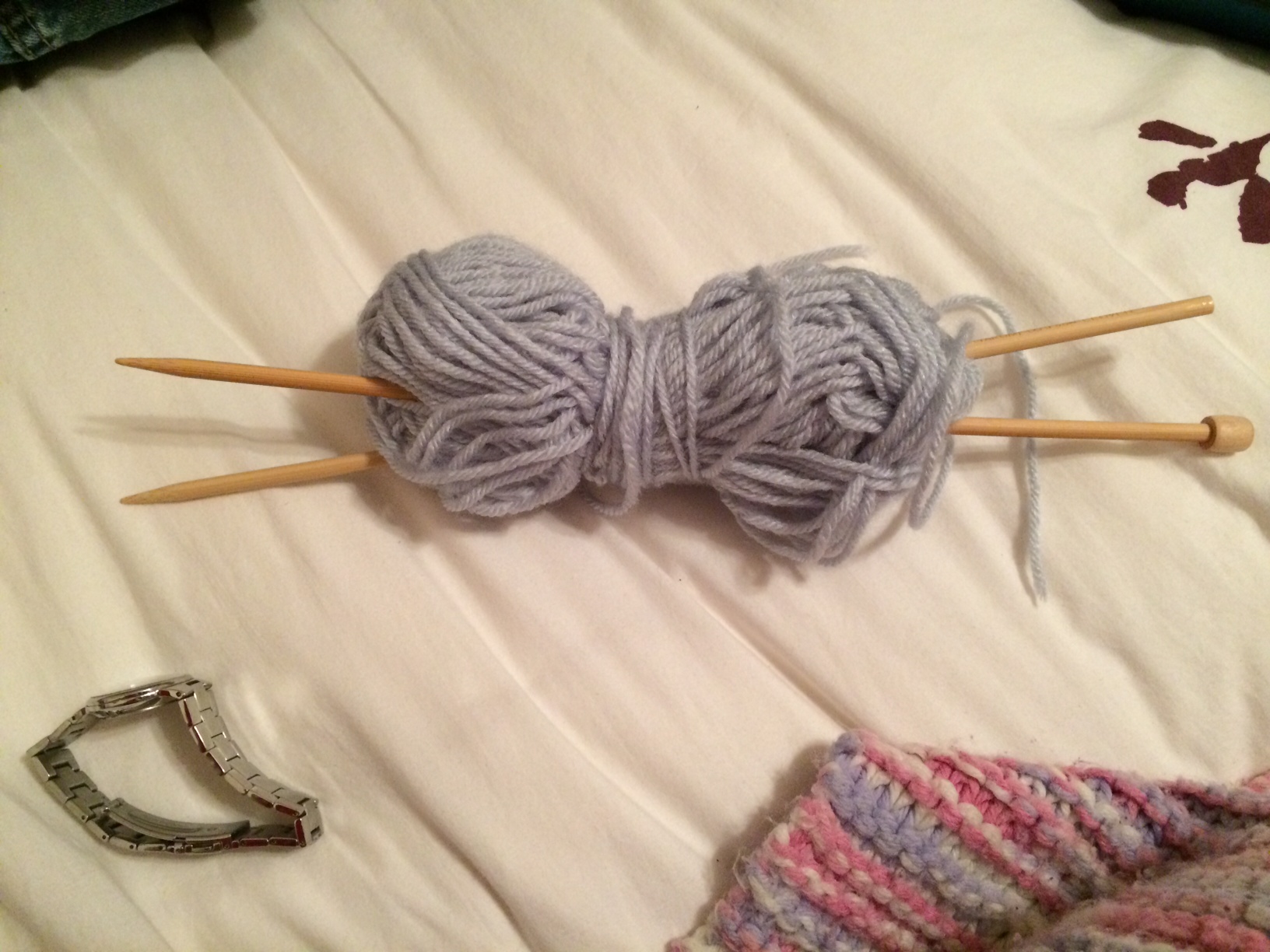
photoIn late November and into December, I often find myself knitting at night, rushing to catch up with projects destined to become Christmas presents.

I am not a very skilled knitter; I can make rectangles (scarves, small blankets) and things that can be made out of rectangles (leg warmers, arm warmers, bags, vastly oversized laptop covers . . . ). I can’t cable, use double-pointed needles, read a pattern, or reliably tell you what a slip-stitch is. Though I was taught by a talented and generous knitter, I am fairly sure that I’m holding the yarn the wrong way.

Still, I love knitting. I like seeing yarn curved and curled into something new and useful (well, mostly useful), and the sense of satisfaction that comes from weaving in the yarn ends on a scarf or a baby blanket. I’m not good enough that I can take my eyes off the work, so I usually knit while listening to a movie or TV show I’ve seen ten times before and chatting with my husband. It’s all very companionable.

Anyway, today I went looking for poems that talk about knitting, and I found a few; here are my two favorites.

The first, Ciarán Carson’s “The Fetch,” is just wickedly cool (that’s a technical term, by the way); it’s about waking, dreaming, loss, the sea, and distance, and features a nice Dickens reference, too. It’s so good I’m putting his book For All We Know on my Christmas wish list.

The second poem links knitting and waves as well. “A simple co-creator, I trust in simple decorum,” says the speaker of Cory Wade’s “Knitting Litany.” An incredibly skilled knitter, the speaker conjures a list of flora and fauna that descend from her needles, and imagines the waves she builds and builds.

Now, who’s going to teach me how to crochet?