The Poetry Concierge Recommends: Rumi

[The Poetry Concierge is an occasional feature here on Rosemary and Reading Glasses wherein I select a poem, poet, or book of poems for individual readers based on a short questionnaire. Come play along! Read the introductory post here, my first recommendation here, and then email me at: rosemaryandreadingglasses [at] gmail [dot] com. ]

This week, our pilgrim in search of poetry is Mark, a friend of some friends, who doesn’t blog.


1. When you read fiction, who’s your go-to author?

E.L. Doctorow, Philip Roth, Isaac Beshevis Singer, Doris Lessing. But I haven’t read much fiction in a long time. If I had the time I’d like to start again.

2. If you read nonfiction, which subjects are most likely to interest you?

I mostly read non-fiction. Buddhist Writings, Vedic Writings, exposes like The Shock Doctrine, Memoirs, Psychology, Myths, Physics/Spirituality

3. If you were stuck on a desert island for a week, which five books would you bring to keep you entertained?

Portnoy’s Complaint, The Sportswriter, Women Who Run With the Wolves, The Beatles, The Dharma Bums.

4. If you were on a five-year mission to Mars, which five books would you bring to keep you sane?

The Science of Yoga (Taimni), a recommended Walt Whitman book, Women Who Run With Wolves, BioCentrism by Robert Lanza, a collection of Isaac Bashevis Singer short stories.

5. What kinds of questions are most likely to keep you up at night?

The meaning of life and how to write my memoirs.

6. If you’ve read poetry before, what have you liked? What have you disliked?

Never really read much poetry. Though I’d like to figure it out someday.


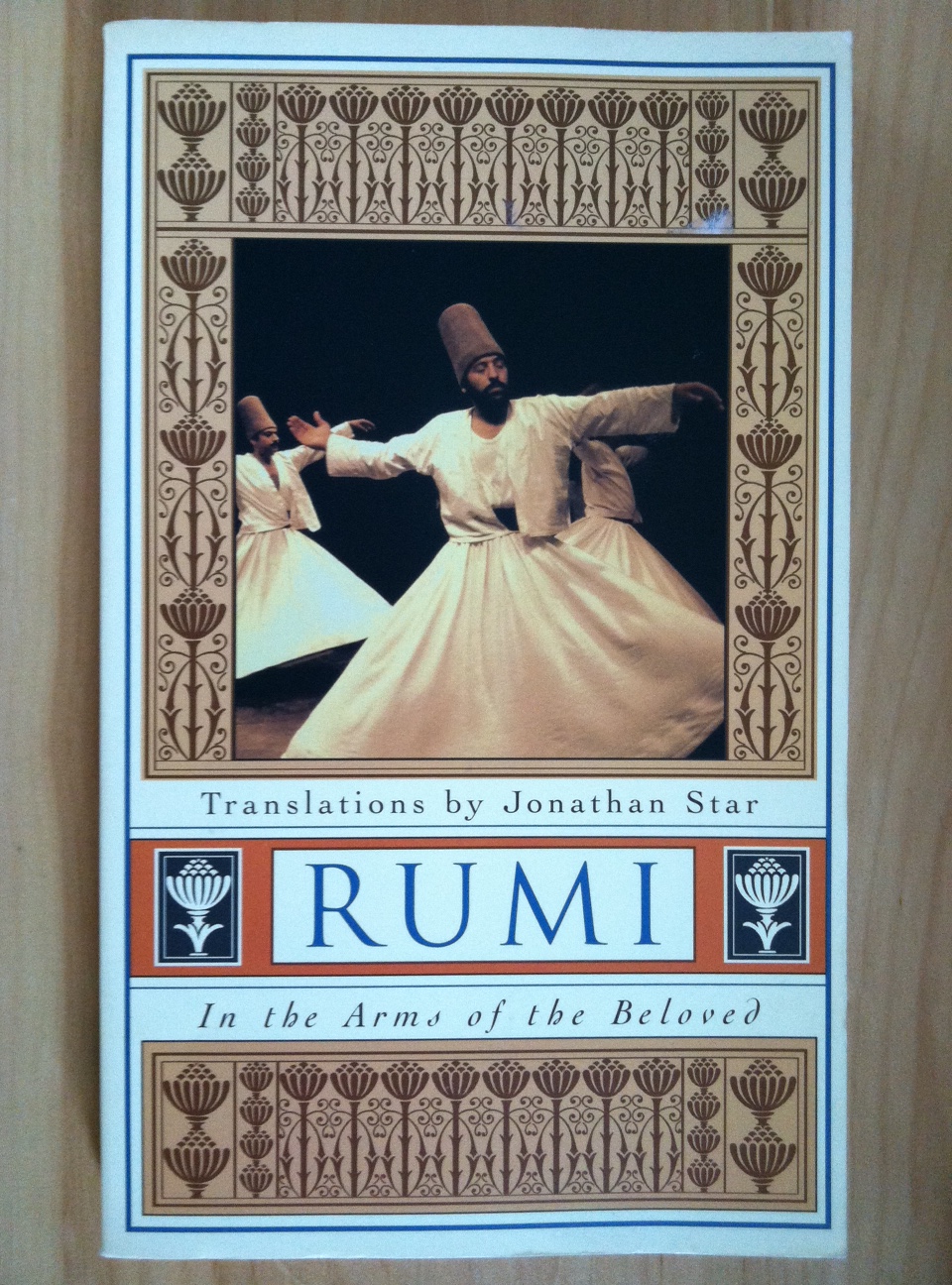
photo (79)Given Mark’s interest in spirituality, myths, and mysticism, I’m recommending the poetry of Jalāl ad-Dīn Muhammad Rūmī, or, as he’s know in the English-speaking world, Rumi.

Rumi was a poet, theologian, and Sufi mystic who lived in the thirteenth century; his work is immensely popular and there are many, many editions of his poems available. I’ve been happy with the one I bought in high school, Rumi: In the Arms of the Beloved, translated by Jonathan Star. The translations are clear, while retaining a sense of mystery, and the book includes a helpful glossary of unfamiliar terms.


Mark, I hope you’ll like reading poetry by Rumi. Thanks for writing in!


Would you like the Poetry Concierge to make a recommendation for you? Check out the introductory post, and send your answers to the questionnaire, along with the name and/or blog you’d like posted with the reply, to rosemaryandreadingglasses [at] gmail [dot] com.

The Poetry Concierge Recommends: Rose, by Li-Young Lee

[The Poetry Concierge is an occasional feature here on Rosemary and Reading Glasses wherein I select a poem, poet, or book of poems for individual readers based on a short questionnaire. Come play along! Read the introductory post here, my first recommendation here, and then email me at: rosemaryandreadingglasses [at] gmail [dot] com. ]

This week, our pilgrim in search of poetry is Cecilia, who writes about life, reading, and parenthood at Only You.


1. When you read fiction, who’s your go-to author?

I have more than one! Junot Diaz, Kazuo Ishiguro, Jhumpa Lahiri, Charlotte Bronte

2. If you read nonfiction, which subjects are most likely to interest you? (cultural history, science, biography, memoir, survival stories?)

memoir, personal essays, history, psychology

3. If you were stuck on a desert island for a week, which five books would you bring to keep you entertained?

This is How You Lose Her (Junot Diaz) and Me Talk Pretty One Day (David Sedaris), for the comfort factor (re-reads by two of my go-to authors); Never Let Me Go (Kazuo Ishiguro) because everyone’s been telling me how amazing this book is; In the Blood by Lisa Unger (I have never read her but this sounded good, as something fast and entertaining); and Teaching My Mother How to Give Birth (Warsan Shire), a book of poetry I haven’t yet read but want to.

4. If you were on a five-year mission to Mars, which five books would you bring to keep you sane?

One comfort book: Me Talk Pretty One Day (David Sedaris) and four books that have been on my to-read list: Middlemarch, either Anna Karenina or The Golden Notebook, Life After Life (Kate Atkinson), and The Mayflower & The Pilgrims’ New World (Nathaniel Philbrick)

5. What kinds of questions are most likely to keep you up at night? (death, the nature of love, politics, environmental issues, meaning of life, end of the world, justice and injustice, etc?)

Closer to home – the meaning/purpose in life, how I’m doing as a parent

The bigger picture – human rights, civil rights

6. If you’ve read poetry before, what have you liked? What have you disliked?

I’d only read an excerpt but I was completely blown away by the writing in Teaching My Mother How to Give Birth by Warsan Shire.

We studied quite a bit of poetry during high school but it was never one of my favorite subjects. I think that my early education in poetry reinforced my fears that poetry is impossible to decipher and difficult to access. A couple of exceptions were Robert Frost and Edgar Allen Poe, whom I did enjoy.


[Sidebar: Never Let Me Go is amazing, and everyone should read it.]

From Cecilia’s list of go-to authors, I got the sense that writing that deals with the immigrant experience is important to her, as well as writing that focuses on the interiority of its characters. One name leapt to mind, and stayed with me as I read the rest of Cecilia’s answers: Li-Young Lee.

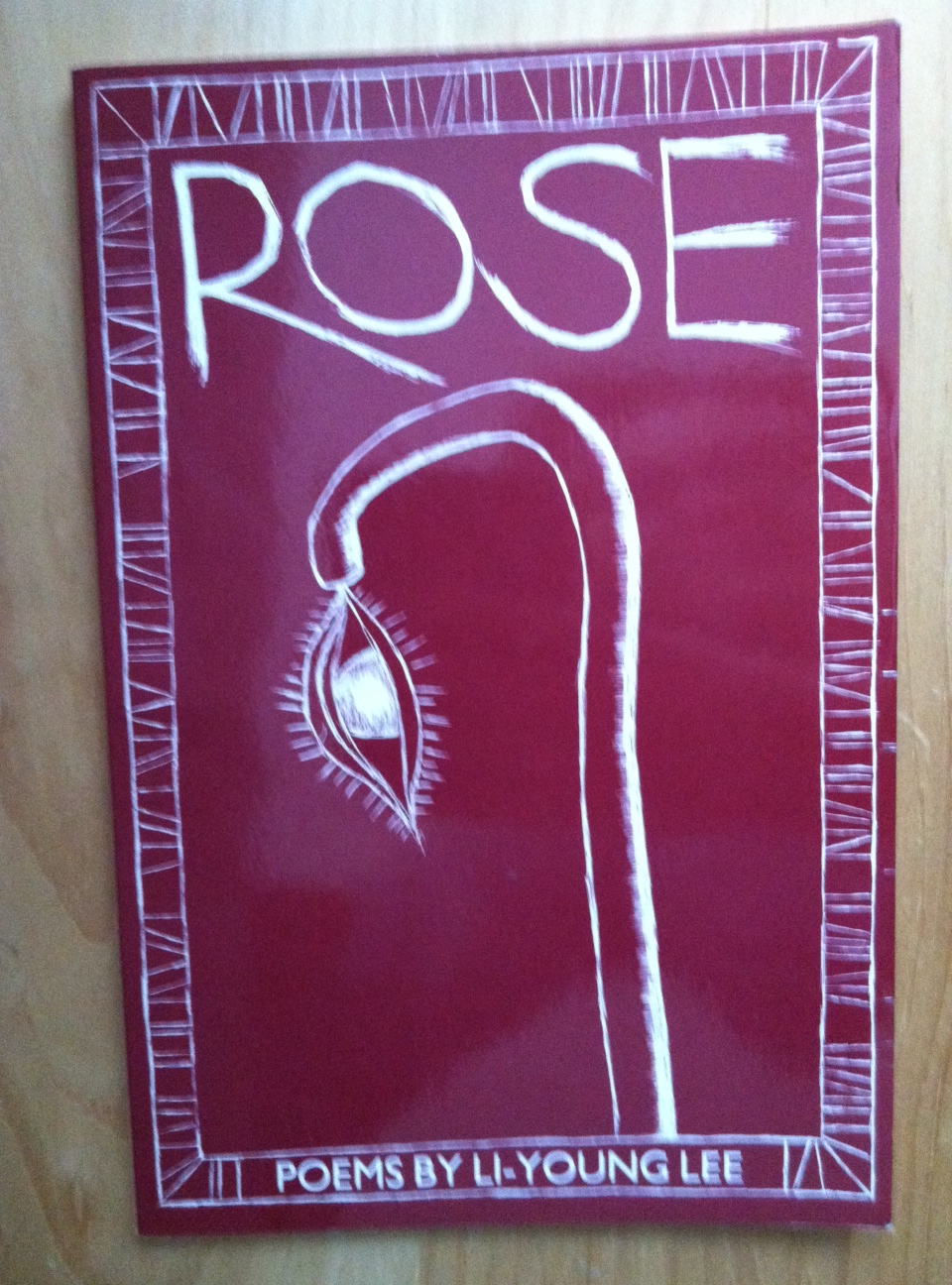
photo (77)Li-Young Lee’s poetry is intensely lyrical and personal. Born in Indonesia to Chinese parents who fled China for political reasons, Mr. Lee came with his family to the United States in 1964. His family (especially his father and his wife) plays a major role in the poetry of Rose, his first collection, which I’m recommending for Cecilia. “The Gift” and “Persimmons” (frequently anthologized) are the second and third poems in the book. In “Persimmons,” the speaker remembers:

In sixth grade Mrs. Walker
slapped the back of my head
and made me stand in the corner
for not knowing the difference
between persimmon and precision

This startling, painful memory forms the foundation of the poet’s exploration of life in two cultures, and how the senses tie us to memory. In fact, because of this poem, I remember the very first time I saw a persimmon in a market, and what it felt like to cut into it at home.

In “The Gift,” the speaker remembers his father pulling a splinter from his hand. It’s one of the most beautiful poems about parents and children that I’ve ever read.
Cecilia, I hope you’ll find poems you love in Rose. Thanks for writing in!


Would you like the Poetry Concierge to make a recommendation for you? Check out the introductory post, and send your answers to the questionnaire, along with the name and/or blog you’d like posted with the reply, to rosemaryandreadingglasses [at] gmail [dot] com.

The Poetry Concierge Recommends: Two Books, This Time Per Request

[The Poetry Concierge is an occasional feature here on Rosemary and Reading Glasses wherein I select a poem, poet, or book of poems for individual readers based on a short questionnaire. Come play along! Read the introductory post here, the first recommendation here, and then email me at: rosemaryandreadingglasses [at] gmail [dot] com.]

This week, our pilgrim in search of poetry is Rick, who blogs about books over at Another Book Blog. Rick went very public with his poetry concierge request (a minor, forgiven insurrection); he further stipulated that he’d like me to recommend two books of poetry, which will become part of his self-re-education program. No pressure or anything.

1. When you read fiction, who’s your go-to author?

I don’t know if I’ve ever had a go-to author, to be honest. I don’t have anyone specific that I turn to when I’m in a reading funk. If anything, my literary achilles heel has always been how easily I get bored with any one thing after a while. However, if there’s anyone who even comes close, it’s Tad Williams. He’s probably my single biggest inspiration, and the author from whom I’ve read the most.

2. If you read nonfiction, which subjects are most likely to interest you? (cultural history, science, biography, memoir, survival stories?)

I really love nonfiction books about people who challenge the status quo. I’m not a big backer of rebellion per se, at least not in any physical way, but intellectual rebellion really appeals to me. I’m fascinated by religion, and science, and historical shifts.

3. If you were stuck on a desert island for a week, which five books would you bring to keep you entertained?

A.J. Jacobs’ The Know-It-All, because it’s basically an encyclopedia in less than 400 pages. Bill Bryson’s A Short History of Nearly Everything, because it’s the best science text for the uninitiated I’ve ever read, and I swear to god it’s funny. Apathy and Other Small Victories, probably the funniest book I’ve ever read. Essex County, my favourite graphic novel of all time, a truly brilliant piece of literature short enough to savour in just a week of exile. And a book of Mad Libs, because ever since I discovered how funny they can be when you think of the most disgusting answers possible, they’ve been one of my favourite things on Earth.

4. If you were on a five-year mission to Mars, which five books would you bring to keep you sane?

I Know This Much is True by Wally Lamb, River of Stars by Guy Gavriel Kay, The Brothers Karamazov by Fyodor Dostoevsky, The Book of Joby by Mark J. Ferrari, and Skippy Dies by Paul Murray. Four of them because they’re four of my favourite single volume stories (and they’re all really long), The Brothers Karamazov because I’ve always wanted to read it, and five years on Mars sounds like I’d finally find the time.

5. What kinds of questions are most likely to keep you up at night? (death, the nature of love, politics, environmental issues, meaning of life, end of the world, justice and injustice, etc?)

I’ve always been a fan of righteous indignation. I’m fascinated by spirituality even though I don’t subscribe to anything in particular. I’m in awe of the universe and all it’s (likely) unanswerable questions. I couldn’t give two s**ts about conversations regarding politics and the environment because there hasn’t been a single one I’ve come across that hasn’t degenerated into smart people sounding like partisan a**holes. [Sorry for the censorship, but my Mom reads this blog, so, you know. –CO]

6. If you’ve read poetry before, what have you liked? What have you disliked?

The one work of poetry that’s actually resonated with me (that’s lasted more than a month is In Memoriam by Lord Alfred Tennyson. I’ve always been awestruck at how thousands of people have been arguing both for and against its Christian/anti-Christian message for hundreds of years. It takes a special kind of rhetorical talent to receive adamant support from both of those groups at the same time. For the record, I think it’s clearly a Christian poem by the end, but Tennyson’s willingness to question his faith has always been the measuring stick to which I hold up all religious persons. Furthermore, it’s just beautifully written and undeniably tragic and heartfelt.

As for what I don’t like: If you prescribe me something like The Red Wheelbarrow, then “Friends Off.”


Like I said, no pressure.

Rick’s into big ideas — science, religion, meaning of life, that kind of thing, so right off I dismissed light verse as a possibility, even though Rick has a wily sense of humor (no Edward Lear for you, Rick.). And while I’m tempted to round out Rick’s poetic education with other DWMs (Dead White Men, for those in the peanut gallery) — think Yeats, Eliot, Browning, Donne — I think living poets deserve to be read by a reader like Rick.

So here are my bold picks:

photo 2 (13)Anne Carson’s work defies categorization, blending poetry, Classics (capital-C), translation, drama, essays, prose, and scholarship. She’s a phenomenal intellect. I was tempted to start off with the unbelievably good Glass, Irony, and God, but given Rick’s fondness for Satan — the Miltonic Satan, that is — I think a poem about a winged red monster might be in order. Anne Carson’s Autobiography of Red is incredibly weird and wonderful, a novel in verse form (framed with some classical scholarship and jokes — just go with it, and it works) in which she transforms the myth of Geryon — said monster, killed by Herakles as one of his labors — into a most unusual bildungsroman. Geryon is a lonely, artistic soul, just a little boy when we first meet him, and Ms. Carson captures his pain and his pleasures with a lens that’s never sentimental, only scintillating. It’s heartbreaking and gorgeous. I’m surprised every time I re-read it.

Bonus: Anne Carson is Canadian, so Rick gets a little CanLit infusion for his syllabus.

Double Bonus: There’s a sequel!
photo 1 (16)Next, I’ve selected Tracy K. Smith’s Life on Mars (which won the Pulitzer in 2012). You want science and the universe, Rick? Here it is. As the New Yorker‘s review puts it, “Smith’s central conceit allows her to see us, our moment, as specks in the future’s rearview mirror. Futures and pasts are, in astronomy as in poetry, all mixed up.” Life on Mars is, in part, an elegy for Ms. Smith’s father, who worked on the Hubble space telescope. The tone varies from wonderment to fury and back again, as the poems consider matters both existential and quotidian, personal and political. Take a look at “Sci Fi,” which is the poem of the week, for an example of Ms. Smith’s original take on the future.

Rick, I (fervently) hope you’ll find poems you love in these books. Thanks for writing in!


Would you like the Poetry Concierge to make a recommendation for you? Check out the introductory post, and send your answers to the questionnaire, along with the name and/or blog you’d like posted with the reply, to rosemaryandreadingglasses [at] gmail [dot] com.
The Poetry Concierge Recommends: Sharon Olds

[The Poetry Concierge is an occasional feature here on Rosemary and Reading Glasses wherein I select a poem, poet, or book of poems for individual readers based on a short questionnaire. Come play along! Read the introductory post here, my first recommendation here, and then email me at: rosemaryandreadingglasses [at] gmail [dot] com. ]

This week, our pilgrim in search of poetry is Laura, who writes about things bookish at Reading In Bed.

1. When you read fiction, who’s your go-to author?

This is hard, there’s no one author who is perfect in my eyes. I might say Michael Ondaatje because I’m in love with him right now. Or I might say David Adams Richards, who if you haven’t read him, lists Faulkner, Dostoyevsky and Emily Bronte among his influences, which sounds about right.

2. If you read nonfiction, which subjects are most likely to interest you? (cultural history, science, biography, memoir, survival stories?)

Personal essays, feminism

3. If you were stuck on a desert island for a week, which five books would you bring to keep you entertained?

Astray by Emma Donoghue
The Many Lives and Secret Sorrows of Josephine B, Sandra Gulland
The Crimson Petal and the White, Michel Faber
High Fidelity, Nick Hornby
The Tenant of Wildfell Hall by Anne Bronte (haven’t read it yet FYI but it’s calling to me)

4. If you were on a five-year mission to Mars, which five books would you bring to keep you sane?
Love in the Time of Cholera
A Confederacy of Dunces
The Stone Angel
Mercy Among the Children
Having trouble with #5!

5. What kinds of questions are most likely to keep you up at night? (death, the nature of love, politics, environmental issues, meaning of life, end of the world, justice and injustice, etc?)
 

Nature of love 80+% of the time

6. If you’ve read poetry before, what have you liked? What have you disliked?

I like prose that reads like poetry. See comment about The English Patient above. In high school I liked John Donne. I liked The Inferno.


Like Kay last week, Laura’s given me lots to work with here: a wide range of authors (not surprising, I guess, since her one of her reading lists is 1001 books long), varied in tone, themes, and style; defined interests; and an openness to poetry in general.

Now, I was tempted to cheat a little and recommend Michael Ondaatje right off (maybe The Cinnamon Peeler?), but I suspect Laura’s thought of that one already. Given her interests in feminism and personal essays, though, I started thinking about feminist poets: Audre Lorde, Adrienne Rich, Carol Ann Duffy, Katha Pollitt, Carmen Giménez Smith (by no means is this an exhaustive list). I think Laura would like the work of any of these poets (and I was inches from choosing Audre Lorde’s “Now That I Am Forever with Child” but I can’t find an online source with copyright permission, so try your local library for her Collected Poems.).

That said, I think the work of Sharon Olds would appeal to Laura, and so I’m recommending Strike Sparks: Selected Poems 1980-2002, which I think gives a rounded view of her work up until that point (she’s published two collections since then; Stag’s Leap won the 2013 Pulitzer for poetry.

Ms. Olds draws on her personal experiences and familial relationships (and not infrequently, her sex life) to construct poems that are simultaneously deeply personal and startlingly universal. While her work is sometimes controversial because of its sexual content, I’m guessing Laura won’t bat an eye after that time we read a paranormal romance.

For now though, Dear Readers, here’s a G-rated but jarring poem to get you started with Sharon Olds:

“I Could Not Tell”

Laura, I hope you’ll find poems you love in this book (Michael Ondaatje did!).  Thanks for writing in!


Would you like the Poetry Concierge to make a recommendation for you? Check out the introductory post, and send your answers to the questionnaire, along with the name and/or blog you’d like posted with the reply, to rosemaryandreadingglasses [at] gmail [dot] com.

The Poetry Concierge Recommends: Two Books (oh my!)

[The Poetry Concierge is an occasional feature here on Rosemary and Reading Glasses wherein I select a poem, poet, or book of poems for individual readers based on a short questionnaire. Come play along! Read the introductory post here, my first recommendation here, and then email me at: rosemaryandreadingglasses [at] gmail [dot] com. ]

This week, our pilgrim in search of poetry is Abby, who blogs about invertebrate marine biology over at The Spineless Life. Weren’t expecting that, were you? Abby and I attended the same high school, walked the boards of the same stage, and now she’s an awesome scientist-ninja.

1. When you read fiction, who’s your go-to author?

My go-to authors change as I read through all of their material. Among people still writing, I am partial to John Irving and Ian McEwan, but also have a very strong liking for Steinbeck, Zola, and Edith Wharton (among recent favorites). Oh, and C.P. Snow.

2. If you read nonfiction, which subjects are most likely to interest you? (cultural history, science, biography, memoir, survival stories?)

I spend all day reading technical science writing, but I still love popular science, as well as travel memoirs. I frequently pick up histories and biographies but rarely make it through.

3. If you were stuck on a desert island for a week, which five books would you bring to keep you entertained?

5 books for a week? Oof. Let’s go with a book of nature essays by David Quammen, The Glass Bead Game (Hesse), Atonement, Slaughterhouse Five, and Wuthering Heights. (actually, that’s a nice cross-section of my strange reading habits right there.)

4. If you were on a five-year mission to Mars, which five books would you bring to keep you sane?
5 books for 5 years is actually easier, because my to-read list is full of long ones that would require that sort of time. War & Peace (no really, Anna Karenina is a favorite of mine), In Search of Lost Time (does that count as a single book?), Stephen Jay Gould’s The Structure of Evolutionary Theory, and to balance all of this heft, Paris to the Moon (Adam Gopnik, already read and loved), and A Tree Grows in Brooklyn (also a favorite).

5. What kinds of questions are most likely to keep you up at night? (death, the nature of love, politics, environmental issues, meaning of life, end of the world, justice and injustice, etc?)
 

Hm. Climate change. My love life. The meaning of family. The state of the academic job market.

6. If you’ve read poetry before, what have you liked? What have you disliked?

I love things that rhyme and have meter, and really don’t like things that don’t. I adore Poe and Longfellow, and “O Captain My Captain” and “The Charge of the Light Brigade” and “In Flanders Field” and pretty much everything else that you would find in an anthology of familiar, comforting verse. When I find something new that I really like, it has some element of familiarity — the rhyming scheme or the rhythm. French surrealism and I did not mix well.


There may have been a fist pump in my vicinity when I read the first phrase of Abby’s last answer: “I love things that rhyme and have meter.” Me too, ladyfriend, and while I’ll read pretty much any kind of poetry out there, there’s something sweet and satisfying about ye olde formalism.

Or, for that matter, the New Formalism. Yes, my Dear Readers, just like 90s fashion, formalism is back. Well, it never really went away (neither did 90s fashion, judging by the amount of flannel that’s lived in my closet for the intervening years), but let’s set that aside for the moment while I recommend post-World War II poetry for Abby.

Given Abby’s fearlessness toward long reading assignments (War and Peace, In Search of Lost Time), I’m going to be daring and recommend two books:

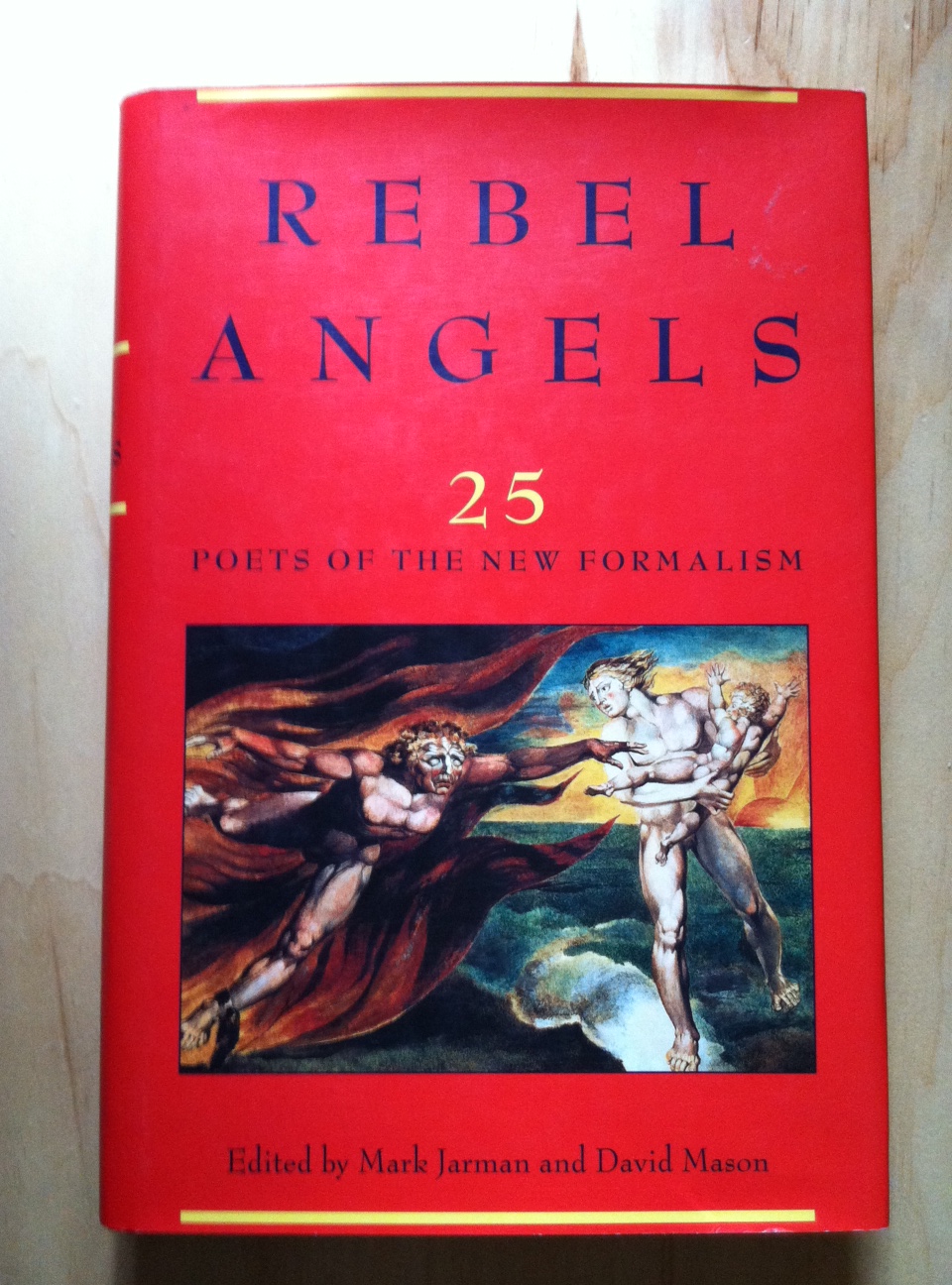
photo (73)Rebel Angels: 25 Poets of the New Formalism came out in 1996, and it’s a great sample of newer formalist work. As with all anthologies, not every poem will appeal to every reader, but I think Abby will find lots to like here. I’d especially recommend the poems by Andrew Hudgins, professor of poetry at The Ohio State University, fabulous reader, and friend of several friends.


photo (72)One of Professor Hudgins’s former students is Ashley McHugh, and it’s her luminous debut, Into These Knots, that I’m also recommending. (Full disclosure: Ashley is a friend, and I’ve met Andrew Hudgins a few times, and been regaled with tales of his workshops more times than I can count.)  Ms. McHugh is an especially accomplished sonneteer, as you’ll see when you read this poem, “The Unquarried Blue of Those Depths is All But Blinding,” which she wrote for her now-husband.

Abby, I hope you’ll find poems you love in these books. Thanks for writing in!


Would you like the Poetry Concierge to make a recommendation for you? Check out the introductory post, and send your answers to the questionnaire, along with the name and/or blog you’d like posted with the reply, to rosemaryandreadingglasses [at] gmail [dot] com.

The Poetry Concierge Recommends: Dorothy Parker

[The Poetry Concierge is an occasional feature here on Rosemary and Reading Glasses wherein I select a poem, poet, or book of poems for individual readers based on a short questionnaire. Come play along! Read the introductory post here, my first recommendation here, and then email me at: rosemaryandreadingglasses [at] gmail [dot] com. ]

This week, our pilgrim in search of poetry is Kay, who blogs about books over at WhatMeRead.

1. When you read fiction, who’s your go-to author?

I don’t know that I have just one go-to author, but maybe Jane Austen. I reread all her books every few years.

2. If you read nonfiction, which subjects are most likely to interest you? (cultural history, science, biography, memoir, survival stories?)

History and biography/memoir (but not usually celebrity biography/memoir) are my favorite nonfiction subjects. I read mostly biographies about figures from history, and literary people or artists.

3. If you were stuck on a desert island for a week, which five books would you bring to keep you entertained?

I would need a big book for the island, so that might be Bleak House. I would need something funny, so that might be something by Georgette Heyer, maybe Cotillion. I would need something I hadn’t read before, maybe another book by Halldor Laxness. I have The Fish Can Sing on my Wish List, so let’s pick that one. I would need something that makes me cry about someone else, so maybe Sense and Sensibility. I would need something about resourceful people to keep me encouraged, so maybe Life After Life by Kate Atkinson. I just read Robinson Crusoe, so I would NOT take that!

4. If you were on a five-year mission to Mars, which five books would you bring to keep you sane?
Hmmm, you’re really trying to make me think, aren’t you? If I was on a five-year mission to Mars, at least I would know I was coming back, so maybe that would be a different choice than the island all right. I’m thinking big books that feel like friends and I can read over and over again: David Copperfield, Jane Eyre, Cloud Atlas or The Thousand Autumns of Jacob De Zoet, maybe read The Luminaries again, and something with beautiful language I can puzzle over, maybe something I haven’t read by Nabokov.

5. What kinds of questions are most likely to keep you up at night? (death, the nature of love, politics, environmental issues, meaning of life, end of the world, justice and injustice, etc?)
 

I actually write reviews in my head at night after I finish a book. Sigh. Also, sometimes work.

6. If you’ve read poetry before, what have you liked? What have you disliked?

I have liked Frost, ee cummings, Shakespeare’s sonnets, some Yeats that isn’t too obscure, some Edna St. Vincent Millay. I have not liked Ezra Pound, because I don’t understand him at all. I have not liked some of the romantic poets, because they have too many allusions to things I don’t know enough about to understand them. Also, I think Keats and Wordsworth are boring. I generally don’t like really long poems, because I find I can’t concentrate on them long enough.


Well, I admit that I’m nervous with this pick, because not only is Kay a very sophisticated

reader, but she’s also read everything (it seems), and she doesn’t pull her punches. On the

Dorothy Parker | Image courtesy Wikimedia commons

Dorothy Parker | Image courtesy Wikimedia commons

other hand, someone who’s liked Shakespeare, ee cummings, and Edna St. Vincent Millay (oh Edna, you’re my favorite) gives me lots of leeway in choosing a poet to recommend. I thought about Howard Nemerov, Seamus Heaney, and Louise Glück, and I think their poetry (judiciously selected) would have been just fine for our purposes.

But Kay makes me laugh with her often acerbic reviews, and for someone whose go-to author is Jane Austen, I think urbane, mordant wit is called for. Enter: Dorothy Parker.

A screenwriter, poet, and satirist, Dorothy Parker is celebrated for her impeccable way with the bon mot, her short and snappy poems with the bite at the end, and her perennial quotability (seriously, she’s on this Kate Spade tote.).

Here are two of her poems, with characteristically deceptive titles: “Interview” and “Love Song.”  Let’s also call “Interview” our poem of the week, shall we?

Kay, I hope these poems make you laugh. Thanks for writing in!


Would you like the Poetry Concierge to make a recommendation for you? Check out the introductory post, and send your answers to the questionnaire, along with the name and/or blog you’d like posted with the reply, to rosemaryandreadingglasses [at] gmail [dot] com.

“Once I walked out and the world / rushed to my side”: Mark Wunderlich’s The Earth Avails

photo (70)Brimming with life and color, Mark Wunderlich’s collection The Earth Avails* is the perfect book to read on Earth Day. In these poems, the natural world is both celebrated and mourned in a speaker’s voice that is sometimes measured, sometimes impassioned, and always thoughtful.

In his Notes on the poems, Mr. Wunderlich explains that upon reading a nineteenth-century small book of German prayers found in his family’s home, as well as Heaven-letters, “folk-religious documents” from the eighteenth and nineteenth centuries, he adapted these documents into poems (69). Roughly half the poems in The Earth Avails take the form of prayers or Heaven Letters; in their posture of supplication, in their evocations of simple desires (“spare the orchards from hail”), they nonetheless suggest that the power addressed is the power of language itself, building in rumbling, crescendoing couplets.

In adapting these older forms, Mr. Wunderlich has written poems with an utterly fluid sense of time. A poem might include charms against flooding or pests or disease — common enough nineteenth-century agrarian concerns — but then mention at its end a detail that places the poem in a contemporary world. The juxtaposition is pleasantly jolting, showing us just how rooted we are in the past — and how far we are from it — while offering the promise that the sense of connection to the land we think we’ve lost could be recovered.

Many of the poems reflect the landscape, both interior and exterior, of Mr. Wunderlich’s home in the Hudson Valley. The word that kept coming to mind as a I read was “renovation,” not only in the sense of rebuilding a structure, like the house here with its “crumbling cow-hair plaster mending the wall,” but also in its etymological sense of “to make new again.” The poems in The Earth Avails make the natural world new again, giving us fresh eyes to see the coyote with mange, or “the green worms / ciphering the cabbages’ leaves” or the wild boar’s “rusty wool along the belly.”  These poems reflect engagement with other nature poets (Robert Frost came to mind more than once, and “Sand Shark” would be a perfect companion piece for anyone teaching Elizabeth Bishop’s “The Fish”), and since I’ve just read The Poetic Species, I couldn’t help thinking about the ways in which this volume works at the intersection of the humanities and the sciences.

I think you can probably tell that I loved these poems. I highly recommend The Earth Avails.

The featured poem of the week is “Prayer for a Birthday,” by Mark Wunderlich, which appears in The Earth Avails. You can read the poem, and a short comment from the poet, on Poets.org.

*My thanks to the publisher for sending me a copy of this book in exchange for an honest review.

“The Wind is sewing with needles of rain”: Hazel Hall’s “Two Sewing”

Yesterday was the (of late) rare fine day here in Boston, so my son and I were able to take a long walk (without coats!). Finally, it felt a bit like spring, with the crocuses blooming in confirmation:

photo (67)

Crocuses are a particular favorite of mine, so I looked for a poem that mentions them. Some heavy hitters cropped up in my search: Tennyson, Browning, even Oscar Wilde. However, it was a little poem called “Two Sewing” that caught my eye. I love everything about this poem: the combination of the natural and the domestic, the subtle rhyme, the well-chosen phrases, the repetition that encodes the sound of rain on windows.

In other words, I’m delighted to have come across, quite by accident, Hazel Hall. I hadn’t heard of her before, but what I learned led me to order the edition of her collected poems that came out in 2000 (not to be had in our library system, alas).

Hazel Hall (1886-1924) used a wheelchair from childhood until her death, and she spent most of her adult life in Portland, Oregon (OSU Press is the publisher of her Collected Poems). She helped to support her family by working as a seamstress, an occupation that’s reflected in the metaphors of “Two Sewing.” You can read John Witte’s Introduction to the Collected Poems here; he writes,

Hall’s poems seem on their surfaces tidy, sometimes as strictly and gorgeously embellished as her needlework. Yet close under their surfaces we sense the seething of a restless intelligence. Beginning with the materials at hand–her limited mobility, her isolation and loneliness, her gifts with needlework and words, and her exquisite grief–Hazel Hall fashioned in the short span of her career a poetry of startling achievement and durability.

I can’t wait to read more.

You can read “Two Sewing” at Poets.org.

Double the Fun: Shepherds and Nymphs and Elizabethan Poets, Oh My!

Happy National Poetry Month!

To celebrate, here are two poems that together form a little poetic conversation. Nothing says spring like four-hundred-year-old pastoral poetry, right?

The Passionate Shepherd to His Love
Christopher Marlowe

Source: Wikimedia Commons

Source: Wikimedia Commons

Come live with me and be my love,
And we will all the pleasures prove,
That Valleys, groves, hills, and fields,
Woods, or steepy mountain yields.

And we will sit upon the Rocks,
Seeing the Shepherds feed their flocks,
By shallow Rivers to whose falls
Melodious birds sing Madrigals.

And I will make thee beds of Roses
And a thousand fragrant posies,
A cap of flowers, and a kirtle
Embroidered all with leaves of Myrtle;

A gown made of the finest wool
Which from our pretty Lambs we pull;
Fair lined slippers for the cold,
With buckles of the purest gold;

A belt of straw and Ivy buds,
With Coral clasps and Amber studs:
And if these pleasures may thee move,
Come live with me, and be my love.

The Shepherds’ Swains shall dance and sing
For thy delight each May-morning:
If these delights thy mind may move,
Then live with me, and be my love.

The Nymph’s Reply to the Shepherd
Sir Walter Ralegh

Source: Wikimedia Commons

Source: Wikimedia Commons

If all the world and love were young,
And truth in every Shepherd’s tongue,
These pretty pleasures might me move,
To live with thee, and be thy love.

Time drives the flocks from field to fold,
When Rivers rage and Rocks grow cold,
And Philomel becometh dumb,
The rest complains of cares to come.

The flowers do fade, and wanton fields,
To wayward winter reckoning yields,
A honey tongue, a heart of gall,
Is fancy’s spring, but sorrow’s fall.

Thy gowns, thy shoes, thy beds of Roses,
Thy cap, thy kirtle, and thy posies
Soon break, soon wither, soon forgotten:
In folly ripe, in reason rotten.

Thy belt of straw and Ivy buds,
The Coral clasps and amber studs,
All these in me no means can move
To come to thee and be thy love.

But could youth last, and love still breed,
Had joys no date, nor age no need,
Then these delights my mind might move
To live with thee, and be thy love.


See also: William Carlos Williams, “Raleigh Was Right”

“with one hand under our head / and with the other in a mound of planets”: Zbigniew Herbert’s “I Would Like to Describe”

This weekend I finished reading Diane Ackerman’s book The Zookeeper’s Wife,  which I’ll be reviewing for the Literary Wives group on April 7 (it’s a quick read, so there’s still plenty of time to hop aboard if you’d like to join the discussion). The book is full of interesting facts; for example, during World War II, the Polish underground movement managed to keep students in high school and college (which had been outlawed for Poles by Nazi decree) — and even grant degrees — through a system of “floating” classrooms.

One of those students was Zbigniew Herbert, who went on to become one of Poland’s most famous post-war poets. For many years he refused to submit his work to state-sanctioned venues, and was throughout his adult life an opponent of communism and censorship.  His work has been translated by, among others, Czeslaw Milosz.

His poem “I would like to describe” expands on the poet’s frustration at his own inability to summon just the right word or words to describe emotion. While bemoaning the inadequacies of metaphor, the speaker nonetheless conjures up some beautiful examples. “I would like to describe courage / without dragging behind me a dusty lion” (l. 12-13) is one of my favorites.

I confess that I didn’t know much about Herbert before I researched this week’s post, but now I’m going to go off and get my hands on a copy of his selected poems.

Who’s a poet you’d like to learn more about?