Recommended Reading: Swoop, by Hailey Leithauser

photo (62)National Poetry Month is on the horizon, Dear Readers, and I can’t imagine a better way to celebrate than by picking up Hailey Leithauser’s exuberant, brilliant debut collection, Swoop*.

Reading Swoop, I couldn’t help but notice myself smiling at first. Then there was the impulse to read aloud, to drum the table in front of me. These poems are musical, rhythmic, dance-provoking. They’re fearless and funny and macabre and eloquent. I loved them.

I came to this conclusion exactly two poems into the collection. The first poem, “Scythe,” imagines the desires of that object, with one of the best images of opposition I’ve ever read . The scythe wants

two bottomless,
unchanging pockets,

the one
that is larder, the other

one locust.

For those keeping track of such things — killer linebreaks, right?

I’ve made no secret of my love for Bogie & Bacall’s first joint film, To Have and Have Not, and so I was prepared to fall hard for Swoop‘s second poem, “Was You Ever Bit by a Dead Bee?” — which, of course, I did. It’s a poem that answers the movie’s famous question, with the kind of rhythm that would make Hoagy Carmichael proud. Here are the first two lines:

I was, I was—by its posthumous chomp,
by its bad dab of venom, its joy-buzzer buzz.

Doesn’t that make you want to read the rest?

As you can probably tell, Ms. Leithauser is the kind of poet who’s enchanted by the sounds that words make, and by the wonderful oddities of the English language.  (More than once I turned to my trusty OED: after all, how often does one encounter “lamaseried”?) Indeed, several poems are composed of entries “From the Grandiloquent Dictionary” (look for a particularly hilarious entry, Metrophobia. Then look up metrophobia.) Reading Swoop is in some ways like like listening to a Dorothy Parker who’s fascinated not only by people, but by the personalities of words themselves. Take these lines, from “Schadenfreude”:

So often ironic,
at times caustic, despotic,

and always so
honestly,

profoundly
Teutonic,

I’d love to take you through each and every one of Swoop‘s poems to tell you what I love about them, from the dazzling description of one of Moby-Dick‘s tragic characters (“Pip, Mid-Sea”), to the bluesy “Bad  Sheep” with its twenty-six synonyms for dark (except black), from the darkly comic “Sex Circumspect” to the downright funny “Sex Fiasco.”

I feel rather cruel, Dear Readers, for passing along these tantalizing morsels and not full plates. Luckily, Swoop is a feast, and you’re invited.

*My thanks to Graywolf Press for sending me a review copy of Swoop.

Tomorrow: One of Hailey Leithauser’s poems will be the featured poem of the week.

Wednesday: An interview with Hailey Leithauser, author of Swoop, winner of the Emily Dickinson First Book Award from The Poetry Foundation.

An Interview with TaraShea Nesbit, Author of The Wives of Los Alamos

Two weeks ago, I reviewed TaraShea Nesbit’s fascinating first novel, The Wives of Los Alamos. Ms. Nesbit graciously agreed to be interviewed via email. 

How would you describe the inception of The Wives of Los Alamos? What was the writing process like?

Author photo by Brigid McAuliffe

Author photo by Brigid McAuliffe

TN: About five years ago, I was researching the creation of the atomic bomb after a friend told me about a high school that has atomic bomb imagery as part of their bomber mascot. That town, Richland, Washington, was the location of a nuclear production complex, Hanford that began during WWII, and currently a repository for nuclear waste. Plutonium manufactured at the site was used in the first nuclear bomb, tested at the Trinity site, and in Fat Man, the bomb detonated over Nagasaki. While researching the history of the Hanford Site, I read a memoir by one female scientist. She mentioned that she never understood why one of the male scientists wives did not like her. This piqued my interest in the domestic community life of these secret Manhattan Project towns.

Simultaneously, I gave a reading on the work about Hanford, (an excerpt of which you can read at Quarterly West here: http://www.quarterlywest.utah.edu/iss_73/iss_73_nesbit.html) and a friend’s aunt, Jane Viste, came up to me after the reading and inquired more about the scientists’ wives. I think she said, “Their story would make a great novel.” These two things—my atomic history research and the aunt’s questions—came together right before winter break two years ago, and once I decided on the point of view, the writing was an urgent endeavor. A first draft was done in less than a year and I revised for another year.

The Wives of Los Alamos is written from the relatively unusual first person plural perspective. What led you to make that choice?

The Wives of Los Alamos

The Wives of Los Alamos

TN: When listening to the women’s oral histories and reading their memoirs, I observed that the women often took on the “we” voice themselves. If asked what Los Alamos was like for them, they replied with things like, “We all hated the stove,” where the “we” was the other wives. This suggested to me that their primary identity during that time was of a group member, and their secondary identity was that of an individual.

In thinking about why I was using this point of view, I read Brian Richardson’s book Unnatural Voices, and his intellectual work added to my thinking. I see the point of view as a way of exploring how our community identities often push against our individual identities.

How did you go about conducting research for the novel? Did you visit archives? The site itself? Were you able to interview any of the women who lived and worked at Los Alamos?

TN: I first read memoirs and collected stories edited by the women who lived in also Alamos during WWII, many of which were published by the Los Alamos Historical Society.  I visited Los Alamos a few times and met with the archivist there, too. Los Alamos still retains a lot of its great history, both geographically and through the preservation of Fuller Lodge and Bathtub Row. One can walk around the town and easily imagine what it was like in the 40s.

Which writers do you read while writing? Do your reading choices change depending on the writing project at hand?

TN: I’m often doing two kinds of reading when I’m writing. I read books related to the topic, and when doing that I’m looking for details and facts. But I also read novels and poetry collections and nonfiction books that I’m hoping to be educated by about story construction. While writing The Wives of Los Alamos I looked back at work by Joan Silber, Leo Tolstoy, Evan S. Connell and George Eliot, among others.

You’ve studied at The Ohio State University (Go Buckeyes!) and Washington University in St. Louis. Which professors and writing courses stand out to you as particularly influential in terms of your growth as a writer?

TN: I began this book in my first year of the Ph.D. at the University of Denver, and specifically, in a fiction class led by Laird Hunt. I did not think of myself as a fiction writer then, but Laird’s reading list and approaches defied my previous conceptions of what a novel could be. We read Open City by Teju Cole, Aliss at the Fire by Jon Fosse, Who Was Changed and Who Was Dead by Barbara Comyns, and Europeana: A Brief History of the Twentieth Century by Patrik Ouředník. But I’ve been fortunate to have so many great teachers: Brian Kitely, Selah Saterstrom, Eleni Sikelianos, Kathy Fagan, Andrew Hudgins, and Mary Jo Bang.

What kinds of writing projects are you planning next?

TN: I’m working on a fiction project set in the 17th century from the perspective of lesser-heard voices, which is also exploring a major narrative of America’s history.

My thanks again to Ms. Nesbit for her time and generous answers. You can learn more about The Wives of Los Alamos and TaraShea Nesbit on her website, tarasheanesbit.com.  

Recommended Reading: A Burnable Book, by Bruce Holsinger

photo (59)A Burnable Book*, the first novel from noted medieval scholar Bruce Holsinger, is enjoyable on so many levels that it’s difficult to decide where to begin. It’s historical fiction, a mystery, a book about books, and a character study, all rolled into one.

London in 1385 is dangerous and dirty, still reeling after a revolt by the commons several years earlier. Nobles jostle each other for favor at court, bishops visit the stews without charity in mind, and everyone from the butcher’s boy to a duke’s mistress tries to navigate through precarious games and ploys.

John Gower, the English poet now better known primarily for his appearance in Shakespeare’s Pericles than for his writing (Mirroir de l’OmmeVox Clamantis, and Confessio Amantis are his major works)  is in Professor Holsinger’s novel a man of secrets, a dealer in information with his own shadows that he’d prefer stay hidden. When his friend Chaucer comes to him for help finding a missing book whose cryptic verses are already spreading through London, Gower, the “subterranean man,” is drawn into a web of conspiracy, murder, and lies that reaches from England’s highest nobles to the maudlyns (prostitutes) in London’s stews. The book is a “burnable book” — treasonous — and those who possess it are hunted by forces that even Gower can’t identify. As the novel approaches its climax, unraveling metaphor and mystery begin to amount to the same thing.

The cast of characters in A Burnable Book is so long that Professor Holsinger includes a listing before the action begins. Gower and Chaucer are delightful to watch from this distance, especially in terms of their combative friendship. Katherine Swynford, John of Gaunt’s mistress, and Isabel Syward, prioress of St. Leonard’s Bromely are drawn with a fine brush, calculating and calm, working for their own ends. And then there are the maudlyns — so very many of them! By far the most interesting of these is Eleanor/Edgar Rykener, who switches gender presentation depending on clients’ preferences and the relative safety of different parts of London and its environs. Eleanor/Edgar is deeply caring and mightily resourceful, easily my favorite of all the author’s inventions.

A Burnable Book’s meticulous attention to period detail reminded me of Hilary Mantel’s Wolf Hall and Bring Up the Bodies, while King Richard’s cameo appearances are notable for the combination of political non-acumen and lyrical speech that characterize Shakespeare’s own Richard II. The narrative is just as earthy as Chaucer’s Wife of Bath’s speech, though considerably (and understandably) less funny. And for its literary/action combination, The Name of the Rose comes to mind. In other words, there’s a little something for all kinds of readers to be found in A Burnable Book, and I hope Professor Holsinger will sally forth into the fictional fourteenth century again soon.

*My thanks to the publisher for sending a copy of this book in exchange for an honest review.

“Sundays, like a stanza break”: Glyn Maxwell’s “Museum”

For reasons I can’t really explain, I’ve been looking for poems about dinosaurs. Surprisingly, they’re tricky to find, but in my search I ran across this little gem by British poet and playwright Glyn Maxwell. It’s not abut dinosaurs, but it’s still delightful.

It’s too short — only one sentence — to quote without giving away the store, so please head on over to poets.org to have a look.

And let me know if you know a good dinosaur poem, won’t you?

Recommended Reading: Strange Bodies, by Marcel Theroux

photo (57)Strange Bodies* is a Frankenstein for the twenty-first century, an engrossing, frightening, funny meditation on technology, memory, language, and the nature of identity. It’s speculative fiction meets literary fiction, and it’s a great read. Marcel Theroux is better known on the other side of the Atlantic, but I do hope Strange Bodies grants him a devoted American readership.

(After all, the novel made me, of all people, want to read Samuel Johnson, so you know it’s good.)

Dr. Nicholas Slopen is dead, but it’s very easy to forget that fact as you read his “testimony,” taken from a flash drive given to an old friend (like Mary Shelley’s classic, Strange Bodies is a frame narrative.).  In life, Nicky had a troubled marriage, a sputtering career as a professor of eighteenth-century literature (specializing in Johnson), and some very strange run-ins with wealthy people claiming to have discovered a cache of never-before-seen papers in Johnson’s hand.  The only trouble is, if Nicky Slope is dead, who’s the “I” narrating his story?

I won’t give too much of the plot away — have a look at the the books several epigraphs, some of the best chosen I’ve ever seen, and you’ll get an idea or two — but the book is more than its twists and bumps in the night. Mr. Theroux clearly enjoys playing with the conventions of mystery and monster novels, and even the lowbrow literary thriller,  but it’s when he lets his own style loose that the novel really shines. His imaginings of Johnson’s reactions to twenty-first-century London are blindingly funny and sad at the same time. And his knack for description is wonderful. Take this sentence:

“Every time I came back, Vera seemed more lovely; her eyes behind their thickly made-up lashes tender with sympathy, her broad mouth with its liverish lipstick, the touch of her gloved hand on my knee fierce and protective like the raised wing of a mother swan” (113).

I love the contrast of the vaguely ghoulish “liverish” lips and the maternal tenderness of the “raised wing of a mother swan.” Elsewhere in the novel, the descriptions are mordant;  he suggests that overindulgence in Bikram yoga has turned a woman to gristle (for the life of me I can’t find the page number on that). Hilarious. Actually, considering the novel’s grim premise, I found myself laughing more than expected.

Strange Bodies is smart and literary and scary, all at once. If you read it, you’ll be wondering why you haven’t read Marcel Theroux before.

* My thanks to Farrar, Straus and Giroux for sending me a copy of this novel in exchange for an honest review.

“There is courtship, and there is hunger”: Mary Szybist’s “In Tennessee I Found a Firefly”

IncarnadineA couple weeks ago, I reviewed Mary Szybist’s new collection, Incarnadine, which won the Pulitzer Prize for poetry last year. This week’s poem, “In Tennessee I Found a Firefly” is from her first collection, Granted (2003).

I was hooked on this poem from the first two lines. The first sentence assumes the “firefly” of the poem’s title as its subject, retaining the punch of the initial verb: “Flashing in the grass; the mouth of a spider clung / to the dark of it” (1-2).  I love the phrasing of “the dark of it,” suggesting both the transitory darkness of the insect’s flickering light and also the permanently dark portions of its body, with a suggestion of private, dark spaces.

The co-incidence of hunger and desire, violence and beauty appears in Incarnadine, too, but I like this poem’s particular study of the minute, physical world, “the burr and the barb of them.”

You can read the full poem here.


Paradise Lost, Books XI and XII: The Bittersweet End

It’s the end of our Paradise Lost readalong, folks.

ParadiseLostReadalongWhen I first started thinking about doing a readalong for Milton’s epic, I planned on a once-a-month posting schedule, but then thought that maybe not too many people would sign up for a year-long immersion in Paradise Lost. Reading-wise, I think two books every ten days is manageable, though strenuous work, especially for first-time readers, and so, after thought and some discussion, I ended up with our every ten-days schedule that you’ve seen.

Posting every ten days, though? I think I may have been optimistic about that. Paradise Lost is so dense, so challenging, so vitally interesting, that I found it pretty much impossible to write the kind of posts I wanted to write in just ten days, especially since I didn’t cut back on my non-Milton reading and posting. The lesson I took from this readalong: go with your gut instincts, even if you think you’ll be the only one reading.

That said, I hope you’ve still found these posts interesting and not too didactic, and that if you haven’t read Milton, you’ve been persuaded to give him a try some day.

So here’s the man himself with summaries of Books XI and XII:

Book XI:

The Son of God presents to his Father the Prayers of our first Parents now repenting, and intercedes for them: God accepts them, but declares that they must no longer abide in Paradise; sends Michael with a Band of Cherubim to dispossess them; but first to reveal to Adam future things: Michael’s coming down. Adam shows to Eve certain ominous signs; he discerns Michael’s approach, goes out to meet him: the Angel denounces their departure. Eve’s Lamentation. Adam pleads, but submits: The Angel leads him up to a high Hill, sets before him in vision what shall happ’n till the Flood.

Book XII:

The Angel Michael continues from the Flood to relate what shall succeed; then, in the mention of Abraham, comes by degrees to explain, who that Seed of the Woman shall be, which was promised Adam and Eve in the Fall; his Incarnation, Death, Resurrection, and Ascension; the state of the Church till his second Coming. Adam greatly satisfied and recomforted by these Relations and Promises descends the Hill with Michael; wakens Eve, who all this while had slept, but with gentle dreams compos’d to quietness of mind and submission. Michael in either hand leads them out of Paradise, the fiery Sword waving behind them, and the Cherubim taking their Stations to guard the Place.

Not everyone likes these final two books, since they compress a great deal of Biblical history into, essentially, forty pages. C.S. Lewis called Books XI and XII “an untransmuted lump of futurity,” and called its verse “curiously bad.” Not one for mincing words, C.S. Lewis. A modern creative writing teacher might tell you that these books “tell” instead of “show,” especially as the lines go on and Adam’s heightened sight fades.

With the exception of a few passages*, I find myself aligning with C.S. Lewis’s sense of Books XI and XII; the illustration of repeated covenants between God and humanity, punctuated with violence and vengeance, is utterly unappealing after the beauties of the garden and Eve’s hymns to God and nature (Eve is, by the way, sleeping through most of these books). On the other hand, this feeling of disappointment is Milton’s point; after the Fall, there can be no return to Paradise, in either location or language.

[* On the Flood: “Sea covered sea, / sea without shore, and in their palaces / Where luxury late reigned, sea-monsters whelped / and stabled” (11.749-52).]

One of the appealing parts of this section of the epic, at least for me, is its political resonance. Milton makes his case here for the always-tyrannical, and yet inevitable nature of monarchy, or as Michael puts it, “Tyranny must be, / Though to the tyrant thereby no excuse” (12.95-96). Risky stuff, but Milton has already aligned himself with the righteous angel Abdiel in Book VI, and in Book XI with Enoch, whom he turns into a figure unjustly persecuted for his righteous political and religious beliefs.

Then there’s Adam. I don’t much care for him in the rest of the poem, but in Books XI and XII I want to throttle him pretty much all the time. Michael usually takes the trouble to correct Adam’s errors in perception, but it’s galling every time Adam waxes rhapsodic about his “seed” someday overcoming Death (with an assist from Mary, of course) — all the while eliding Eve’s necessary role in populating the Earth. Here’s the worst offence, and one that seems to go uncorrected (after Michael explains the coming of the Son of God):

Now clear I understand
What oft my steadiest thoughts have searched in vain,
Why our great expectation should be called
The Seed of woman: Virgin Mother, hail!
High in the love of Heav’m, yet from my loins
Thou shalt proceed and from thy womb the Son
Of God Most High: so God with Man unites! (12.376-82; emphasis mine)

See what I mean? Adam inserts himself into the redemption narrative, while totally ignoring Eve’s role. And it seems that this elision will stand — but Milton is nothing if not surprising, because guess who gets the last spoken lines of the poem?

Eve.

And here they are:

This further consolation yet secure
I carry hence: though all by me is lost,
Such favor I unworthy am vouchsafed,
By me the promised Seed shall all restore. (12.620-23)

It’s a definite revision of Adam’s claim that Milton not only allows to stand, but also emphasizes with Adam’s silent confirmation: “So spake our mother Eve and Adam heard / Well pleased but answered not” (12.624-25).

Milton’s poetic prowess returns in full force these last thirty lines. Here’s a metaphor I love for its multilayered quality:

from the other hill
To their fixed station all in bright array
The cherubim descended, on the ground
Gliding meteorous as evening mist
Ris’n from a river o’er the marish glides
And gathers ground fast at the laborer’s heel
Homeward returning. (12.626-32)

Isn’t that lovely? The cherubim, fierce and dangerous in their “bright array” move from a “fixed point” into midair, “gliding” like insubstantial “evening mist,” which itself might “glide” from a “marish” (marsh) and comes to earth around the feet of the working man walking home.  The descent of the cherubim emphasizes the change in Adam and Eve’s state; they will become laborers who must return home each night, though to to their first home they can never return. The cherubim’s gliding ease contrasts with the heavy, weary step we imagine for the laborer; their speed reminds us how swiftly the fortunes of the first human pair have changed. The heavenly and the homely in one metaphor — just lovely.

I’ll leave you with the poem’s final lines, as Adam and Eve turn away from Paradise:

The world was all before them, where to choose
Their place of rest, and Providence their guide.
They hand in hand with wand’ring steps and slow
Through Eden took their solitary way.

Recommended Reading, Classics Club Edition: Narrative of the Life of Frederick Douglass, by Frederick Douglass

This slim volume, published in 1845, was one that I should have read years ago. Sure, I’ve Narrative of the Life of Frederick Douglassread excerpts from time to time, but really, at 106 pages, this should be required reading in high school American lit classes. It’s powerful, not only for its depictions of the myriad cruelties of slavery, but also for Douglass’s tour de force rhetorical performance.

I think it’s also important to find the right edition of this text (I read an Oxford University Press edition), since context is so important to the narrative. I found the introduction, chronology, and background notes especially helpful when I’m reading autobiography — which is, no matter how truthful, always a literary production, with an intended audience and an agenda.

In this case, for example, it was helpful to learn from the notes that while Frederick Douglass was noted later in life for his support of women’s suffrage, black women are nearly voiceless in his narrative. For example, his fiancee (and later wife), Anna Murray, helped him to escape, but he doesn’t credit her at all in the Narrative. And that, I think, is because the rhetorical strategy Douglass deploys is one that insists on his independence, which is signaled from the book’s original title and authorial designation: Narrative of the Life of Frederick Douglass, American Slave, Written by Himself.

It’s shocking just how much Douglass overcame to reach a free state, and the Narrative is often difficult to read due to the many scenes of brutality. It’s impassioned, frank, and blistering in its indictment of slaveholders. It’s a must-read.

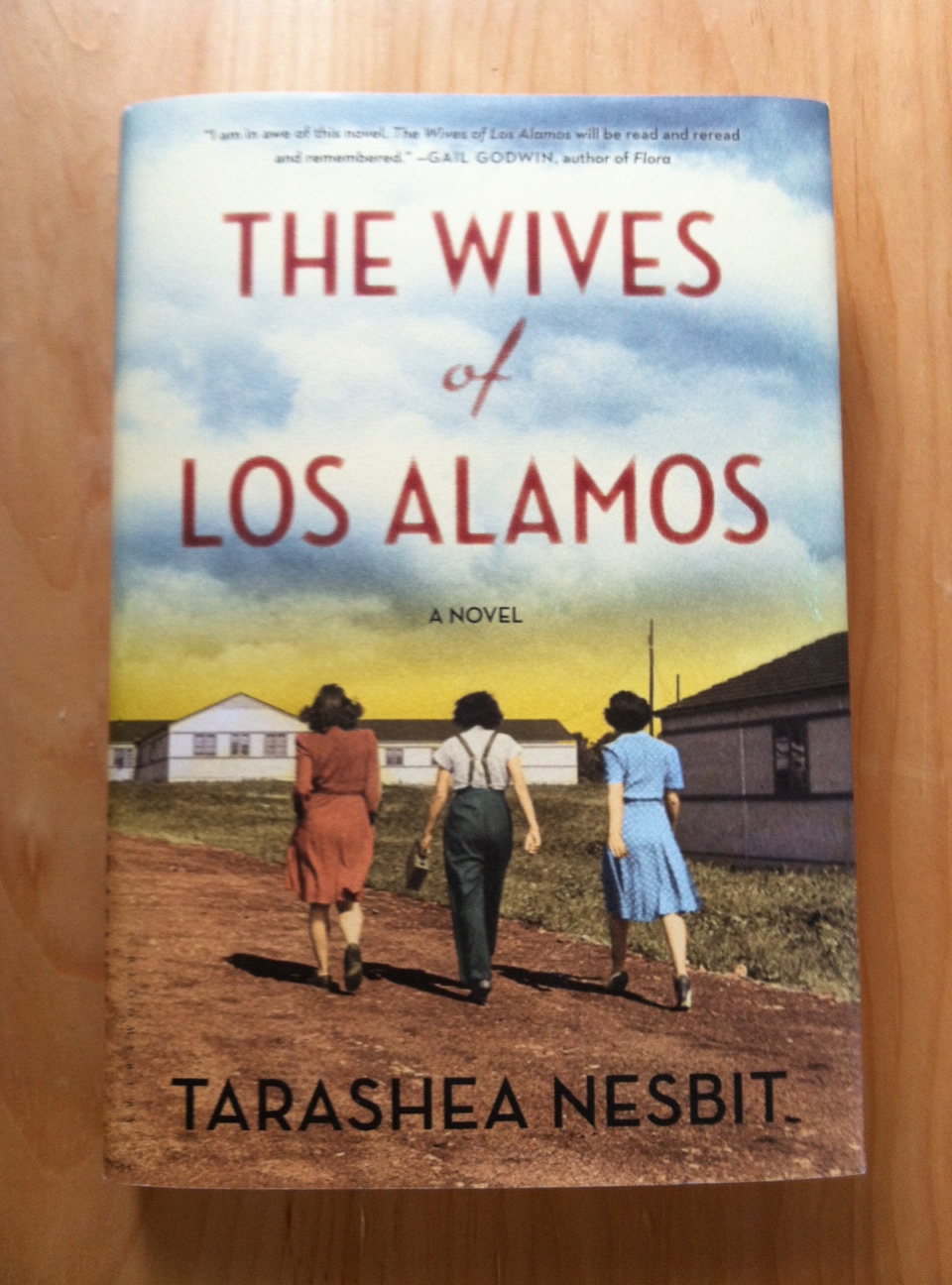
Recommended Reading: TaraShea Nesbit’s The Wives of Los Alamos

The Wives of Los Alamos

The Wives of Los Alamos

If you’re looking for refreshing, stylistically bold historical fiction, look no further. The Wives of Los Alamos*, TaraShea Nesbit’s debut novel, is the book for you.

[Full disclosure: Ms. Nesbit and I share friends in common, but we have never met.]

Written from the unconventional first-person plural perspective, The Wives of Los Alamos explores the difficult transition from the ordinary world to the extremely secretive world of the Los Alamos site of the Manhattan Project. Leaving behind their families, friends, and often careers of their own, the women married to the scientists who created the atomic bomb gradually form a community in the desert.

At first the choice of the first-person plural threw me; I was expecting a standard interconnected-threads type of novel, following maybe three or four women through their time at Los Alamos. Instead, I found Ms. Nesbit’s approach simultaneously universal and intimate, emphasizing both the common struggle to adapt to new living conditions and the idiosyncrasies of particular women.

At first, the women focus on the physical isolation and practical problems of life in New Mexico: no automatic washing machines or bathtubs, often inadequate supplies at the commissary — and the inability to visit with parents or even children old enough to attend college. And of course their husbands are sequestered in the labs, unable to discuss anything about their work. As time goes on, strain mounts as the wives negotiate the complex web of relationships they’ve developed — with each other, with their husbands, with the men guarding them, with the women hired to help them around the house, with their own children — and, finally, as they come to understand the awesome destructive force their husbands have constructed.

In addition to the well-articulated historical detail, I loved the roundness of the portraiture in The Wives of Los Alamos. While attesting to the scenic grandeur of the surroundings and the occasional pleasures of solitude, Ms. Nesbit doesn’t sugarcoat the realities of the women’s isolated lives, or their own blindness when it comes to the lives of their maids, often women of color. The women’s reactions to the revelation of the atomic bomb are mixed in tone, and treated thoughtfully. There are no easy answers, no neat endings — but that’s part of what makes this such a fascinating novel.

*My thanks to Bloomsbury for providing me with a review copy of this book in exchange for an honest review.

“El amor como la resina”: Pablo Neruda’s “Física”

Well, it’s the end of February, which means this is the last entry in my series of sexy poems by photo (56)dead poets. It’s been fun — let me know in the comments if you think I should try this again next February, or something different?

Neruda is over-anthologized when it comes to love poems, but here’s one that’s less well known. I cannot find the full text of this poem anywhere online, so here it is in the original Spanish, with my (very humble) translation following.

Física

El amor como la resina
de un árbol colmado de sangre
cuelga su extraño olor a germen
del embeleso natural:
entra el mar en el extremismo
o la noche devoradora
se desploma el alma en ti mismo,
suenan dos campanas de hueso
y no sucede sino el peso
de tu cuerpo otra vez vacío.

Physics

Love, like the resin
of a tree, overflowing with blood
suspends its strange scent over the bud
of spontaneous ecstasy:
the sea enters us in the last extremity,
or the devouring night
collapses your soul into itself,
two bells of bone ring out,
and nothing follows except the weight
of your body, hollow again.